

The best gifts for artists and makers match how they already work. An illustrator or sculptor gets the most from a 3D pen with a live temperature readout, a tinkerer from a printer that calibrates itself, an engineer from an enclosed printer for tougher plastics, and someone who already prints from a filament dryer or a tool kit.
This guide is for buying for an adult: a partner who sketches, a friend who builds models, a colleague who designs parts for a living. Start with who they are, not with the gadget. The table below gives the short version; the sections after it explain each match and who should skip it.
Who are they, and what should you give them?
Find the line that sounds most like the person you’re buying for. If two lines fit, go with the one that describes what they do most weekends, not what they say they’d like to try.
| Who they are | Gift | Why it suits them |
|---|---|---|
| Illustrator, sketcher, sculptor | 3Doodler Flow | Draws in PLA, ABS and wood-fill, with the live nozzle temperature on screen |
| Artist who draws for hours | MYNT3D Super | Stepless flow slider and an ultrasonic nozzle MYNT3D describes as almost clog-proof |
| Tinkerer or model-builder, new to printing | Bambu Lab A1 mini | Arrives assembled and calibrates itself, so the first print comes quickly |
| Engineer or designer of working parts | Elegoo Centauri Carbon | Enclosed, with a 320 °C hardened-steel nozzle for tougher and fibre-filled plastics |
| Someone who already owns a printer | SUNLU FilaDryer S2 or Creality 3D Printer Tool Kit Pro | Fixes the two everyday annoyances: damp filament and fiddly part removal |
All of these are on our shortlists. If you’d rather compare every pen side by side, see our ranked list of 3D pens; for printers, our ranked 3D printer shortlist does the same job.
What actually matters when you buy for a creative adult
A gift for a maker is a tool, and a tool is only good if it fits the work. Four things decide whether it gets used or ends up in a cupboard.
The material they want to work in
A 3D pen that only takes PLA is fine for drawing; an artist who likes texture will want more. A printer with an open frame suits PLA, PETG and TPU, while ABS and ASA want an enclosure. Prusa’s material guide says ABS should be printed inside an enclosure with a warmer ambient temperature. If the person talks about heat-resistant or mechanical parts, that points to an enclosed machine.
Control they can see
Artists adjust as they go. A pen that shows its temperature lets them change it on purpose rather than by guesswork. 3Doodler says the Flow adjusts between 160 and 220 °C, and the screen shows where it sits. For a sketcher who switches plastics, that readout matters more than any extra feature.
Time from box to first result
Nothing kills enthusiasm like an evening of setup. For a first printer, pick one that arrives assembled and calibrates itself, so the person spends the first evening printing rather than levelling a bed. Experienced makers care less about this and more about what the machine can do in month three.
Space, noise and fumes
A printer needs a sturdy surface and a room where it can run for hours. Some plastics also ask for ventilation: Prusa notes that ABS releases fumes and substances that could pose a potential health risk, and recommends a ventilated room without a draught over the print. Before you buy a printer, check where it will actually live.
Our picks by who they are
One product per person, with a note on who should skip it. These are matches, not rankings: the right gift is the one that fits the person.
For illustrators and sculptors: 3Doodler Flow
The 3Doodler Flow comes from the brand behind the original 3D pen. Its LCD shows the nozzle temperature in real time, and its listing covers 1.75 mm PLA, ABS and wood-fill. For someone who draws, that range is the point: PLA for clean lines, wood-fill for pieces that look carved rather than moulded.
The starter filament and a stencil book come in the box, so they can draw on the day. Wood-fill is more abrasive and more prone to clogging than plain PLA, so encourage them to clean the nozzle after each wood session. 3Doodler also warns never to draw on skin with the Flow: it runs hot enough to burn.
Skip it if they only ever draw in PLA: the extra material range would go unused.
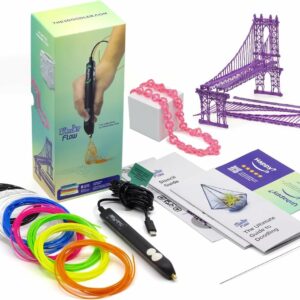
Live temperature on screen and three materials, including wood-fill, give an artist real control over line and texture.
For artists who draw for long sessions: MYNT3D Super
The MYNT3D Super suits someone who will use a pen often and for long stretches. Its stepless slider gives fine control over flow, and MYNT3D describes the ultrasonic nozzle as almost clog-proof. According to MYNT3D’s manual, it runs from 140 to 230 °C, with marks at 190 °C for PLA and 210 °C for ABS.
It has no battery and only works plugged in, which matters little at a desk. The starter filament is ABS, which gives off fumes when heated, so add a pack of PLA if they draw in a small room.
Skip it if they want to sketch away from a socket.
For tinkerers and model-builders: Bambu Lab A1 mini
The Bambu Lab A1 mini is our usual answer for a first printer. It arrives assembled, calibrates itself and prints at up to 500 mm/s. For a model-builder, that means less fiddling and more time painting and assembling.
The trade-off is the bed: 180 × 180 × 180 mm, the smallest of the printers we list. Larger models print in parts and get glued, which most model-builders already do. With the optional AMS lite it can print up to four colours; if multicolour appeals, our guide to how multicolour printing works explains what the feeder adds.
Skip it if they want to print ABS or ASA: the open frame and 80 °C bed suit PLA, PETG and TPU.
For engineers: Elegoo Centauri Carbon
Engineers tend to print things that have to work: brackets, enclosures, jigs, parts that sit near heat. The Elegoo Centauri Carbon is an enclosed CoreXY printer with a die-cast aluminium frame and a 256 × 256 × 256 mm build volume. Its brass-hardened steel nozzle reaches 320 °C.
Elegoo lists PLA, PETG, TPU, ABS, ASA, PET, PC, PA and carbon- or glass-fibre reinforced filaments. That’s the range an engineer reaches for once PLA softens too early. It arrives assembled and pre-calibrated, and a built-in chamber camera records time-lapses and lets them check a long print.
Skip it if they need multicolour: this model prints one colour at a time. It also weighs 17.5 kg, so it needs a solid bench.
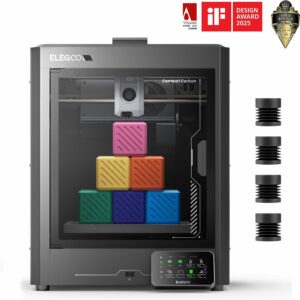
Enclosed, with a 320 °C hardened-steel nozzle, it takes the tougher and fibre-filled plastics working parts often need.
What to add so it’s ready on the day
A gift that can’t be used on the day loses half its charm. Each of these comes with a little starter material, but not much. Add the following so they can start straight away.
- For a 3D pen: a refill pack of 1.75 mm PLA. The Flow and the MYNT3D Super both take it. Packs such as the Yungden 30-Colour PLA Refills give a wide palette in 3 m lengths.
- A surface: hot filament sticks to wood and melts plastic tablecloths. A heat-rated silicone mat, like the one in the AQTAQ 3D Pen Starter Kit (rated 220–260 °C), protects the table.
- For a printer: a full spool. SUNLU PLA Filament is the usual first spool for any of our printers. For an engineer, add SUNLU PETG Filament: SUNLU gives it a heat deflection temperature of 70 ± 5 °C against 55 ± 5 °C for its PLA.
- A note: if the printer needs an app or an account, write that on the card so they can set it up before opening the box.
Choosing a printer for someone else raises its own questions, from bed size to who will set it up. Our guide to giving a 3D printer covers those in detail.
Gifts for someone who already owns a printer
This is the hardest person to buy for, because they already have the main thing. Don’t buy them a second printer unless they’ve asked. Upgrade what they live with every day instead.
A filament dryer
Filament takes on moisture from the air, and damp filament prints badly. The SUNLU FilaDryer S2 heats one spool at 35–70 °C on a 1–99 hour timer and shows a live humidity reading. It also works as a spool holder while it dries, with an outlet that feeds the printer.
It’s a gift people rarely buy themselves, then wonder how they managed without. If you’re unsure whether they need one, our explainer on whether a filament dryer is worth it sets out the signs.
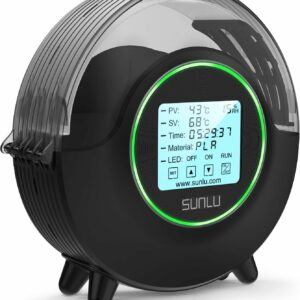
A live humidity reading and a timer up to 99 hours, and it feeds the printer while it dries.
A proper tool kit
The Creality 3D Printer Tool Kit Pro puts 74 pieces in one case: spatulas for lifting prints, a deburring tool with a rotating blade, files, tweezers, nozzle-cleaning needles and screwdriver bits. Most printers ship with a scraper and a hex key; this is the step up. The blades and needles are sharp, so it isn’t one for a shared family drawer.
Material they haven’t tried
A spool of something new is a low-risk gift. PETG for tougher outdoor parts or SUNLU TPU 95A Filament for flexible parts such as bumpers and cases. Check their printer first: SUNLU advises feeding TPU from a spool holder rather than a multi-colour feeder unless the feeder’s maker says it takes TPU.
What to avoid
- A printer for someone who’s never mentioned one. A 3D pen is a smaller step. A printer asks for space, time and software.
- An open-frame printer for an engineer who wants ABS. Without an enclosure, ABS tends to warp; Prusa names warping as one of its main drawbacks.
- The wrong refills. The pens above take 1.75 mm filament. Low-temperature children’s pens take their own strands, and these won’t swap.
- A gift with nothing to use on the day. Add filament or refills and a mat.
- Resin printers as a surprise. They need gloves, ventilation and a wash-and-cure step. They suit someone who has asked for one, not a surprise.
Common questions
Is a 3D pen a good gift for an adult artist?
Yes, if they enjoy drawing and building by hand. A pen with adjustable temperature and more than one material gives them room to experiment. Add a refill pack and a heat-rated mat so they can start straight away.
What do you buy an engineer who likes making things?
If they don’t print yet, an enclosed printer that handles tougher plastics fits the way engineers work. If they already print, a filament dryer, a tool kit or a spool of a material they haven’t tried are safer choices than a second printer.
Do I need to buy filament with a 3D printer gift?
It helps. Printers usually include only a small amount to test with, so a full spool of PLA means they can print properly on the day. Check the printer’s maker for the filament diameter, which is 1.75 mm for every printer we list.
Can a 3D pen use wood filament?
Some can. The 3Doodler Flow’s listing covers wood-fill as well as PLA and ABS. Wood-fill clogs more easily than plain PLA, so the nozzle needs cleaning after use.