Buying a 3D pen: what to check before you choose
A 3D pen melts a thin rod of plastic and pushes it out of a fine nozzle, so you can draw lines that harden on a mat or stand up in the air. The five pens here differ in who they suit, what they melt and how they are powered; this guide narrows the grid to one or two. For the full side-by-side ranking with every published figure, see our ranked list of 3D pens.
How to choose a 3D pen
Start with the age of the person drawing
The maker's age guidance is the first filter, before any feature. 3Doodler designs the Start+ for children aged 6 to 13 and says it has no external hot parts. LIHUACHEN gives 7 and over for its RPC200B, which has a hot ceramic nozzle, so a younger child needs an adult at the table. The P1 is for ages 14 and up, according to SCRIB3D. If the pen is a present for a child, our page on 3D pen safety for children sets out the conditions that matter.
Check which plastic it takes
PLA at 1.75 mm is the standard diet of a hot pen; the SCRIB3D P1 and MYNT3D Super also accept ABS, and the 3Doodler Flow adds wood-fill. The Start+ is the odd one out: it only takes 3Doodler Start plastic or strands sold as compatible with it, so standard PLA refills won't go in. Buying the wrong refills is the easiest mistake to make in this category, and our explainer on PLA, ABS and PCL for pens sorts the materials out.
Look at how the flow is controlled
A single button is quick to learn but gives you little say over how fast the plastic comes out. A stepless slider, as on the SCRIB3D P1 and the MYNT3D Super, lets you slow right down for an outline and speed up to fill a shape. If drawing is going to become a regular hobby, that control earns its place.
Decide between cord and battery
Only one pen here, the Start+, is rechargeable. The others need an adapter or a cord, although SCRIB3D's manual says the P1 also runs from a power bank with at least 2 A output. A cable is no trouble at a desk; cordless helps with young children. Our comparison of cordless and mains 3D pens weighs up the two.
Read what is in the box
Each pen ships with some starter plastic but no heat-proof mat, and starter filament goes quickly. Plan for a refill pack and a safe work surface from the first day.
Which pen for whom
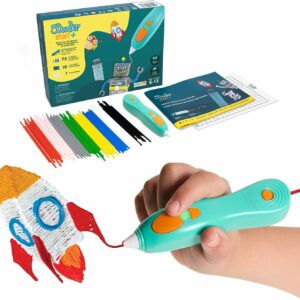
A child aged 6 to 13: the 3Doodler Start+. It draws with low-temperature eco-filament strands, and the Essentials set from 3Doodler UK includes 72 of them, a charging cable and an activity guide. It has a stand-by mode. The softer plastic suits play and simple models more than fine detail.
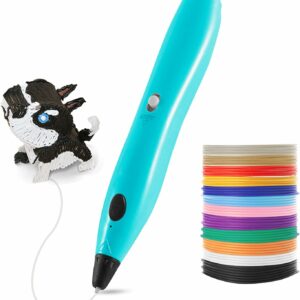
A first pen on a small budget: the LIHUACHEN RPC200B 3D Pen (Button Version). It sets its own temperature for PLA, at 190–210 °C, and one button handles heating, feeding, pausing and speed. LIHUACHEN says it warms up in about 60 seconds, and the box holds twelve PLA colours, templates and a finger guard. It takes PLA only.
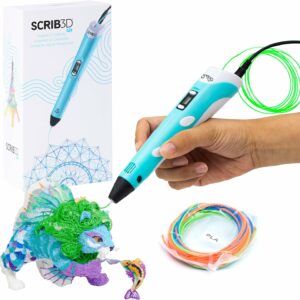
A teenager of 14 or over, or an adult learning properly: the SCRIB3D P1. It takes PLA and ABS, has a stepless slider, a temperature display and a ceramic nozzle. SCRIB3D's sources differ on ABS: 210–235 °C on its Amazon listing, 200–230 °C in the user manual. PLA runs at 160–210 °C.
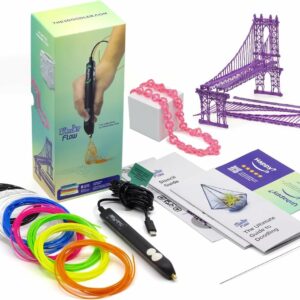
Someone who wants more than one material: the 3Doodler Flow. It takes 1.75 mm PLA, ABS and wood-fill, and its LCD shows the nozzle temperature as it changes. 3Doodler's FAQ gives an adjustable range of 160–220 °C.
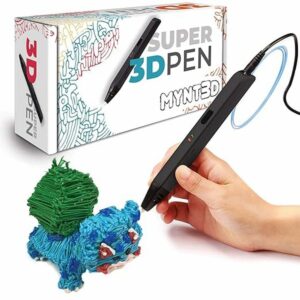
Someone who draws often and hates clogs: the MYNT3D Super. MYNT3D describes its ultrasonic nozzle as almost clog-proof, and a stepless slider sets the flow. It works on mains power only, and its starter filament is ABS, which wants a ventilated room. MYNT3D doesn't publish a temperature range.
Prefer to browse by profile? The same pens are split into pens for kids and beginners, pens for artists and regular makers and lower-cost pens.
What you'll need alongside
- Refills. Match the diameter and material to the pen: 1.75 mm PLA for the hot pens, Start strands for the Start+. Every pack, with what it fits, is in Filament & Refills.
- A heat-proof surface and finger guards. Hot plastic sticks to wood and marks plastic tablecloths. Mats, guards, stencils and cases are in Accessories & Tools.
- Something to draw. Print a few of our free 3D pen templates and follow a first hour with a 3D pen.
Common questions
Do all 3D pen refills fit every pen?
No. Hot pens in this collection take 1.75 mm filament, while the 3Doodler Start+ only accepts 3Doodler Start plastic or strands sold for it. Check both the diameter and the material on the refill listing before ordering.
Which 3D pen here works away from a socket?
The 3Doodler Start+, which is rechargeable. The SCRIB3D P1 has no battery, but its manual says a 2 A or stronger power bank can run it. The MYNT3D Super and the RPC200B need mains power.
Is a 3D pen a good first step before a 3D printer?
It can be. A pen teaches you how melted plastic behaves and how shapes are built up in layers, without software. A printer makes accurate, repeatable parts from a digital file, which a pen cannot do.
Should a beginner draw with PLA or ABS?
PLA is the easier start: every hot pen here takes it, and it works at lower temperatures than ABS. ABS is tougher once set but needs a higher heat setting and a well-ventilated room.