
It depends on the pen. A standard pen such as the SCRIB3D P1 melts PLA at up to 210 °C and can burn, so we’d wait until ten, with an adult beside the child until 14. A low-temperature pen is different: 3Doodler says the Start+ has no external hot parts and designs it for ages 6 to 13.
So the useful question is not whether a 3D pen is safe, but which pen, for which child, with which rules. The answer starts with where the heat is.
Which parts of a 3D pen get hot?
On a standard pen, the hot parts are the nozzle and the plastic that has just come out of it. The pen melts the filament inside the tip, pushes it out through the nozzle, and the strand hardens as it cools in the air. The barrel you hold is not the heating part; the risk is a hand that slides towards the tip, or fingers that reach for a strand that is still soft.
What makers publish for hot pens
The figures are well above boiling water. The SCRIB3D P1, which has a ceramic nozzle, runs at 160–210 °C for PLA; for ABS, SCRIB3D gives 210–235 °C on its Amazon listing and 200–230 °C in its user manual. The LIHUACHEN RPC200B 3D Pen (Button Version) sets itself automatically at 190–210 °C, and PLA refills such as the Yungden 30-Colour PLA Refills list 180–210 °C.
| Pen | Plastic | Nozzle temperature | Maker’s age rating | Auto standby |
|---|---|---|---|---|
| 3Doodler Start+ | 3Doodler Start plastic only | Low; no external hot parts, according to 3Doodler; no figure published | 6 to 13 | Stand-by mode |
| LIHUACHEN RPC200B 3D Pen (Button Version) | PLA, 1.75 mm | 190–210 °C, set automatically | 7+ | Not published |
| SCRIB3D P1 | PLA and ABS, 1.75 mm | PLA 160–210 °C; ABS 210–235 °C (Amazon listing) or 200–230 °C (manual) | 14+ | After 2 minutes (Amazon listing) or 5 minutes (manual) without use |
On a standard pen, the nozzle and the plastic leaving it are far hotter than boiling water: up to 210 °C for PLA on the SCRIB3D P1. Never leave a switched-on hot pen with a child under 14 and no adult at the table, even for a minute.
Low-temperature pens: no external hot parts, according to the maker
3Doodler says the 3Doodler Start+ pen set runs at a low temperature with no hot external parts, and that its plastic is non-toxic, BPA-free and compostable. 3Doodler UK says it is designed for ages 6 to 13; it is rechargeable, with a charging cable in the box, so it can be used away from a socket, and has a stand-by mode. The trade-offs: it only takes 3Doodler Start plastic, and that plastic sets softer than PLA, so expect simple models rather than fine detail.
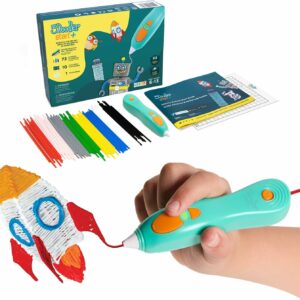
No external hot parts and designed for ages 6 to 13, according to 3Doodler, plus a rechargeable battery: the simplest way to say yes to a young child.
Fumes: PLA versus ABS
Melting plastic releases ultrafine particles and gases, and both the plastic and its temperature make a difference. A study of nine filaments in two 3D pens, in Science of the Total Environment, found the most particles from ABS, then PLA, then PCL, a low-temperature plastic; and a study by NIOSH researchers of children’s toy 3D pens and printers found that a hotter nozzle released more particles and more volatile organic compounds. For children, that points to PLA or low-temperature plastic at the lowest setting that flows well, a window open when drawing indoors with a 3D pen, and ABS left to adults.
The plug and the charger
Pens with no built-in battery, such as the SCRIB3D P1, run from a power adapter (or, according to its manual, a power bank with at least 2 A output), so a mains cable can be caught by an elbow and pull a hot pen off the table: run it away from the edge. For rechargeable pens, Electrical Safety First advises buying USB chargers from a reputable retailer rather than a third-party online seller, not charging overnight or while you’re out, and unplugging once the battery is full.
Features that reduce the risk
Auto sleep and stand-by
The SCRIB3D P1 goes to sleep after a few minutes without use (2 minutes on its Amazon listing, 5 in its user manual), and the Start+ has a stand-by mode. Treat these as a backup for the moment someone forgets, not as a reason to leave the table. If a pen’s maker doesn’t mention an auto-off, assume it has none.
A heat-rated silicone mat
A silicone mat gives the hot tip and stray plastic somewhere to land that won’t stick or melt. Check its heat rating against your pen. The mat in the AQTAQ 3D Pen Starter Kit is rated 220–260 °C, which covers PLA and ABS pen temperatures. Bare wood and plastic tablecloths are not among the surfaces that work under a 3D pen: hot plastic grips one and melts the other.
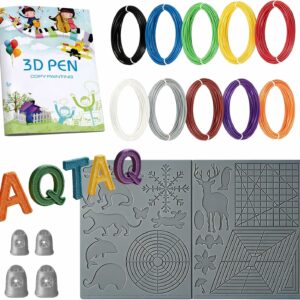
The heat-rated mat and finger guards a hot pen needs, in one box, with templates to trace. The pen isn’t included, and the kit’s 1.75 mm PLA won’t fit the Start+.
Finger guards
Finger guards are small silicone sleeves for the thumb and fingers nearest the tip. The AQTAQ kit and the 3Dmate PLA Refill Kit each include a set, and the LIHUACHEN pen comes with one in the box. They matter less on a low-temperature pen; on a hot pen, fit them before it’s switched on. You’ll find mats, guards and cases among our 3D pen accessories and tools.
A UKCA or CE mark and an age on the box
Under the toy safety rules for Great Britain, a toy for children under 14 must carry a UKCA or CE mark, warnings in English, and the maker’s name and contact address on the toy or its packaging. If the pen or its box shows none of these, or no age rating at all, choose another pen.
What age can a child use a 3D pen?
From six with a low-temperature pen, and from about ten with a hot PLA pen and an adult beside them, always within the age the maker puts on the box. The rating is a minimum, not a target: an impulsive eleven-year-old may be better off on a low-temperature pen a while longer.
| Age | What fits | The adult’s role | Plastic |
|---|---|---|---|
| 5–7 | A low-temperature pen, from the maker’s minimum age (the Start+ is designed for ages 6 to 13). Under six: wait. No hot pens. | At the table: sets up, hands over, puts away | The maker’s low-temperature plastic |
| 8–10 | A low-temperature pen; a hot PLA pen only from about ten, within its maker’s rating | Beside the child for the whole session with a hot pen | Low-temperature plastic (PLA from about ten) |
| 11–13 | A hot PLA pen within its maker’s rating | Beside the child at the table; checks the mat, guards and cable first | PLA |
| 14+ | A hot pen within its maker’s rating, such as the SCRIB3D P1 (rated 14+) | In the room; checks the mat, guards and cable before each session | PLA; ABS only for adults, in a ventilated room |
LIHUACHEN rates its pen 7+, but we’d still wait until about ten for any hot pen: keeping fingers away from the tip is a habit that takes practice. A good test at any age: can the child follow the house rules below without reminders? SCRIB3D rates the P1 for ages 14 and up on its own site, and we’d follow that, whatever a listing suggests. For younger children, that means the Start+ under ten and, from about ten, a hot PLA pen such as the RPC200B with an adult beside them.
Choosing the right 3D pen for under-tens is a separate question from safety. When you get there, browse the pens in our kids and beginners range, checking each one’s age rating against your child, and read up on the specs worth checking on any pen.
House rules for safe use
Rules work when they’re short, the same every time, and enforced by the adult in charge. These are the ones we’d pin up:
- Draw at a table, on the silicone mat. Never on a lap, a bed or the carpet.
- Tie long hair back and fit the finger guards before the pen is switched on.
- Hold the pen like a pencil, fingers well back from the tip.
- The tip never points at a person, and nobody touches the tip or a fresh strand.
- Put the pen down on the mat with the tip facing away, or in its stand if it has one.
- PLA or low-temperature plastic only. ABS is for adults, with a window open.
- Whenever the table is left empty, even for a minute, the adult switches the pen off and unplugs it.
- Leave the pen on the mat to cool for at least five minutes before it goes back in its case.
- Charge rechargeable pens in the daytime while someone is home, with the charger uncovered, and unplug them when full.
What to do if a child gets a burn
Cool it straight away: the NHS advice on burns and scalds is to hold the burn under cool running water for 20 minutes, as soon as possible and within 3 hours. Then work through these steps:
- Switch the pen off, unplug it and put it down on the mat.
- Hold the burn under cool running water for 20 minutes. If there’s no running water, use cool bottled water or a wet towel.
- Take off clothing or jewellery near the burn, but don’t remove anything stuck to it, plastic included.
- Once it has cooled, lay cling film over the burn. Don’t wrap it round.
- Give paracetamol or ibuprofen for pain, at the dose on the pack for the child’s age.
- Don’t put creams, oils or butter on it, don’t use plasters or sticky dressings, and don’t burst blisters.
Call 999 or go to A&E if the burn is very large or deep, is on the face, genitals or bottom, or was caused by electricity. If you’re not sure what to do, get help from NHS 111. If a pen sparks, smokes or has a damaged cable, switch it off at the socket, unplug it and stop using it.
Common questions
Can a 5-year-old use a 3D pen?
Not a hot one, and not on their own. 3Doodler designs the Start+, a low-temperature pen, for ages 6 to 13, so we’d wait until six. In the meantime, a five-year-old can pick templates and colours while an adult draws.
Can my child use a 3D pen without supervision?
With a low-temperature pen, an older child who knows the rules can work with an adult nearby rather than at their elbow. With a hot pen, we’d keep an adult beside anyone under 14, and in the room from 14. Auto sleep is a backup, not a babysitter.
Can I use normal PLA in a 3Doodler Start+?
No. Standard 1.75 mm PLA doesn’t fit and needs a hot pen. The Start+ takes 3Doodler Start plastic or a compatible 2.5 mm pack such as the Kretrum 32-Colour Refills for 3Doodler Start; if you’re unsure, 3Doodler’s own plastic is the surest choice.
How long does a 3D pen take to cool down?
None of these makers publishes a cooling time. We’d leave a hot pen on the mat for at least five minutes after switching it off before anyone touches the tip or packs it away.
Sources
- Burns and scalds — NHS
- 3Doodler Start+: Our Award-Winning 3D Pen for Kids — 3Doodler
- Evaluation of particle and volatile organic compound emissions during the use of 3D pens — Science of the Total Environment, via Europe PMC
- Particle and organic vapor emissions from children’s 3-D pen and 3-D printer toys — Inhalation Toxicology, via PubMed Central
- Toys (Safety) Regulations: Great Britain — GOV.UK
- USB chargers — Electrical Safety First