For under-tens, buy a pen with no external hot parts: the 3Doodler Start+, rated 6 to 13 by 3Doodler. From ten, a hot PLA pen such as the LIHUACHEN RPC200B 3D Pen (Button Version) is an option, with an adult beside your child. From 14, SCRIB3D’s own rating, choose the SCRIB3D P1 on PLA. Budget for refills from day one.
Under ten, the question isn’t which pen has the most features. It’s whether the pen has any part that can burn. A young child needs a different kind of pen, not a budget version of an adult one. Below you’ll find one pick per age, what comes in each box, the refills each pen needs and the extras worth adding.
One pen per age: the short version
The pen we’d buy at each age, the plastic it takes and the age rating its maker publishes.
| Age | Our pick | Plastic it takes | Hot nozzle | Maker’s age rating |
|---|---|---|---|---|
| 6 to 9 | 3Doodler Start+ | 3Doodler Start plastic only | None, according to 3Doodler | 6 to 13 |
| 10 to 13 | LIHUACHEN RPC200B 3D Pen (Button Version) | PLA, 1.75 mm | Yes: 190–210 °C, set automatically | 7 and over |
| 14 and over | SCRIB3D P1 | PLA and ABS, 1.75 mm | Yes: PLA 160–210 °C; ABS 210–235 °C (SCRIB3D’s Amazon listing) or 200–230 °C (user manual) | 14 and over |
The 10-to-13 row is for a child who has outgrown the Start+. 3Doodler rates the Start+ up to 13, so a child still happy with it can carry on. And under 14, a hot pen in a child’s hands always means an adult at the same table.
What actually matters in a 3D pen for a child
For a child, the usual order of specs changes. These are the ones that decide it, most important first. For the specs that matter in any pen, adult or child, see our guide to choosing a 3D pen.
External hot parts: none beats every other feature
This one spec settles the under-ten choice on its own. 3Doodler says the Start+ is designed with no external hot parts. A pen that takes standard PLA works differently. It pushes the plastic through a heated nozzle, and the P1’s published PLA range is 160–210 °C.
UK toy law points the same way. It treats a product designed for play by children under 14 as a toy, and says an electric toy’s directly accessible surfaces must not get hot enough to cause burns when touched. The Start+ is designed around that idea. With a hot-nozzle pen, however small or colourful, the protection comes from the adult at the table instead.
Burns, supervision and house rules have their own page: we cover them in our 3D pen safety guide for children. Here, the rule is short: under ten, no external hot parts.
The age on the box
Treat the maker’s age rating as the minimum, and follow it. The ratings on the pens we list vary widely. 3Doodler rates the Start+ for ages 6 to 13, LIHUACHEN rates the RPC200B for 7 and over, and SCRIB3D’s own product page rates the P1 for ages 14 and over.
A rating isn’t a promise that a child can draw alone. A hot pen rated for seven still has a ceramic nozzle that runs at 190–210 °C, which is why our 10-to-13 pick comes with an adult at the table. For a pen sold as a toy, also look for the UKCA or CE mark: GOV.UK guidance confirms that either can be used on products sold in Great Britain.
The plastic: Start plastic or standard 1.75 mm
This spec decides what you’ll be buying for as long as your child draws. The Start+ takes only 3Doodler Start plastic, which 3Doodler describes as a low-temperature, non-toxic, BPA-free eco-plastic sold in strands. Standard 1.75 mm PLA does not fit it. Your refills are 3Doodler’s own packs or a compatible 2.5 mm pack.
Hot pens such as the RPC200B and the P1 take standard 1.75 mm PLA. Refills come from many makers and in far more colours. The trade-off is the hot nozzle.
The two plastics also behave differently. Start plastic stays softer than PLA, so it suits play and simple models more than fine detail. Once a child wants crisp edges and rigid models, that softness is the reason to move on.
Control: one button or a stepless slider
A single button is easier for a beginner. The RPC200B uses one button for heating, feeding, pausing and speed, and sets its own temperature, so there is nothing to adjust. A stepless slider, as on the P1, lets you pick any speed between slow and fast: slow for corners and upright lines, faster for filling in a shape.
Fine control is something an older child grows into. For a first hot pen, fewer choices is no bad thing.
Power: battery or plug
The Start+ is rechargeable, with a charging cable in the box, so your child can draw at the kitchen table, in the garden or on a long car journey. The P1 has no built-in battery: it runs from its 5 V 2 A adapter or, according to SCRIB3D’s manual, a power bank with at least 2 A output. The RPC200B is corded. When choosing between battery and mains for a child’s hot pen, we see the lack of a battery as a plus: it keeps the drawing at one table, where you can see it.
What’s in each box
Each pen comes with a little starter plastic. Here is what each box holds.
| Pen | In the box | Refills it takes |
|---|---|---|
| 3Doodler Start+ | Pen, charging cable, 72 strands of Start eco-filament, activity guide (according to 3Doodler UK) | 3Doodler Start plastic, or a compatible 2.5 mm pack |
| LIHUACHEN RPC200B 3D Pen (Button Version) | Pen, 12 colours of PLA (length per colour not published), finger guard, drawing templates | PLA, 1.75 mm |
| SCRIB3D P1 | Pen, 3 colours of PLA (30 ft, about 9 m, in total), power adapter, manual, stencil guide | PLA or ABS, 1.75 mm |
Neither hot pen comes with a heat mat, and no box holds much plastic. The P1’s starter filament covers a few small projects, so order a refill pack with the pen rather than after the first weekend.
Our picks by age
One pen per age, and who should skip each one. If you’d rather browse, you’ll find every pen in our kids and beginners range listed with its published specs.
Ages 6 to 9: 3Doodler Start+
For a first pen under ten, this is the one we’d buy. It is the only pen we list with no external hot parts, according to 3Doodler, and it is rechargeable and has a stand-by mode. Because the plastic stays softer than PLA, expect toys, simple figures and flat shapes lifted into 3D rather than detailed models.
Who should skip it: a child of ten or more who wants crisp detail or rigid models, and anyone who already has 1.75 mm PLA at home, since it does not fit. If you’re torn between the Start+ and the SCRIB3D P1, the makers’ ages settle it: 6 to 13 for one, 14 and over for the other.
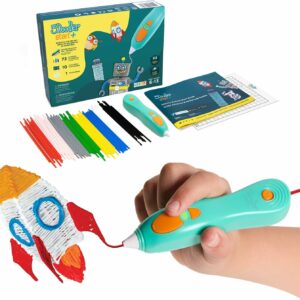
No external hot parts, according to 3Doodler, which designs it for ages 6 to 13. The pen to start with under ten.
Ages 10 to 13: LIHUACHEN RPC200B, with an adult at the table
If your child has outgrown the Start+ and wants harder plastic, finer lines or more colours, the next step is a hot PLA pen. A hot pen means an adult beside them for every session.
Our pick for this age is the LIHUACHEN RPC200B 3D Pen (Button Version), because its maker’s rating covers it: LIHUACHEN rates it for 7 and over. One button does everything and the pen sets its own temperature, so there is nothing to adjust. LIHUACHEN says it warms up in about 60 seconds, and a finger guard comes in the box.
Why not the P1 at this age? It has the finer control, but SCRIB3D rates it for ages 14 and over, and we follow the maker’s rating.
Who should skip it: under-tens, who are better off with the Start+, and a family that needs a cordless pen. It takes PLA only, which is no loss at this age: we leave ABS to adults.
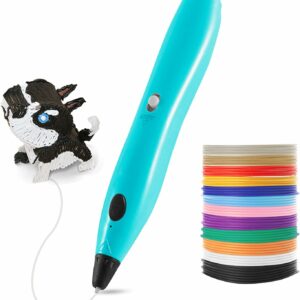
A hot PLA pen its maker rates for 7 and over, with one-button control and automatic temperature. Use it with an adult beside your child.
Ages 14 and over: SCRIB3D P1 on PLA
From 14, SCRIB3D’s own rating, the SCRIB3D P1 is the pen we’d suggest to most first-time buyers. Its stepless speed slider gives the fine control the one-button pen lacks. Its published temperature ranges cover both plastics: 160–210 °C for PLA, and for ABS 210–235 °C on SCRIB3D’s Amazon listing or 200–230 °C in its user manual. The nozzle is ceramic, and the pen goes to sleep after a few minutes without use.
Keep a teenager on PLA. ABS needs the higher temperature setting and a well-ventilated room, so we leave it to adults; PLA is also the easier plastic to learn on.
Who should skip it: anyone under 14, and anyone who wants a pen with a built-in battery. To see how it stands against pens made for adults, look it up in our ranked list of 3D pens.
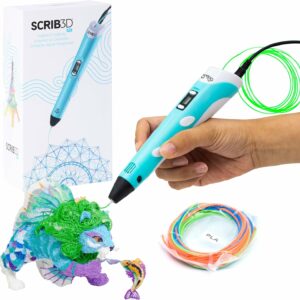
A stepless speed slider and a ceramic nozzle: room to grow for a teenager on PLA. It takes ABS too, which we’d leave to adults.
Refills: the part you keep buying
You buy the pen once; the plastic, again and again. Every pen here comes with starter plastic, and every one runs out. Pick the refill when you pick the pen.
Refills for the Start+
The Start+ takes Start plastic only. 3Doodler sells its own Start+ Eco-Filament in packs of 75 and 250 strands, and says it may not be compatible with other 3D pens. Store it somewhere cool and dry, out of direct sunlight, which 3Doodler says prevents warping.
For more colours, the Kretrum 32-Colour Refills for 3Doodler Start are low-temperature PCL of about 2.5 mm, sold as compatible with the Start and Start+ only. You get 32 colours, glow-in-the-dark included, in 15 cm strands and a resealable pack. It is a third-party refill, so if you are unsure, 3Doodler’s own plastic is the sure choice.
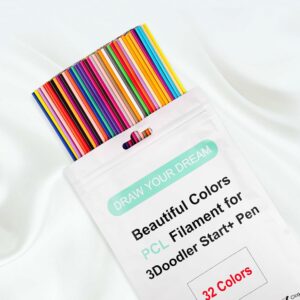
Thirty-two colours of low-temperature 2.5 mm plastic, sold to fit the 3Doodler Start and Start+. They won’t fit a 1.75 mm pen.
Refills for 1.75 mm PLA pens
The RPC200B and the P1 take standard 1.75 mm PLA. Check the refill’s printing temperature against the pen. The Yungden 30-Colour PLA Refills list 180–210 °C, which sits within the P1’s PLA range and overlaps the RPC200B’s automatic 190–210 °C. SCRIB3D’s manual ties the P1’s warranty to SCRIB3D-approved filament, so while the warranty runs, its own SCRIB3D PLA Refills are the safer choice.
The Yungden pack holds 30 colours of 3 m each, 90 m in all, about ten times the starter filament in the P1’s box. Yungden gives a diameter tolerance of ±0.02 mm.
For P1 owners, the SCRIB3D PLA Refills are the maker’s own: 20 colours, about 100 m in total, each colour vacuum packed. Whatever you buy, reseal opened colours, because filament that has taken on moisture can bubble in a hot pen. You’ll find every pack we list among our filament refills.
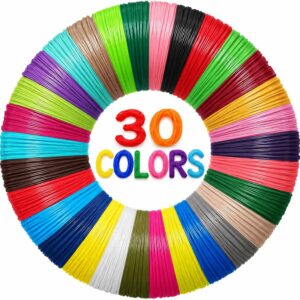
Ninety metres of 1.75 mm PLA in 30 colours, with a 180–210 °C range that suits both of our hot-pen picks (for a P1 still under warranty, SCRIB3D’s own refills). Not for the Start+.
Accessories worth adding
Most extras sold with 3D pens are optional. For a hot pen, two are not: a heat-rated mat and finger guards.
A silicone mat protects the table, because hot filament sticks to wood and melts plastic tablecloths. The AQTAQ 3D Pen Starter Kit pairs a washable 45 × 28 cm silicone mat, rated 220–260 °C, which covers PLA and ABS pen temperatures, with four finger guards (two large, two small). It adds 40 templates on 20 double-sided sheets, a transparent drawing board and 50 m of PLA in 10 colours. The pen is not included, and the PLA won’t fit a Start+.
With a Start+ the mat matters less, but the templates still help a young child trace a shape before trying it freehand.
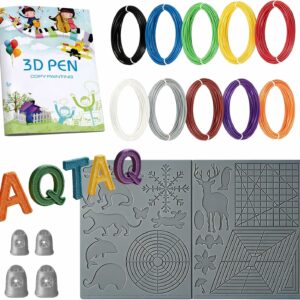
A heat-rated silicone mat, four finger guards and 40 templates, plus 50 m of PLA. Add it to any hot pen; the pen is sold separately.
Two more, if they suit how your child draws. The 3Dmate PLA Refill Kit bundles about 110 m of PLA with a silicone mat, a stencil book and four finger guards, if you’d rather buy plastic and protection in one go. The Lebakort Hard Case is sold to fit the SCRIB3D P1, with mesh pockets for filament; let the nozzle cool for five minutes before packing the pen away.
Buying the pen as a present? Wrap the refills and a mat with it: that rule holds for 3D pen gifts at every age.
What to avoid when buying a 3D pen for a child
- A hot pen for an under-ten because it’s the budget choice. At this age the difference that matters is the nozzle, not the price.
- Ignoring the age rating. It is the youngest age the maker designed the pen for. A rating of 14 and over means 14.
- The wrong refills. 1.75 mm PLA won’t fit the Start+, and 2.5 mm Start refills won’t fit a standard 1.75 mm pen. Check the diameter and the pens named on the pack.
- Starting a child on ABS. It needs a higher temperature and a well-ventilated room. Keep children and teenagers on PLA and leave ABS to adults.
- A toy with no UKCA or CE mark. Great Britain accepts either mark, so a pen sold for children should carry one of them.
- Drawing straight on the table. Use a silicone mat with any hot pen.
- Buying the pen without refills. The plastic in the box is a taster, not a supply.
Common questions
What age can a child start using a 3D pen?
From six, with a pen that has no external hot parts: 3Doodler aims the Start+ at ages 6 to 13, the youngest age any maker gives among the pens we list. Hot-nozzle pens carry higher ratings, from 7 and over for the LIHUACHEN RPC200B to 14 and over for the SCRIB3D P1. Under ten, we’d only buy a pen with no external hot parts.
Can the 3Doodler Start+ use normal PLA filament?
No. 3Doodler says the Start+ takes Start+ refills only, and standard 1.75 mm PLA does not fit. Compatible 2.5 mm low-temperature packs, such as the Kretrum 32-colour set, are sold for it, but 3Doodler’s own plastic is the sure choice.
Can a teenager use ABS in the SCRIB3D P1?
The pen can take it: SCRIB3D gives 210–235 °C for ABS on its Amazon listing and 200–230 °C in the user manual, against 160–210 °C for PLA. ABS needs that higher setting and a well-ventilated room, so we’d keep teenagers on PLA and leave ABS to adults.
How long does the plastic in the box last?
There is no published figure in hours or projects. The Start+ comes with 72 strands; the P1’s 30 ft of PLA covers a few small projects. Order a refill pack at the same time as the pen.
Sources
- 3Doodler Start+ Essentials 3D Printing Pen Set — 3Doodler UK
- 3D Pen Filaments: 3Doodler Start — 3Doodler UK
- SCRIB3D P1 3D Printing Pen — SCRIB3D
- SCRIB3D P1 user manual — SCRIB3D
- Toys (Safety) Regulations: Great Britain — Office for Product Safety and Standards, GOV.UK
- The Toys (Safety) Regulations, Schedule 2: Particular Safety Requirements — legislation.gov.uk