
3D printer filament and resin: picking the right material
This collection covers what goes into a 3D printer rather than a pen: three 1 kg spools of 1.75 mm filament (PLA, PETG and TPU) and one water-washable resin for MSLA machines. Each material does a different job, and the right one depends on what the part has to survive. The guide below sets out the maker's published settings for each and the questions to ask before you order a spool.
How to choose a filament or resin
Check what your printer is: filament or resin
Filament and resin are not interchangeable. A filament printer needs a spool of the diameter it was built for; the SUNLU spools here are 1.75 mm, the usual first choice for any of the printers we list. A resin printer needs a liquid resin matched to the wavelength of its light, and Elegoo makes this one for 405 nm machines. Our explainer on how FDM and resin printers work sets out the difference.
Ask what the part has to cope with
Heat, knocks and bending decide the material. SUNLU publishes a heat deflection temperature of 55 ± 5 °C for its PLA and 70 ± 5 °C for its PETG, which is why PLA is a poor choice for a car dashboard or anything near a radiator. When a part has to flex or grip, TPU is the material. When the point is fine surface detail, resin is.
Check the temperatures against your printer
Each maker publishes a nozzle and a bed range. Your printer's maximum nozzle and bed temperatures must reach them. SUNLU's PETG range of 240–260 °C sits within the maximum nozzle temperature of every filament printer we list, so none of them is ruled out on heat alone.
Look at the spool and the feed
Spools vary in width and hub size between brands. SUNLU's measures 19.5 cm across and 5.9 cm wide, with a 6.3 cm hub hole; make sure that fits your printer's holder or automatic feeder. Flexible TPU is best fed from a plain spool holder, unless the feeder's maker says it handles TPU.
Plan for storage
Filament takes on moisture once opened, and damp filament prints badly. Our guide to storing and drying filament covers airtight boxes and when a dryer is worth it.
Published settings at a glance
| Material | Nozzle | Bed | Heat deflection |
|---|---|---|---|
| SUNLU PLA | 200–210 °C at 50–100 mm/s; 210–240 °C at 100–200 mm/s | 50–60 °C | 55 ± 5 °C |
| SUNLU PETG | 240–260 °C, up to 300 mm/s | 60–70 °C | 70 ± 5 °C |
| SUNLU TPU 95A | 190–210 °C at 50–80 mm/s; 210–230 °C at 80–120 mm/s | 50–60 °C | Not published |
Figures are SUNLU's own. The Elegoo resin is cured by 405 nm light, not heated, so it has no nozzle or bed setting.
Which material for whom
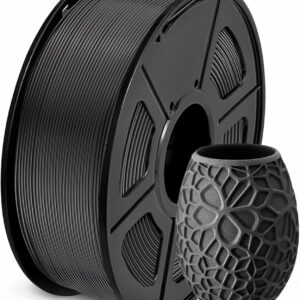
Everyone's first spool: SUNLU PLA Filament. Easy to print, with a ±0.02 mm diameter tolerance according to SUNLU and two published speed bands. It suits models, toys, organisers and prototypes that stay indoors and away from heat. Our PLA settings and storage guide goes into detail.
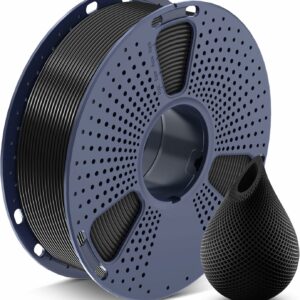
Parts that take knocks or live outside: SUNLU PETG Filament. Tougher and more heat-resistant than PLA, with a tensile strength of 48 ± 10 MPa according to SUNLU. It can bond very hard to smooth PEI plates, so check your printer maker's advice before the first print. PLA or PETG for first prints compares the two.
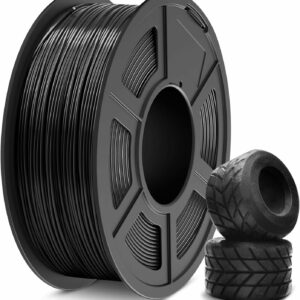
Anything that bends: SUNLU TPU 95A Filament. A Shore 95A flexible filament for phone cases, bumpers and seals, with elongation at break above 900 %, according to SUNLU. It strings more than PLA, so start at the slow settings. SUNLU gives a diameter tolerance of ±0.02 mm on its website and ±0.03 mm on the listing.
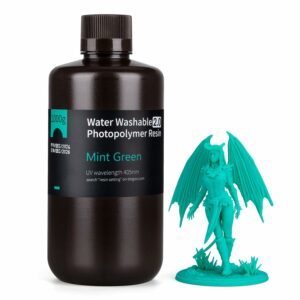
Resin printer owners: Elegoo Water Washable Resin 2.0. A 1,000 g bottle of 405 nm resin that, according to Elegoo, rinses clean in water instead of isopropyl alcohol and works with most MSLA, LCD and DLP printers using that wavelength. Water-washable does not mean harmless: wear nitrile gloves, ventilate the room, and let the rinse water cure in sunlight or under UV before disposal, never down the sink.
What you'll need alongside
- A printer to match. Filament and resin machines are in 3D Printers, compared in the 3D printer ranking.
- A dryer for PETG and TPU. The SUNLU FilaDryer S2 holds one spool and feeds the printer as it dries.
- Resin post-processing. Wash-and-cure stations and finishing tools are in Accessories & Tools.
Common questions
What is the best filament for a beginner?
PLA. It prints at moderate temperatures, needs no enclosure and is forgiving of small setting errors. Move to PETG when a part needs more toughness or heat resistance.
How long does a 1 kg spool last?
It depends on the size of your models and how solid you print them. Your slicer estimates the weight of each print before you start, which is the reliable way to judge how far a spool will go.
Can TPU go through a multicolour feeder?
Only if the feeder's maker says so. Otherwise, feed flexible filament from a simple spool holder, where it has a short, direct path to the extruder.
Is water-washable resin safer than standard resin?
It changes the cleaning liquid, not the hazard. Uncured resin still irritates skin, so gloves and ventilation apply in the same way.