

The full guide to the SUNLU PLA
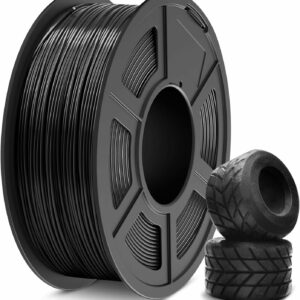
SUNLU PLA is a plain, everyday PLA in 1.75 mm on a 1 kg spool: the filament most people load for their first prints, calibration cubes and household parts. It prints at modest temperatures with little warping, and SUNLU publishes settings for both normal and faster printing. The trade-off is heat: PLA softens at around 55 °C, so it is the wrong choice for anything that lives in a hot car or next to a radiator.
Key specifications
| Material | PLA |
|---|---|
| Diameter | 1.75 mm, ±0.02 mm tolerance according to SUNLU |
| Net weight | 1 kg |
| Nozzle temperature | 200–210 °C at 50–100 mm/s; 210–240 °C at 100–200 mm/s |
| Bed temperature | 50–60 °C on SUNLU’s product page; 60–70 °C on a textured PEI plate in its technical data sheet |
| Retraction | 0.8–1.2 mm at 30–40 mm/s |
| Part cooling fan | On |
| Heat deflection temperature | 55 ± 5 °C (Vicat softening point 54 °C) |
| Tensile strength | 40 ± 6 MPa; elongation at break 10 ± 5 % |
| Density | 1.23 g/cm³ |
| Drying | 50 °C in the data sheet; 50–55 °C for 6–8 hours in SUNLU’s usage guide |
| Spool | 19.5 cm across, 5.9 cm wide, 6.3 cm hub hole |
| Length per spool | Not published by the maker |
Who it suits — and who should pick something else
- Pick it if you have just set up a printer such as the Bambu Lab A1 mini and want a forgiving material for models, organisers, toys and test prints.
- Pick it for decorative pieces and prototypes where a clean surface matters more than toughness. SUNLU’s data sheet lists decorative items, toys, figurines and lighting fixtures as its main uses.
- Choose PETG instead for brackets, garden parts or anything that bends, takes knocks or sits in the sun. The SUNLU PETG Filament has a heat deflection temperature of 70 ± 5 °C against 55 ± 5 °C here.
- Choose TPU if the part has to flex, such as a phone case or a bumper.
What’s in the box
One 1 kg spool of 1.75 mm PLA in the colour you select. SUNLU’s quick-start guide describes its filament arriving vacuum-sealed in a bag with a desiccant pack; it tells you to keep the desiccant and the spool’s filament clip for storage.
How to use it
- Check the bag is still tight and the seal intact before opening; SUNLU suggests cutting along the sealed edge with scissors so the desiccant isn’t damaged.
- If the bag was loose, or the spool has been open for a while, dry it first. SUNLU’s usage guide gives 50–55 °C for 6–8 hours for PLA.
- Put the spool on the holder, cut the tip at 45°, push it into the extruder and use the printer’s load function. SUNLU suggests holding it in place for about 10 seconds once it starts feeding.
- In the slicer, pick a generic PLA profile, then match it to SUNLU’s window: 200–210 °C for 50–100 mm/s, or 210–240 °C if your printer runs at 100–200 mm/s.
- After printing, tuck the free end into the spool’s side hole and reseal the spool with its desiccant.
Temperatures, bed and the two speed windows
The two nozzle ranges are the most useful part of SUNLU’s sheet. A slower printer melts the filament comfortably at 200–210 °C; a fast machine pushes more plastic through the nozzle each second, so it needs 210–240 °C to keep up. If you see thin, weak walls at speed, raise the temperature within that upper range before you slow the print down. Our filament temperature chart sets these figures next to other materials.
SUNLU’s own figures for the bed don’t agree. The product page says 50–60 °C; the technical data sheet says 60–70 °C on a textured PEI plate. Start at 60 °C, which sits in both, and only go higher if corners lift. The cooling fan stays on for PLA.
Spool fit and storage
The spool measures 19.5 cm across and 5.9 cm wide with a 6.3 cm hub hole. That suits an ordinary spool holder. Bambu Lab’s AMS lite FAQ lists spools 40–68 mm wide with a 53–58 mm hub hole, so the hole on this spool is wider than that range: check how it sits before you rely on a multicolour feeder, or run it from the external holder.
PLA absorbs moisture from the air. SUNLU’s guide links damp filament to popping, stringing, weak layers and occasional clogs, and recommends a sealed bag or dry box with desiccant, kept cool and out of direct sunlight. The data sheet adds that PLA may yellow under UV light. Our guide to PLA settings and storage covers the rest.
How it compares
| SUNLU figure | PLA | PETG |
|---|---|---|
| Nozzle | 200–240 °C | 240–260 °C |
| Bed | 50–60 °C | 60–70 °C |
| Heat deflection | 55 ± 5 °C | 70 ± 5 °C |
| Tensile strength | 40 ± 6 MPa | 48 ± 10 MPa |
PLA is the easier start; PETG takes more heat and more abuse. Our PLA vs PETG comparison explains when the switch is worth it, and the printer filament and resin collection lists every material we cover.
Common questions
Will SUNLU PLA work in a Bambu Lab A1 or A1 mini?
SUNLU names Bambu Lab among the printer brands its PLA suits, and its 200–240 °C range sits well inside the 300 °C maximum both printers list. Use a generic PLA profile in Bambu Studio and adjust the temperature to SUNLU’s window. For the AMS lite, check the spool’s 6.3 cm hub hole against Bambu Lab’s 53–58 mm range first.
What temperature suits SUNLU PLA?
Match it to your speed: 200–210 °C for 50–100 mm/s, 210–240 °C for 100–200 mm/s. For the bed, 60 °C satisfies both of SUNLU’s published ranges. Fine-tune in 5 °C steps.
Does a new spool need drying?
Not if the vacuum bag is tight and the desiccant looks unchanged. SUNLU still recommends drying when in doubt, at 50–55 °C for 6–8 hours. Popping sounds and fine strings are the usual signs of damp PLA.
Can this filament go in a 3D pen?
Some pens take 1.75 mm PLA from a spool, but check your pen’s manual for the diameter and a PLA setting first. A 1 kg spool is a lot of filament for a pen, so the short colour refills made for pens are usually more practical.
Why do PLA prints sag in summer?
SUNLU gives a heat deflection temperature of 55 ± 5 °C, which a car interior or a sunny windowsill can reach. Print those parts in PETG instead.
Specifications as published by SUNLU on its official pages, checked November 2026. Where a figure isn’t published, we say so.