
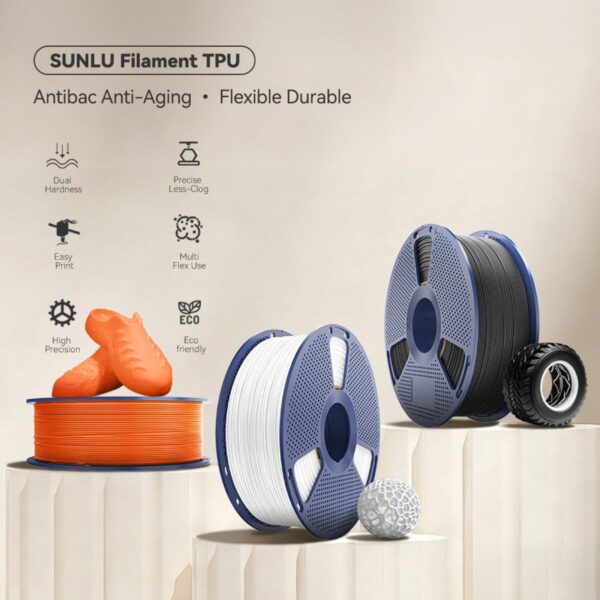
The full guide to the SUNLU TPU 95A
SUNLU TPU 95A Filament is a rubber-like 1.75 mm filament on a 1 kg spool, for prints that need to bend, grip or absorb a knock: phone cases, bumpers, feet for furniture, seals and watch straps. At Shore 95A it is the firmer kind of flexible filament, which makes it one of the more printable. The catch is feeding: soft filament dislikes long tubes and fast retractions, so it rewards patience and a simple filament path.
Key specifications
| Material | TPU, Shore hardness 95A |
|---|---|
| Diameter | 1.75 mm; tolerance ±0.02 mm on SUNLU’s website, ±0.03 mm on the listing |
| Net weight | 1 kg |
| Nozzle temperature | 190–210 °C at 50–80 mm/s; 210–230 °C at 80–120 mm/s |
| Bed temperature | 50–60 °C, textured PEI plate in SUNLU’s data sheet |
| Retraction | 0.8–1.2 mm at 30–40 mm/s |
| Elongation at break | Over 900 % |
| Tensile strength | 31 ± 3 MPa |
| Notched impact strength | 47 ± 5 kJ/m² |
| Density | 1.21 g/cm³ |
| Drying | Required by SUNLU: 50–60 °C for 6–8 hours |
| Heat deflection temperature | Not published by the maker |
| Spool dimensions | Not published by the maker |
Who it suits — and who should pick something else
- Yes if you want soft-touch, shock-absorbing parts: cases, grips, gaskets, cable tidies, anti-slip pads.
- Yes if your printer feeds from a spool holder with a short path to the extruder. The Flashforge Adventurer 5M lists TPU among its materials, as do the Bambu Lab A1 and A1 mini.
- Not ideal if you print everything through a multicolour feeder. Bambu Lab’s AMS lite FAQ says it cannot use TPU of 95A or softer, so on the Bambu Lab A1 Combo TPU goes on the external spool holder.
- Not ideal for rigid parts. If it must not bend, the SUNLU PETG Filament is the better choice.
What’s in the box
One 1 kg spool of 1.75 mm TPU 95A in the colour you choose. SUNLU’s quick-start guide describes its filament as packed in a vacuum-sealed bag with a desiccant pack; with TPU in particular, keep that bag.
How to use it
- Dry it before the first print. SUNLU puts TPU in its “must dry” group, at 50–60 °C for 6–8 hours.
- Mount the spool on a holder that lets it turn freely, with the shortest, straightest path into the extruder. Don’t tug the filament through: SUNLU warns that pulling or stretching it can deform it.
- Choose a TPU profile in the slicer and start in SUNLU’s slow window, 190–210 °C at 50–80 mm/s. SUNLU’s own test pieces were printed at 45 mm/s and 230 °C.
- Set the bed to 50–60 °C. SUNLU’s data sheet pairs TPU with a textured PEI plate and says no surface treatment is needed.
- Reduce retraction compared with your PLA profile, as SUNLU advises, staying within its 0.8–1.2 mm at 30–40 mm/s.
- Once a small part prints cleanly, try the faster window: 210–230 °C at 80–120 mm/s.
Feeding flexible filament
A flexible strand behaves like a wet noodle when pushed: if there is space beside it, or friction along a long tube, it buckles instead of feeding. That is why feeders and long tube runs cause most TPU failures, and why slow, steady printing works best. Our guide to printing TPU as a beginner covers the slicer settings in more depth.
Moisture and storage
SUNLU files TPU under high-moisture-absorption materials and marks drying as required, where PLA and PETG are only recommended. Damp filament, SUNLU notes, leads to bubbling, popping, stringing and weaker layers. Dry the spool before printing, keep it sealed with desiccant between jobs, and store it away from direct sunlight, which SUNLU says can yellow the material. Our filament dryer guide explains when a heated dryer is worth having.
How it compares
| SUNLU figure | TPU 95A | PETG |
|---|---|---|
| Nozzle | 190–230 °C | 240–260 °C |
| Top published speed | 120 mm/s | 300 mm/s |
| Elongation at break | Over 900 % | 11 ± 5 % |
| Drying | Required | Recommended |
The SUNLU PLA Filament and PETG are the easier materials to feed; TPU is the one to choose when flexibility is the point. See the whole printer filament range for the others.
Common questions
Can SUNLU TPU 95A run through the AMS lite?
No. Bambu Lab’s AMS lite FAQ lists 95A among the TPU grades it cannot use. Feed it from the external spool holder instead.
What does Shore 95A mean?
It is a hardness rating on the Shore A scale, where a higher number means a firmer material. A 95A part flexes and squashes but keeps its shape, which also makes the filament easier to push through a printer than softer grades.
How fast can TPU 95A print?
SUNLU publishes up to 120 mm/s at 210–230 °C. Start in the 50–80 mm/s window at 190–210 °C, and only speed up once small parts come out clean.
Why is TPU stringing so much?
Moisture is the usual cause, so dry the spool at 50–60 °C for 6–8 hours first. Then try a lower nozzle temperature within SUNLU’s range and check retraction is set within 0.8–1.2 mm.
Which tolerance is right, ±0.02 or ±0.03 mm?
SUNLU’s website gives ±0.02 mm; the listing gives ±0.03 mm. Either is a tight tolerance for 1.75 mm filament, and neither changes how you set up the printer.
Specifications as published by SUNLU on its official pages, checked November 2026. Where a figure isn’t published, we say so.