For a 3D pen, three plastics matter: PLA, the everyday refill; ABS, which needs a hotter setting and fresh air; and low-temperature plastics such as PCL, sold in 2.5 mm strands for the 3Doodler Start+. The rule is simple: buy the diameter your pen takes, in a material whose printing temperature overlaps the pen’s published range.
PLA, ABS and PCL: properties at a glance
The pen temperatures below come from the SCRIB3D P1, the only pen in our catalogue whose maker publishes a range for each material. Where nobody publishes a figure, the table says so.
For the temperature ranges makers publish for each material, see our filament temperature chart.
| Material | Diameter in pens | Pen temperature (published example) | Heat resistance once drawn | Good to know |
|---|---|---|---|---|
| PLA | 1.75 mm | 160–210 °C on the SCRIB3D P1 | Softens and deforms above about 60 °C, according to Prusa | Made from plants such as corn; little warping; brittle on impact |
| ABS | 1.75 mm | 210–235 °C on the SCRIB3D P1, according to SCRIB3D’s Amazon listing; 200–230 °C in its user manual | Described by Prusa as high-temperature resistant; no single figure given | Tougher; gives off fumes including styrene; shrinks 1–2 % as it cools |
| Low-temperature plastic (PCL, 3Doodler Start plastic) | About 2.5 mm | No figure published; 3Doodler says the Start+ has no external hot parts | PCL melts at around 55–60 °C, according to a Scientific Reports study | Stays softer than PLA; only for pens built for it |
PLA: the refill most pens are built around
PLA is made from corn, sugar cane or sugar beet, according to Prusa. It isn’t prone to significant warping, and every 1.75 mm pen in our catalogue accepts it, which makes it the default first refill.
The trade-offs are brittleness and heat. Prusa notes that PLA breaks along layers or into shards on impact and softens above about 60 °C; SUNLU publishes a heat deflection temperature of 55 ± 5 °C for its own PLA. Keep finished models off sunny dashboards and away from heaters.
ABS: tougher, hotter, and it needs fresh air
Prusa describes ABS as tough and heat-resistant, suited to parts under mechanical stress. It needs more heat too: on the SCRIB3D P1, 210–235 °C according to SCRIB3D’s Amazon listing, or 200–230 °C according to its user manual, against 160–210 °C for PLA. Prusa warns that it releases fumes, including styrene, so draw with it in a well-ventilated room.
If you’re weighing the two for a project, our side-by-side PLA and ABS comparison covers that choice. None of the refill packs in our catalogue is ABS, so if you buy some, check its temperature against your pen’s ABS range.
PCL and 3Doodler Start plastic: the cool-running option
PCL (polycaprolactone) generally melts at around 55–60 °C, according to a study in Scientific Reports: far below the temperatures a PLA pen runs at. 3Doodler says its 3Doodler Start+, built for low-temperature plastic, has no external hot parts, and 3Doodler UK says it is designed for ages 6 to 13.
3Doodler describes its Start plastic as a 2.5 mm eco-filament that is non-toxic, BPA-free and melts at low temperatures, without naming the polymer. The third-party Kretrum pack for the Start and Start+ is sold as PCL. Either way, the result stays softer than PLA, so it suits play and simple models more than fine detail.
Which pens take which filament: 1.75 mm or 2.5 mm?
Your pen’s manual or listing tells you. Every hot pen in our catalogue takes 1.75 mm filament; the 3Doodler Start+ takes 2.5 mm Start plastic. The two don’t cross over: 1.75 mm PLA doesn’t fit the Start+, and 2.5 mm packs won’t fit a 1.75 mm pen.
| Pen | Diameter | Materials | Published temperature |
|---|---|---|---|
| SCRIB3D P1 | 1.75 mm | PLA, ABS | PLA 160–210 °C; ABS 210–235 °C (SCRIB3D’s Amazon listing) or 200–230 °C (user manual) |
| MYNT3D Super | 1.75 mm | ABS, PLA | Not published by the manufacturer |
| 3Doodler Flow | 1.75 mm | PLA, ABS, wood-fill | 160–220 °C, according to 3Doodler |
| LIHUACHEN RPC200B 3D Pen (Button Version) | 1.75 mm | PLA only | 190–210 °C, set automatically |
| 3Doodler Start+ | 2.5 mm | 3Doodler Start plastic or a compatible pack | None given; no external hot parts, according to 3Doodler |
Still choosing a pen? Diameter and temperature range are among the specs worth checking before you buy, and our ranked list of 3D pens sets out the shortlist. The printer filament we list is 1.75 mm too, but diameter isn’t the only question: see our guide to using printer filament in a pen.
The one rule: match the filament to your pen’s published range
Pick a refill whose printing temperature overlaps your pen’s range for that material, then set the pen inside the overlap. Here it is with the SCRIB3D P1:
- Check the diameter and materials. The P1 takes 1.75 mm PLA and ABS.
- Find the pen’s range for your material: 160–210 °C for PLA on the P1.
- Read the pack’s printing temperature: 160–210 °C on SCRIB3D’s own refills, 180–210 °C on the Yungden pack.
- Check the overlap. Both packs sit inside the P1’s PLA range.
- Set the pen inside it: 180–210 °C for the Yungden pack. Third-party packs may affect the P1’s warranty, though: its manual ties the warranty to SCRIB3D-approved filament, so check SCRIB3D’s terms first.
A fixed-temperature pen needs the same check. The LIHUACHEN RPC200B 3D Pen (Button Version) sets itself to 190–210 °C, so a pack rated 180–210 °C overlaps; one that stops below 190 °C doesn’t. Where a pen publishes no range, as with the MYNT3D Super, stick to the materials its manual lists.
For a P1 still under warranty, the closest match is the SCRIB3D PLA Refills: the same published range as the pen, with each colour vacuum packed.
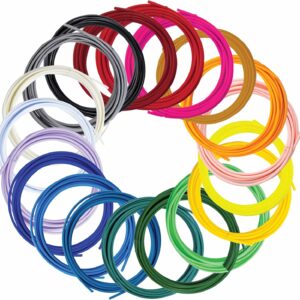
SCRIB3D publishes the same 160–210 °C range as the P1’s PLA setting, with about 4.9 m of each of 20 colours, every one vacuum packed.
How to read a refill pack
Look for five things: material, diameter, length per colour, printing temperature and diameter tolerance. The packs on our filament refills shelf show how much labels differ.
| Pack | Diameter | Per colour | In total | Also published |
|---|---|---|---|---|
| Yungden 30-Colour PLA Refills | 1.75 mm | 3 m | 90 m | 180–210 °C; ±0.02 mm tolerance |
| SCRIB3D PLA Refills | 1.75 mm | 16 ft (about 4.9 m) | About 100 m | 160–210 °C; vacuum packed |
| Helweet 20-Colour PLA Refills | 1.75 mm | 3 m | 60 m | Colours picked at random |
| Kretrum 12-Colour PLA Refills | 1.75 mm | Not published | Not published | Twelve named colours, gold included |
| Kretrum 32-Colour Refills for 3Doodler Start | About 2.5 mm | 15 cm strands | Not published | PCL; Start and Start+ only; resealable |
Metres per colour, not number of colours
A 30-colour pack sounds bigger than a 20-colour one, but the Yungden pack holds 90 m and the SCRIB3D pack about 100 m. Three metres per colour suits outlines and accents; for large areas, you want more of one colour, not more colours. When a listing gives no length, as with the Kretrum 12-Colour PLA Refills, compare packs by total metres.
Diameter tolerance
Tolerance is how far the strand may stray from its nominal diameter. Yungden publishes ±0.02 mm, so its 1.75 mm strand should measure between 1.73 and 1.77 mm. Of the pen packs in our catalogue, only Yungden publishes a figure.
That gives the Yungden 30-Colour PLA Refills the most complete label we list: diameter, length, temperature and tolerance, plus transparent and fluorescent shades.
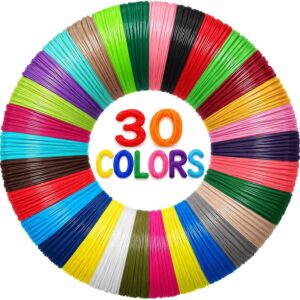
Thirty colours of 1.75 mm PLA, 3 m each, with a published 180–210 °C range and a ±0.02 mm tolerance, for standard hot 3D pens.
What not to mix up
- 1.75 mm and 2.5 mm. Standard PLA won’t go into a 3Doodler Start+, and Start-type strands won’t go into a 1.75 mm pen.
- Hot and low-temperature refills. The Helweet 20-Colour PLA Refills, the Kretrum 12-Colour PLA Refills and the Yungden pack are not for low-temperature pens such as the 3Doodler Start.
- “Most pens” and all pens. SCRIB3D says its refills don’t fit the 3Doodler Create+. Read the compatibility line before you order.
- ABS in a PLA-only pen. The LIHUACHEN RPC200B 3D Pen (Button Version) takes PLA only.
- Melting and softening. PLA that flowed at 160–210 °C still deforms above about 60 °C once drawn, so a hot car can ruin a model.
For a 3Doodler Start+, the choice is 3Doodler’s own Start plastic or a pack sold as compatible. The Kretrum 32-Colour Refills for 3Doodler Start add glow-in-the-dark shades in resealable packaging; as a third-party pack, though, 3Doodler’s own plastic is the surest choice if you’re unsure.
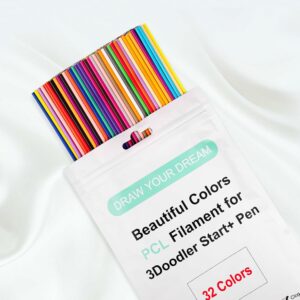
Thirty-two colours of about 2.5 mm low-temperature PCL in 15 cm strands, sold for the 3Doodler Start and Start+ only.
How to get good results with each material
Start with the surface: draw on a heat-rated silicone mat rather than a bare table. The one in the AQTAQ 3D Pen Starter Kit is rated 220–260 °C, above the top of the P1’s ABS range.
Watch the filament as it comes out. Bubbling and smoke are signs of wet filament, according to Prusa. Wood-fill filament, which the 3Doodler Flow accepts, is more abrasive than plain PLA, so clean the nozzle after use, and follow the manual when you switch between PLA and ABS.
If the flow stops, unplug the pen and let it cool before you touch the nozzle, then work through how to clear a clogged pen in order.
Storage and safety basics
Most filaments are hygroscopic: they draw water from the air, Prusa explains. PLA’s properties don’t change much as it does, but damp filament can still give blobs, poor adhesion between layers, and bubbling as it’s extruded. Keep opened colours in a closed box or bag with a desiccant sachet, away from heat; vacuum bags work too.
SCRIB3D vacuum-packs each colour and the Kretrum Start strands come resealable, so keep using those seals. For drying filament that has already taken on moisture, see our guide to storing and drying filament.
On safety, follow your pen maker’s age rating. Any pen that heats PLA or ABS has a hot nozzle, so we’d keep a hot pen for ages ten and up, with an adult beside them; under ten, choose a pen with no external hot parts such as the 3Doodler Start+. Use ABS only in a well-ventilated room, and read what we know about 3D pen fumes before long sessions indoors.
Common questions
Can I put normal PLA in a 3Doodler Start+?
No. The Start+ takes 2.5 mm Start plastic, and standard 1.75 mm PLA does not fit. Use 3Doodler’s own Start plastic or a pack sold as compatible with the Start and Start+.
Which filament suits a young child?
Under ten, low-temperature plastic in a pen built for it. 3Doodler UK says the Start+, which takes that plastic and has no external hot parts according to 3Doodler, is designed for ages 6 to 13. PLA pens have a hot nozzle, so we’d keep them for ages ten and up, with an adult beside them, and always within the maker’s age rating.
Does PLA filament go off if the pack is left open?
It doesn’t spoil quickly, but it does take on moisture from the air. Damp filament can bubble, smoke and give blobby results, according to Prusa. Keep opened colours in a sealed bag with a desiccant sachet.
Is 3D pen filament biodegradable?
PLA breaks down only in specialised composting facilities running above 80 °C, according to Prusa, so it won’t disintegrate on a home compost heap. 3Doodler says its Start+ Eco-Refills break down naturally over time but doesn’t publish the conditions. Either way, put offcuts in the bin rather than the compost.
Sources
- PLA — Prusa Knowledge Base
- ABS — Prusa Knowledge Base
- Drying filament — Prusa Knowledge Base
- Development of a new poly-ε-caprolactone with low melting point for creating a thermoset mask used in radiation therapy — Scientific Reports (PubMed Central)
- 3Doodler EDU Start+ Learning Pack Filament Kit, 1200 Strands — 3Doodler
- 3D Pen Filaments, 3Doodler Start+ — 3Doodler