

The best 3D printer gift is one that works on day one, so buy for the person’s patience and space, not the spec sheet. We’d give the Bambu Lab A1 mini to a curious beginner, the Flashforge Adventurer 5M to a teenager and the Bambu Lab A1 Combo to a crafter who wants colour. Add PLA; skip resin unless asked.
A 3D printer makes a brilliant present when the first print comes off the bed on the day it’s unwrapped, and a poor one when it needs an evening of setting up, a missing spool or a desk that isn’t there. So this guide skips most of the specifications and asks three questions about the person: how patient are they, where will it live, and what do they want to make?
If the printer is for you rather than someone else, our guide on choosing a first printer for yourself goes through every specification in detail.
Which 3D printer to give: the short list
Find the row that sounds like the person, then read the full pick below, including who should skip it.
| Who it’s for | Our pick | Why it works on day one | Space to plan for | Add to the parcel |
|---|---|---|---|---|
| Curious beginner | Bambu Lab A1 mini | Arrives assembled and calibrates itself | The smallest bed we list, 180 mm; the bed slides back and forth | A 1 kg spool of PLA |
| Teenager | Flashforge Adventurer 5M | Ready in 10 minutes or less, according to Flashforge | 363 × 376 × 413 mm, excluding the screen and spool holder | PLA and a tool kit |
| Crafter who wants colour | Bambu Lab A1 Combo | Four-colour feeder included; calibration is automatic | A 256 mm moving bed plus the feeder | Four spools in their colours |
| Miniature painter who asked for resin | Anycubic Photon Mono 4 | Only once resin, gloves and a wash-and-cure set-up are ready | 230 × 235 × 391 mm, in a ventilated room | Resin, nitrile gloves, a wash-and-cure station |
What actually matters when the printer is a present
A gift has to win the recipient over on the first day. Five things decide whether it does.
Whether it prints on day one
This is the feature that matters most. Calibration is the setting-up a printer needs before its first layer goes down evenly. When the printer does it by itself, the first evening goes on printing rather than adjusting.
Here is what the makers publish for our picks:
- Bambu Lab A1 mini: arrives assembled and calibrates itself.
- Bambu Lab A1 Combo: automatic Z-offset, bed levelling, vibration compensation and flow calibration.
- Flashforge Adventurer 5M: 95 % pre-assembled with automatic levelling, and ready in 10 minutes or less, according to Flashforge.
- Anycubic Photon Mono 4: 4-point manual levelling, needed once, according to Anycubic.
Our rule for a gift: automatic levelling at the very least, and ideally a printer that needs no assembly at all.
The space it will live in
Build volume is the space inside; the printer is much bigger. Flashforge gives the Adventurer 5M’s outer size as 363 × 376 × 413 mm without the screen and spool holder, for a 220 mm build volume. Anycubic gives 230 × 235 × 391 mm for the Photon Mono 4.
How the printer moves matters too. The Bambu Lab A1 mini and A1 Combo have a moving bed that slides back and forth, so they need clear space in front and behind. The Adventurer 5M is a CoreXY printer: the print head moves across the top, so the frame is the footprint. Add room for the spool, the cable and a pair of hands.
If it’s a surprise, ask someone who lives with the recipient to measure the desk or shelf. Note the depth as well as the width, and the height under any shelf above it.
Noise, and the room where it will run
Prints often run for hours, with fans and motors working throughout. Noise isn’t published for every model: Flashforge’s specification table leaves that line blank for the Adventurer 5M. So think about the room rather than a figure: a spare room or a study is easier than a bedroom where someone sleeps while a long print finishes.
How much patience they have
Someone who just wants to see what 3D printing is wants a first print in an evening and little else. A teenager who likes taking things apart will enjoy swapping nozzles and trying new filaments. Colour adds a feeder and longer prints; resin adds gloves, washing and curing.
Match the printer to that patience, not to the most impressive listing. And if you doubt they’d sit through hours-long prints, or the present is for a younger child, a hand-held pen is a smaller first step: see our 3D pen gift ideas by age.
The materials they’ll want
PLA is the everyday material, and all four filament printers we list handle it, along with PETG and TPU (on the Adventurer 5M, TPU needs an optional 0.6 or 0.8 mm nozzle, according to Flashforge). ABS and ASA want an enclosure, and Flashforge states that ABS is not compatible with the Adventurer 5M. If the recipient already talks about ABS, ask before you buy: none of our open-frame picks is built for it. An enclosed printer such as the Elegoo Centauri Carbon, which lists ABS and ASA among its materials, is the better match there.
Our picks by recipient
Start from the person, not the printer: each pick below fits one kind of recipient. If you’d like them in order, see our ranked list of 3D printers, or browse every 3D printer we list.
For a curious beginner: Bambu Lab A1 mini
The Bambu Lab A1 mini is the surest bet when you don’t know how far the interest will go. It arrives assembled and calibrates itself, so the first print can start on the day. Its open frame and 80 °C bed suit PLA, PETG and TPU.
- Build volume: 180 × 180 × 180 mm, the smallest we list, which is also why it fits where the others don’t.
- Room to grow: it takes the AMS lite feeder for up to four colours, sold separately or as the A1 mini Combo.
- In this bundle: an LED lamp kit.
Skip it if the things they want to make are bigger than 180 mm in any direction, or they want ABS or ASA, which call for an enclosure.
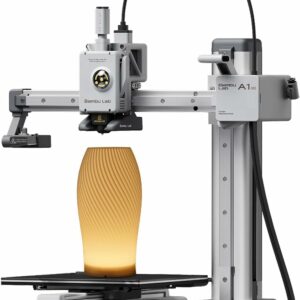
For someone new to the hobby: it comes built, sets itself up and has a compact 180 mm bed, so the first print can start on the day it’s unwrapped.
For a teenager: Flashforge Adventurer 5M
The Flashforge Adventurer 5M suits a teenager who wants bigger prints and will happily learn the controls. It’s an open CoreXY printer with an all-metal frame and a 220 mm bed, between the two Bambu Lab sizes.
- Build volume: 220 × 220 × 220 mm, on a flexible, removable PEI steel plate.
- Quick-release nozzle: swaps in about 3 seconds, which makes a clog a short job rather than a long one.
- Connections and software: Wi-Fi, Ethernet and USB, with FlashPrint 5, Orca-Flashforge or OrcaSlicer to prepare prints, according to Flashforge.
Flashforge’s product page gives no age rating, and the nozzle reaches 280 °C on an open frame. For a younger teenager, stay close for the first few prints and agree the house rules: hands out of the printer while it runs, and let the nozzle cool before touching it.
Skip it if they want ABS, which Flashforge says isn’t compatible, or multicolour: it prints one colour at a time.
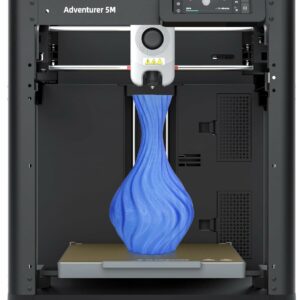
A 220 mm bed, automatic levelling and a 3-second nozzle swap: room for bigger projects without hours of setup.
For a crafter who wants colour: Bambu Lab A1 Combo
The Bambu Lab A1 Combo is for someone who already pictures signs, name tags, badges or toys in several colours. It pairs the full-size A1 and its 256 mm bed with the AMS lite feeder, included, for up to four colours in one print.
- Build volume: 256 × 256 × 256 mm.
- Colour ceiling: four, since the A1 connects to a single AMS lite.
- The trade-off: a four-colour name tag takes longer and uses more filament than a one-colour one, as the old colour is flushed out at each change.
Skip it if they would rarely use more than one colour, or the desk can’t take a moving 256 mm bed plus the feeder. The A1 mini can take an AMS lite later; our A1 mini and A1 comparison weighs up the bigger bed.
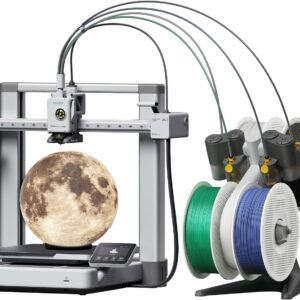
Four colours and a 256 mm bed in one box, with calibration that runs itself, for a crafter who wants colour from the first week.
For a miniature painter who has asked for resin: Anycubic Photon Mono 4
Tabletop miniatures and jewellery are where resin beats filament on detail. The Anycubic Photon Mono 4 is a compact 7-inch 10K resin printer with an XY resolution of 17 × 17 µm on a 153.4 × 87 × 165 mm platform. It is our pick only for someone who paints miniatures, has said they want a resin printer, and has a ventilated space for it.
- Size: 230 × 235 × 391 mm, according to Anycubic.
- In the box: Anycubic lists the printer, platform, resin vat, manual, screen protector kit, levelling paper and protective equipment. Resin isn’t on the list.
Skip it if it would be a surprise, the printer would have to live in a child’s room, or they want larger models: the platform is small.
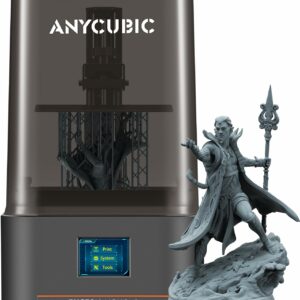
Fine detail for miniatures in a compact machine, for a painter who already knows what resin printing involves.
Why resin is rarely a good surprise
A resin printer can’t work on day one without a workspace, consumables and a routine the recipient has signed up for. Elegoo’s beginner guide advises nitrile gloves, protective masks, safety goggles and aprons to keep resin off the skin, in a well-ventilated space away from UV rays.
Each print then needs a rinse in isopropyl alcohol, or in water for a water-washable resin, and a cure under UV light. That means a wash-and-cure station, a supply of resin and somewhere to keep it all. Our rule: give a resin printer only to someone who has asked for one by name and already has a place for it in mind.
Liquid resin irritates skin, so wear nitrile gloves and keep resin printers out of children’s rooms. Used alcohol and rinse water carry uncured resin: never pour them down the drain.
If they have asked, give the whole set-up rather than the printer alone. The Anycubic Wash & Cure 3 fits printers of 7.3 inches and below, including the Photon Mono 4 series, according to Anycubic. Elegoo Water Washable Resin 2.0 is a 405 nm resin you rinse in water instead of alcohol; gloves and ventilation still apply.
What to put in the parcel
Don’t count on filament in the box: add a full spool of the material they’ll use most, so the first prints don’t wait for a shopping trip.
SUNLU PLA Filament is 1.75 mm PLA on a 1 kg spool, with a ±0.02 mm diameter tolerance and published print settings, according to SUNLU. Its spool is 19.5 cm across and 5.9 cm wide with a 6.3 cm hub hole, so check that it suits the printer’s holder or feeder. For the A1 Combo, four spools in the recipient’s favourite colours make the feeder useful straight away, as long as the spools’ hub hole is 53–58 mm wide, the AMS lite’s published range; SUNLU’s 6.3 cm hub is larger.
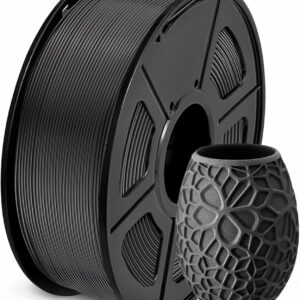
Everyday 1.75 mm PLA on a full 1 kg spool, with SUNLU’s published settings: the first material for any filament printer we list.
A few tools help too. The Creality 3D Printer Tool Kit Pro has 74 pieces, including plastic and metal spatulas for lifting prints, a deburring tool and nozzle-cleaning needles. The blades and needles are sharp, so keep the case out of children’s reach.
Before you wrap it: a day-one checklist
A few checks before and after delivery decide whether the printer runs on the day or waits in its box.
- Measure the spot. Use the printer’s outer size, not its build volume, and add space for the spool and, on the A1 mini or A1 Combo, the moving bed.
- Buy a UK model from a reputable retailer. Electrical Safety First advises buying electrical presents from reputable retailers and not bringing home electrical products bought outside the UK.
- Read the returns policy. Online, you normally have a 14-day cooling-off period starting the day after you receive the order, then another 14 days to send the item back, according to Citizens Advice. The clock runs from delivery, not from the day it’s opened.
- Keep the box. A printer is a large parcel to send back without its packaging.
- Line up a first model. Printables, Thingiverse and similar libraries offer models to download. Licences vary by model: many are Creative Commons Non-Commercial, which allows a present but not selling prints, so the recipient should check each model’s licence and credit the designer.
- Suggest they register the printer. Electrical Safety First recommends registering electrical appliances so the maker can contact you if there’s a problem.
If it’s a Christmas present, ordering early takes the stress out of delivery, but it also means the cooling-off period may have passed by the time the paper comes off. Check whether the seller offers a longer returns window or a gift receipt.
What to avoid
- Buying on headline speed. The Adventurer 5M is rated at 600 mm/s and the two Bambu Lab printers at 500 mm/s; neither figure tells you whether the printer will be used.
- A resin printer as a surprise. It needs gloves, ventilation, a wash-and-cure step and a room away from children.
- A printer bigger than the space. A 256 mm moving bed needs room in front and behind, plus space for the feeder.
- Colour for someone who wants single-colour parts. The feeder would take up desk space and rarely be used.
- An open frame for someone set on ABS. Ask first: our open-frame picks are built for PLA and PETG.
- No filament in the parcel. A printer with nothing to print makes for a disappointing morning.
Common questions
Is a 3D printer a good gift for a beginner?
It can be, if it works on day one. Choose one that arrives assembled and calibrates itself, such as the Bambu Lab A1 mini, add a full spool of PLA and line up a first model to print. A printer that needs hours of tuning before the first print is a project, not a present.
What filament should I buy with a 3D printer gift?
A 1 kg spool of 1.75 mm PLA suits every filament printer we list. SUNLU publishes settings of 200–210 °C at 50–100 mm/s and a 50–60 °C bed for its PLA. Check that the spool fits the printer’s holder or feeder, since spool sizes differ between brands.
Can a teenager use a 3D printer on their own?
It depends on the teenager and on the maker’s manual, so read the safety section before you decide. The nozzles on our filament picks reach up to 280 or 300 °C, and the frames are open. Stay close for the first prints and agree simple rules, such as letting the nozzle cool before touching it.
What can I give someone who already has a 3D printer?
Consumables and tools rather than another machine. A spool of a material they haven’t tried, a tool kit for removing and finishing prints, or a filament dryer such as the SUNLU FilaDryer S2, which heats from 35 to 70 °C on a 1–99 hour timer. Ask which printer they own first, so spools and tools fit.
Sources
- Adventurer 5M 3D Printer — Flashforge
- Anycubic Photon Mono 4 — Anycubic
- Get Started in Resin Printing — Elegoo
- Where can you get 3D models? — Prusa Research
- Changing your mind about something you’ve bought — Citizens Advice
- Christmas tips — Electrical Safety First