The full guide to the Yungden 30-colour refills
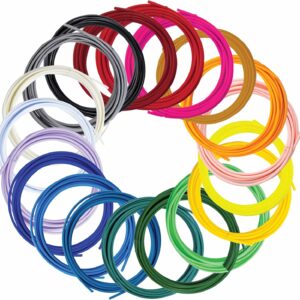
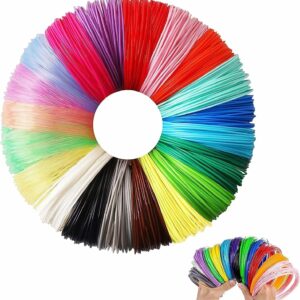
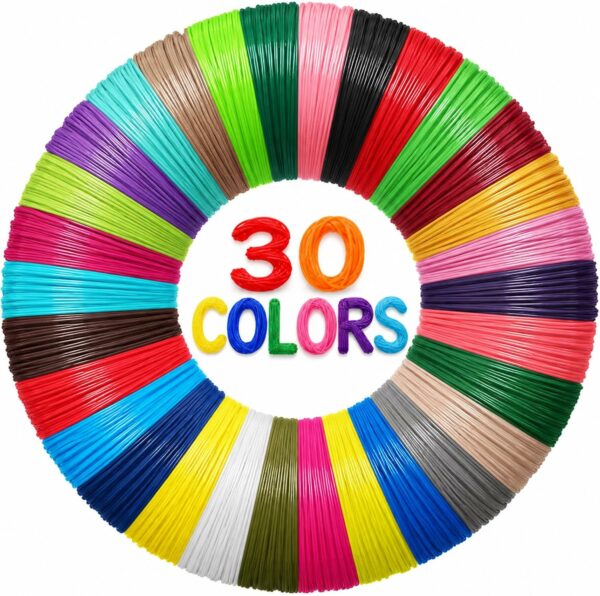
Yungden’s pack is the widest palette we list for hot 3D pens: thirty colours of 1.75 mm PLA, 3 m each, with two transparent and four fluorescent shades among them. It suits makers who want effects as well as plain colours, and Yungden publishes both a temperature range and a diameter tolerance, which many refill packs leave out. The trade-off is length: 3 m per colour is ideal for detail and accents, less so for large single-colour models.
Key specifications
| Material | PLA, 1.75 mm |
|---|---|
| Colours | 30: 24 standard, 2 transparent, 4 fluorescent |
| Length | 3 m per colour, 90 m in total |
| Printing temperature | 180–210 °C |
| Diameter tolerance | ±0.02 mm, according to Yungden |
| Not for | Low-temperature pens that use PCL, and the 3Doodler Start family |
Who it suits — and who should pick something else
Choose the Yungden pack if:
- You want special effects without buying them separately: clear shades for windows and suncatchers, fluorescent ones for signs and party pieces.
- Your projects use many colours in small amounts, such as characters, lettering, badges and jewellery.
- Your pen takes 1.75 mm PLA and can heat within 180–210 °C (see the table below).
Pick something else if:
- You build big pieces in one colour. 3 m runs out quickly in solid infill; the SCRIB3D refill pack offers about 4.9 m per colour, or buy a single colour in a longer length.
- You draw with a 3Doodler Start+. It takes low-temperature Start plastic, not PLA.
What’s in the box
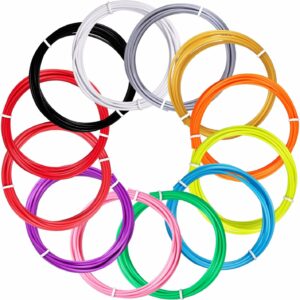
Thirty colours of 1.75 mm PLA, 3 m of each: 24 standard colours, 2 transparent and 4 fluorescent, 90 m in total. No pen or accessories are included.
Will it work in your pen? Temperatures matched
Yungden gives 180–210 °C for this PLA. Here’s how that lines up with the pens we list, using each maker’s published figures:
| Pen | PLA temperature | What to do |
|---|---|---|
| SCRIB3D P1 | 160–210 °C, adjustable | Use PLA mode and keep it between 180 and 210 °C |
| LIHUACHEN RPC200B | 190–210 °C, set automatically | Nothing to adjust: inside Yungden’s range |
| 3Doodler Flow | 160–220 °C, adjustable | Set 180–210 °C; 3Doodler accepts third-party 1.75 mm filament in its range but can’t guarantee it |
| MYNT3D Super | Not published | Use the pen’s PLA setting and test a short line first |
| 3Doodler Start+ | Start plastic only | Not compatible |
Start at the low end of the range for fine lines and raise it if the pen struggles. Our filament temperature chart lists other materials too.
Getting started
- Heat the pen in PLA mode and wait for its ready light.
- Cut the end of the strand flat. SCRIB3D’s manual explains that a flat end pushes the previous strand through cleanly, while a ragged tip can jam.
- Feed the filament in with the forward button running until plastic flows.
- To change colour, reverse the strand out completely. A strand left half-withdrawn can swell inside the pen, according to SCRIB3D.
Planning with transparent and fluorescent shades
Six effect colours go furthest when they sit on top, where light reaches them:
- Transparent: fill an outline drawn in an opaque colour, so the frame holds the shape and the clear PLA lets light through.
- Fluorescent: use them for edges, lettering and small details that should stand out. They suit Halloween masks and lanterns; our Halloween 3D pen ideas have projects to try.
- Standard colours: keep one dark and one light shade for bases and hidden layers, so the effects aren’t used up on structure.
Tracing a printed outline first keeps every line where you want it: try our 3D pen templates.
Storing thirty loose lengths
PLA picks up moisture from the air. SUNLU’s filament guide links damp filament to bubbling or popping during extrusion, more stringing and weaker bonding, and recommends a sealed bag or box with desiccant, kept cool, dry and out of direct sunlight. Filament dryers are designed around spools; Bambu Lab’s drying guide warns that PLA has a low softening temperature, so coils left static while drying can stick together or deform. For short pen lengths, sealing them away after each session is the simpler habit.
How it compares
- Yungden 30-Colour PLA Refills: 30 colours including 2 transparent and 4 fluorescent; 3 m each, 90 m in total; 180–210 °C; ±0.02 mm.
- SCRIB3D PLA Refills: 20 colours; about 4.9 m each, about 100 m in total; 160–210 °C; each colour vacuum packed.
- Helweet 20-Colour PLA Refills: 20 random colours; 3 m each, 60 m in total; temperature not published.
Common questions
Which pens do Yungden refills fit?
Pens that take 1.75 mm PLA and can heat within 180–210 °C, such as the SCRIB3D P1, the LIHUACHEN RPC200B and the 3Doodler Flow. They don’t fit the 3Doodler Start family or other low-temperature pens.
What does a ±0.02 mm tolerance mean?
It is how far the diameter may vary from 1.75 mm, according to Yungden. A tight tolerance means each strand stays close to the 1.75 mm size the pen is built for. SUNLU publishes the same figure for its 1 kg PLA spool.
How many fluorescent and transparent colours are there?
Four fluorescent and two transparent, alongside 24 standard colours, according to the listing.
Is 3 m per colour enough?
For outlines, lettering, jewellery and details, yes. For a large model in one colour, plan to top up that colour separately.
Comparing pens for this filament? See our ranked list of 3D pens.
Specifications as published by Yungden on its official listing, checked November 2026. Where a figure isn’t published, we say so.