The full guide to the Helweet 20-colour refills
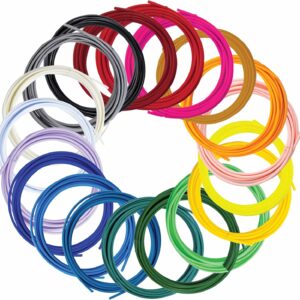
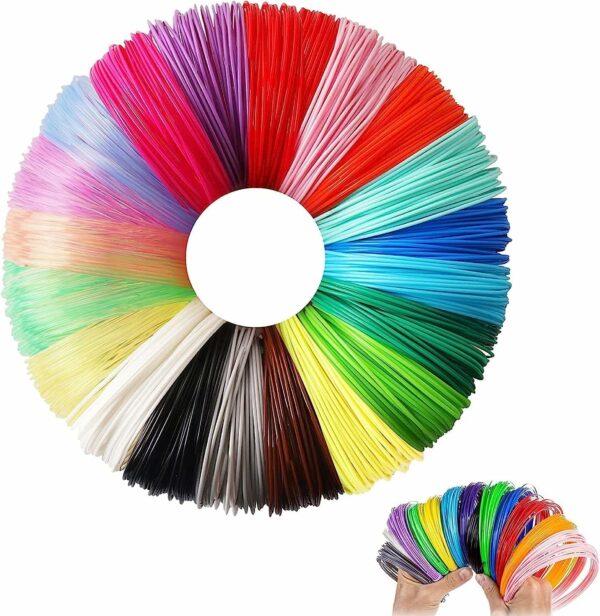
Helweet’s pack is twenty 3 m lengths of 1.75 mm PLA, 60 m in all, for hot 3D pens that take standard filament. The catch is in the small print: the seller picks the colours at random, so you don’t know which twenty you’ll get. That makes it a good practice and activity pack, and a poor choice when a project needs one particular shade.
Key specifications
| Material | PLA, 1.75 mm |
|---|---|
| Quantity | 20 colours, 3 m each |
| Total length | 60 m |
| Colour choice | Random selection, according to the seller |
| Printing temperature | Not published by the maker |
| Diameter tolerance | Not published by the maker |
| Not for | Low-temperature pens and the 3Doodler Start+ |
Who it suits — and who should pick something else
A random pack works when the colour of each piece matters less than having plenty of them:
- Learning to draw: first lines, flat shapes on templates and practice cubes use filament quickly, whatever the colour.
- Groups of children sharing pens at a party or a club, where variety is part of the fun. Follow each pen’s own age rating and supervise as its maker advises.
- Topping up a mixed collection you already own.
Choose a pack with a published colour list if:
- You are planning a model in set colours, such as a named character, a team badge or a flag. The Kretrum 12-colour pack lists all twelve shades.
- You want transparent or fluorescent effects you can count on. The Yungden 30-colour pack states how many of each it includes.
What’s in the box
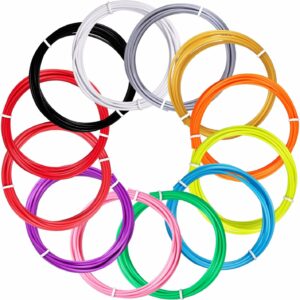
Twenty lengths of 1.75 mm PLA, 3 m each, in a random mix of colours chosen by the seller. The listing doesn’t mention a pen, mat or stencils, so assume filament only.
Getting started with a random pack
Five minutes of sorting when the pack arrives saves time at every session:
- Lay all twenty lengths out in daylight and group them by family: neutrals, warm colours, cool colours, anything unusual.
- Bag each group separately and write the colours on the bag, so you can grab the right shade without opening everything.
- Pick two neutrals, ideally a light and a dark, as your structural colours for bases, frames and infill.
- Choose projects from the colours you actually have. Our easy 3D pen projects include plenty that work in any shade.
- Note which colours you use up first. That tells you which single colour to buy in a longer length next time.
Which temperature to use
Helweet doesn’t publish a printing temperature, so start from your pen’s own PLA setting and follow its manual:
- The LIHUACHEN RPC200B button pen sets 190–210 °C automatically for PLA, so there is nothing to adjust.
- The SCRIB3D P1 offers 160–210 °C in PLA mode. Its manual says to lower the temperature by 5–10 °C if the plastic bubbles or crackles, and to raise it by 5–10 °C if the colour looks dull and the motor strains.
- The 3Doodler Flow pen accepts third-party 1.75 mm filament that melts within its 160–220 °C range, according to 3Doodler, which adds that it can’t guarantee third-party filament.
Because the colours come from a mixed batch, treat each one as its own small test: draw a short line on scrap before starting a project.
Storing loose 3 m lengths
Short lengths have no spool to protect them, so they need a bag. Bambu Lab’s drying guide explains why: filament absorbs moisture from the air, and in a hot nozzle that moisture turns to vapour, causing bubbles, stringing, oozing and rough surfaces. Bambu Lab’s advice for daily storage is to keep filament sealed. 3Doodler, for its pen filament, recommends a cool, dry, dark place. Coil each length loosely, tuck the end in, and keep the labelled bags in a box away from radiators and sunny windows.
How it compares
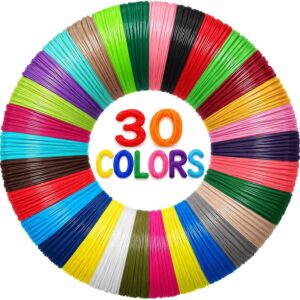
- Helweet 20-Colour PLA Refills: 20 colours, 3 m each, 60 m in total; colours random; temperature not published.
- Kretrum 12-Colour PLA Refills: 12 named colours, gold included; length per colour not published.
- Yungden 30-Colour PLA Refills: 30 colours, 3 m each, 90 m in total; 24 standard, 2 transparent and 4 fluorescent; 180–210 °C.
Helweet and Yungden share the same 3 m length per colour; Yungden adds ten colours and tells you what they are.
Common questions
Can you choose the colours in the Helweet pack?
No. According to the seller, the twenty colours are a random selection. If specific shades matter, pick a pack with a published colour list.
Does it fit the 3Doodler Start+?
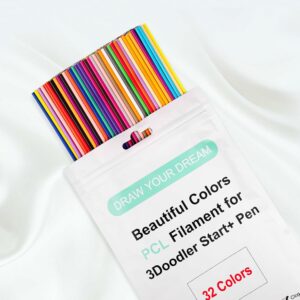
No. The Start+ takes 3Doodler’s low-temperature Start plastic only, and this is standard 1.75 mm PLA for hot pens. It isn’t for other low-temperature pens either.
How many projects will 60 m make?
Helweet doesn’t say, and it depends on the size and density of what you draw. Flat outlines on a template use far less than solid 3D models, so plan larger pieces in your most plentiful colour.
Why is the filament bubbling in the pen?
The two usual causes are a temperature set too high and filament that has absorbed moisture. Lower the temperature a step first, then check how the opened lengths have been stored.
Will two packs contain the same colours?
There’s no guarantee, as the selection is random. If you need to finish a model in a matching colour, keep a length of that shade aside before you start.
Need flat outlines to practise on? Print our free 3D pen templates, or compare pens in our ranked list of 3D pens.
Specifications as published by Helweet on its official listing, checked November 2026. Where a figure isn’t published, we say so.