
Halloween with a 3D pen comes down to spiders, things to wear and lanterns, and lanterns get an LED tea light, never a candle. Masks need eye holes wide enough to see your feet. The ten ideas run from a quick stencil web to a cauldron lit from inside, and the web, the mask and the box lantern get step outlines.
Which Halloween project suits your pen?
Start with the pen, then the person holding it. The 3Doodler Start+ is designed for ages 6 to 13 according to 3Doodler UK and, according to 3Doodler, has no external hot parts. Its low-temperature plastic stays softer than PLA, though, so it suits the flat ideas and small builds; for masks and lanterns, PLA holds its shape better.
A standard pen with 1.75 mm PLA handles everything here, masks and lanterns included. Its nozzle is hot: the SCRIB3D P1 runs PLA at 160–210 °C, and SCRIB3D’s product page rates it for ages 14 and up, while its user manual says adult use only. Follow the age rating of whichever pen you have, and stay beside younger makers whenever a hot pen is switched on. If the pen is brand new, warm up with our easy projects for beginners before the first spider.
10 Halloween ideas, grouped by difficulty
Allow longer for first attempts; the times below are our estimates.
Easy: flat spiders, webs and bats
1. Stencil spider web. Trace a printed web, spokes first, then the spiral, and hang it in a window or a corner. Allow 15 to 20 minutes. You need white or glow-in-the-dark filament, a web stencil and thread.
2. Flat spiders with glowing eyes. Draw an oval body, add four bent legs on each side, then dot two eyes in glow filament. Allow about 15 minutes. You need black filament and one glow strand.
3. Bat garland. Draw a row of bats from one stencil, fill the wings with zigzags so they don’t flex, and add a loop to each wing tip. 3Doodler publishes a downloadable bat stencil. Allow about 10 minutes per bat. You need black filament and string.
4. Creepy-crawly badges. Draw a small spider or beetle, then fix a brooch pin to the back with a few lines of filament. Allow about 15 minutes. You need two colours and a brooch pin.
Intermediate: spiders with depth and things to wear
5. Standing spider. Draw a lattice over each half of a taped ping-pong ball in turn, pop each off and join them into a round body. Add eight bent legs drawn flat, tacked to the underside so it stands. Allow about an hour. You need black filament, a ping-pong ball, masking tape and a nail file.
6. Floating ghost. 3Doodler’s version is drawn around a scrunched tissue or paper towel, with filament stretched down at the bottom so the ghost has something to stand on. Allow 30 to 40 minutes. You need white or glow filament and tissue.
7. Eye mask. A flat domino mask from a stencil, with a thick rim, generous eye holes and elastic. Allow about 45 minutes. You need one or two colours, a stencil, a nail file and thin elastic.
Ambitious: masks and lanterns
8. Creature half-mask. Wrap a plain mask form or a bowl in masking tape, draw a lattice over it, then add horns or fins drawn flat. For a flatter route, 3Doodler’s Swamp Thing mask is drawn from a stencil, taped and joined at the seams, given fins drawn from a second stencil, then tied on with string or elastic. Allow two to three hours. You need two or three colours, masking tape and elastic.
9. Jack-o’-lantern box lantern. Four orange panels with a face left open in one, joined into a box on a square base, with an LED tea light inside. Allow about two hours. You need plenty of orange, some black and an LED tea light.
10. Cauldron lantern. A black lattice drawn over an upturned, taped bowl, lifted off and turned over, with a doubled rim, three thick legs and green or transparent drips. An LED tea light inside glows through the gaps. Allow two to three hours. You need plenty of black, some green or transparent, a small bowl, masking tape and an LED tea light.
What you need for Halloween 3D pen projects
You need a pen, filament in Halloween colours, a heat-rated silicone mat with stencils and a few household odds and ends.
Filament colours
You need black and orange most, then white, purple and green, plus glow-in-the-dark for eyes and transparent for the cauldron’s drips. For a 3Doodler Start or Start+, the Kretrum 32-Colour Refills for 3Doodler Start are the pack with glow strands: 32 colours of low-temperature plastic, about 2.5 mm across, in 15 cm strands and a resealable bag. They won’t fit a 1.75 mm pen, and as a third-party refill, 3Doodler’s own Start plastic is the safe default if you’re unsure.
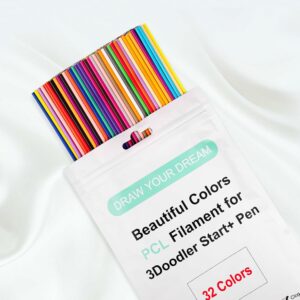
Thirty-two colours for the Start and Start+, glow-in-the-dark included: right for flat spiders, webs and glowing eyes.
For a standard pen, the Yungden 30-Colour PLA Refills hold 30 colours of 1.75 mm PLA, 3 m each, at 180–210 °C, with 2 transparent and 4 fluorescent shades among them. Three metres per colour suits spiders, eyes and drips. The box lantern eats orange and the cauldron eats black, so buy those in bulk from our filament refills shelf.
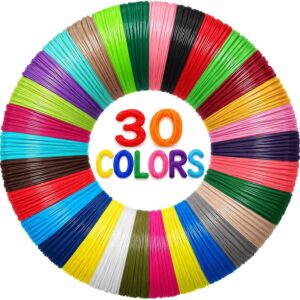
Thirty colours of 1.75 mm PLA, with transparent strands that catch a tea light’s glow and fluorescent ones for bright accents.
If you’d rather know the exact colours before you buy, the Kretrum 12-Colour PLA Refills name black, orange, purple, green, white and grey among their twelve, though the length per colour is not published by the manufacturer.
Keep glow strands for eyes, webs and outlines rather than whole panels. Our guide to glow-in-the-dark 3D pen filament covers how it works, how long it glows and which pens take it.
For shaping, joining and wearing
Keep masking tape, a ping-pong ball, a bowl, tissue, a nail file, thread and thin elastic to hand. 3Doodler advises wrapping any object you draw over in masking tape, so the piece comes off cleanly. For lanterns, buy LED tea lights, and check what battery they take before small children handle them.
Light 3D pen lanterns with LED tea lights only, never a real candle or a lit tea light. London Fire Brigade warns that tea lights get very hot and can melt through plastic surfaces without a proper holder, and Prusa says PLA gets soft and deforms above 60 °C. Keep masks and costumes away from naked flames too.
Step outlines for a web, a mask and a lantern
Stencil spider web (easy)
- Tape a web stencil under a clear sheet on your silicone mat.
- Draw the spokes from the centre outwards, each one in a single steady line.
- Draw the spiral from the centre, touching each spoke so the two fuse.
- Go over the outer ring a second time, because single thin lines snap easily.
- Add a small loop at the top and go round it twice.
- Let the web cool on the mat, then peel it off slowly.
- Draw a flat spider, then tack it to one strand of the web.
Eye mask with big eye holes (intermediate)
- Print a domino mask stencil sized for the wearer and cut the eye holes wider than printed.
- Tape it under a clear sheet on the mat.
- Trace the outer edge and both eye holes, twice over.
- Fill between them with zigzags, joining every line to the rim.
- Let it cool, peel it off and smooth every edge with a nail file, eye holes first.
- Hold it up to the wearer’s face, never while drawing, and check they can see their feet and both sides without turning their head. Widen the holes if not.
- Draw a small loop at each side, anchored into several lines.
- Thread thin elastic through the loops and knot it.
The American Academy of Pediatrics suggests non-toxic make-up and decorative hats as safer alternatives to masks, and says hats shouldn’t slide over the eyes or block vision. That’s why the eye holes come first, and why we’d skip a full-face mask for trick-or-treating.
Jack-o’-lantern box lantern (ambitious)
- Draw a square base a little wider than your LED tea light and fill it with a criss-cross.
- Draw four orange panels the same width as the base, filled with tight zigzags.
- On one panel, leave two triangle eyes and a jagged mouth open, then outline each gap twice.
- Let every piece cool and peel it off the mat.
- Stand the face panel on one edge of the base, taped on the outside to hold it.
- Tack its bottom corners, then draw along the whole joint, the method 3Doodler gives for building in 3D.
- Join the side panels to the base and the face panel, then add the back and go over every upright seam.
- Leave the top open so you can reach the switch, and draw a loop handle across it with a short black stalk on top.
- Switch on an LED tea light and stand it in the middle.
The cauldron skips panels: it’s one lattice over a taped bowl, like the half-mask. The flat-and-join skills carry straight over to our Christmas decoration ideas, so nothing you practise now is wasted.
Where to display your decorations safely
Keep PLA away from heat as well as flames: radiators, warm bulbs and hot, sunny windowsills. Prusa says it gets soft and deforms above 60 °C. London Fire Brigade notes that you can leave flameless candles unattended, one more reason to use them.
Bring outdoor pieces in after the night. Prusa notes that PLA degrades under UV light and calls it unsuitable for outdoor use. It’s brittle too, breaking into shards on impact, so hang spiders and garlands from doubled loops and stand lanterns on a shelf.
If your LED tea lights take button batteries, store spares up high. The Child Accident Prevention Trust warns that a swallowed button battery can badly hurt or kill a small child, and says to go straight to A&E or call an ambulance if you think a child has swallowed one. If you have a 3D printer too, 3D printed Halloween decorations take over where the pen stops.
Common questions
Can I draw straight onto a real pumpkin?
It’s easier to draw the pieces on a silicone mat and pin them on afterwards. A curved, damp skin is awkward to draw on, and pins let you keep the spiders and bats for next year. Wipe the pumpkin dry first and hide each pin behind the plastic.
Can children make Halloween masks with a 3D pen?
Yes, with an adult beside them for any hot pen, and within the pen maker’s age rating. 3Doodler UK designs the Start+ for ages 6 to 13, but its softer plastic suits flat eye masks more than big creature masks. Keep the eye holes generous and try the mask on only once it has cooled.
How do I stop spider legs from snapping off?
Draw each leg twice over so it is thicker, and join it to the body with a small blob of filament rather than a single touch. PLA is brittle and breaks on impact, so let the spider cool fully before you lift it.
How long does glow-in-the-dark filament glow?
It glows brightest for the first few minutes after charging, then fades; how long depends on the filament. Charge glowing pieces in daylight or under a strong LED before dark; our glow-in-the-dark filament guide has the figures makers publish.
Sources
- PLA — Prusa Knowledge Base
- Candles – Fire safety at home — London Fire Brigade
- Halloween Fun and Safety Tips for Kids of All Ages — American Academy of Pediatrics (HealthyChildren.org)
- Button Battery Safety — Child Accident Prevention Trust
- Spooktacular Doodle Ideas Using Your 3D Pen — 3Doodler
- How To Draw In 3D with a 3D pen — 3Doodler