

For most classes, buy the 3Doodler Start+: 3Doodler says it has no hot external parts and designs it for ages 6 to 13, so a whole primary class can draw at once. Keep hot PLA pens for small supervised groups, and from Year 10 consider the SCRIB3D P1, rated 14 and over on SCRIB3D’s product page.
In a classroom, the right pen depends on two things: your pupils’ ages and the number of adults in the room. Below: one pick per stage, a set-up checklist and lesson ideas for art and design and for design and technology (D&T). Year groups and curriculum links are for England; elsewhere, go by your pupils’ ages, which the table also gives.
Want something ready to trace? Download our free printable 3D pen templates, with shapes, letters and simple 3D builds on A4 pages.
Which 3D pen for which year group?
It comes down to whether the nozzle gets hot. Our pick per stage, with each maker’s own age rating; year groups and ages follow the GOV.UK key stages.
| Stage | Years and ages | Our pick | Hot nozzle | Maker’s age rating |
|---|---|---|---|---|
| Key stages 1 and 2 | Years 1 to 6, ages 5 to 11 | 3Doodler Start+, whole class | No hot external parts, according to 3Doodler | 6 to 13, according to 3Doodler UK |
| Key stage 3 | Years 7 to 9, ages 11 to 14 | 3Doodler Start+ for the class; LIHUACHEN RPC200B 3D Pen (Button Version) for small supervised groups | RPC200B: 190–210 °C, set automatically | Start+: 6 to 13; RPC200B: 7 and over |
| Key stage 4 and up | Year 10 onwards, ages 14 and over | SCRIB3D P1 on PLA | PLA 160–210 °C | 14 and over |
The rule behind it: below the age of 14, a hot pen needs an adult beside the pupil holding it, and in a full class you can’t give every pupil that. So whole-class work up to Year 9 gets a pen with no hot external parts. In Year 1, check ages first: GOV.UK puts Year 1 at ages 5 to 6, and 3Doodler’s rating starts at six.
What actually matters when you buy pens for a class
Hot parts and the maker’s age rating
This one spec settles most choices. 3Doodler says the Start+ runs at a low temperature with no hot external parts, and designs it for children aged 6 to 13. A standard pen melts PLA in a heated nozzle: the SCRIB3D P1’s published PLA range is 160–210 °C.
Treat the age on the box as a minimum. The ratings on our picks run from 6 to 13 for the Start+, through 7 and over for the RPC200B, to 14 and over for the P1 on SCRIB3D’s own product page. If a shop listing suggests a younger age than the maker’s site, go with the maker. One gap to settle before you buy P1s: SCRIB3D’s user manual is stricter than its product page and says adult use only, so record which you follow in your risk assessment.
Battery or mains in a busy room
The Start+ is rechargeable, with a charging cable in the box, so there are no cables to trip over in use. 3Doodler’s Start+ page gives up to 45 minutes of continuous drawing, or 1 to 1.5 hours of stop-start use, and a charge in as little as 30 minutes. Its help centre is more cautious: about 30–45 minutes per charge, and 45 minutes to 2 hours to charge. The pen can’t be used while charging and should be switched off on charge, so charge between lessons.
The RPC200B is corded. The P1 has no built-in battery: it runs from its 5 V 2 A adapter or, according to SCRIB3D’s manual, a power bank of at least 2 A. On mains, you need a socket for each hot pen, with cables kept away from table edges and walkways. For a hot pen that’s no bad thing, as a cord keeps it at one table where an adult can see it. Outside the classroom, choosing between battery and mains power is a closer call.
One plastic per class set
The Start+ takes 3Doodler Start plastic or a compatible 2.5 mm pack; standard 1.75 mm PLA does not fit. The RPC200B and the P1 take 1.75 mm PLA, and the P1 also takes ABS. Buy a class set that runs on one plastic, so refills can be pooled and nobody feeds the wrong strand into the wrong pen.
Plastic is also your running cost. The Start+ comes with 72 strands and the P1 with 30 ft (about 9 m) of PLA. Treat that as a starter supply and order refills with the pens.
Controls pupils can’t get wrong
Fewer settings means fewer mistakes when one adult watches several pupils. The RPC200B uses one button for heating, feeding, pausing and speed, and sets its own temperature. The P1 adds a stepless speed slider and a temperature display: good for older pupils learning to control the flow.
Our picks by class
One pen per stage, and who should skip each one. To compare more models, browse our kids and beginners range. Buying for one child at home instead? See our guide to choosing a pen by age.
Primary, Years 1 to 6: 3Doodler Start+
For whole-class work in primary, this is the pen we’d buy. It is the only pen we list with no hot external parts, according to 3Doodler, so every pupil can draw at the same time.
- Heat: runs at a low temperature with no hot external parts, according to 3Doodler
- Age: 6 to 13, according to 3Doodler UK
- Power: rechargeable, charging cable included, with a stand-by mode
- Plastic: 3Doodler Start plastic, not 1.75 mm PLA; 72 strands in the box
The plastic stays softer than PLA, so expect simple figures and flat shapes lifted into 3D. Who should skip it: secondary pupils who need rigid, detailed models, and departments that want to share filament with a 3D printer.
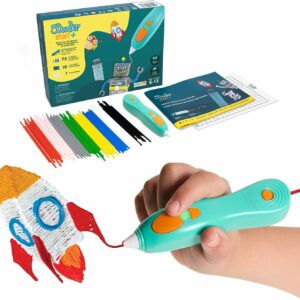
No hot external parts and designed for ages 6 to 13, according to 3Doodler, and no cables across the room. The pen for whole-class sessions in Years 1 to 6.
Years 7 to 9: a hot pen for small groups
A whole Year 7, 8 or 9 class can stay on the Start+, though 3Doodler designs it for ages up to 13. When a small group is ready for harder plastic and finer lines, with an adult at the table, the LIHUACHEN RPC200B is the hot pen we’d pick.
- Heat: ceramic nozzle at 190–210 °C, set automatically
- Age: 7 and over, according to LIHUACHEN
- Controls: one button; warms up in about 60 seconds, according to LIHUACHEN
- In the box: 12 colours of PLA, a finger guard and drawing templates
The P1 has finer control, but SCRIB3D rates it for 14 and over. Who should skip it: any group without an adult at the table, and anyone who needs a cordless pen.
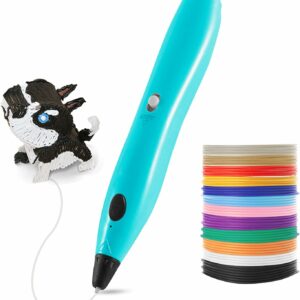
A hot PLA pen its maker rates for 7 and over, with one-button control and automatic temperature. Use it with an adult at the table.
Year 10 and up: SCRIB3D P1 on PLA
From Year 10, when pupils reach the age on SCRIB3D’s product page, the P1 is the pen we’d suggest to most departments. Its stepless speed slider and display give the control a one-button pen lacks, so pupils can slow the flow for upright lines and joins. It is still a hot pen: give every pupil a mat and finger guards, and let your risk assessment set how many draw at once.
- Heat: ceramic nozzle; PLA 160–210 °C; ABS 210–235 °C on SCRIB3D’s Amazon listing, 200–230 °C in its manual
- Age: 14 and over on SCRIB3D’s product page; adult use only in its user manual
- Safety: goes to sleep when left unused: after 2 minutes on SCRIB3D’s Amazon listing, 5 minutes in its manual
- Power: no built-in battery; runs from the supplied 5 V 2 A adapter or, according to the manual, a power bank of at least 2 A
Keep the class on PLA: ABS needs the higher setting and a well-ventilated room. Who should skip it: anyone under 14, and schools that follow the manual’s adult-only line. To see how it compares with pens made for adults, check our ranked list of 3D pens.
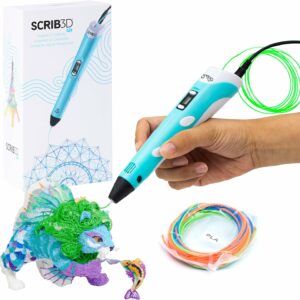
A stepless speed slider, a temperature display and published PLA and ABS ranges: room for older pupils to learn real control, on PLA.
For every hot pen: AQTAQ 3D Pen Starter Kit
A hot pen isn’t ready for class without finger guards and a silicone mat, because hot plastic bonds to wood and plastic. The AQTAQ 3D Pen Starter Kit covers both: a washable mat rated 220–260 °C and finger guards, plus drawing templates. Its PLA won’t fit the Start+.
The pen isn’t included, so plan one kit per hot pen. The templates help Start+ classes too: younger pupils trace a shape flat before trying it freehand.
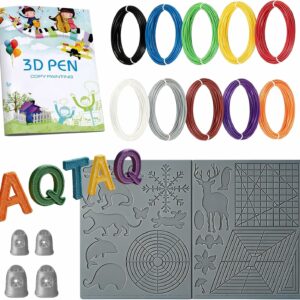
A heat-rated silicone mat, finger guards and drawing templates in one kit. Add one to each hot pen; the pen is sold separately.
Refills for a class set
For the Start+, 3Doodler’s own Start plastic is the sure choice; the Kretrum 32-Colour Refills for 3Doodler Start are a third-party option sold to fit the Start and Start+ only. For 1.75 mm PLA pens, the Yungden 30-Colour PLA Refills hold 30 colours of 3 m each, 90 m in all, at 180–210 °C, a range that suits both our hot pens. For P1s still under warranty, though, buy the SCRIB3D PLA Refills: SCRIB3D’s manual ties the P1’s warranty to SCRIB3D-approved filament. Reseal opened colours to keep them dry.
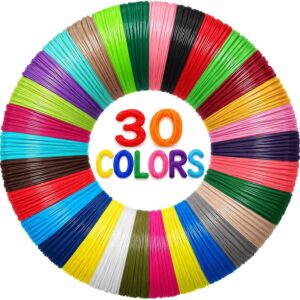
Ninety metres of 1.75 mm PLA in 30 colours, in a temperature range that suits both of our hot-pen picks. For P1s still under warranty, SCRIB3D’s own refills are the safer buy. Not for the Start+.
How to set up a safe 3D pen session
None of the official guidance cited here sets an adult-to-pupil ratio for 3D pens, so we build the session around one rule: under 14, every hot-pen group has an adult at the table; from Year 10, the teacher watches the room and your risk assessment sets the group size. With the Start+, we’d keep your usual staffing.
Before the lesson
- Check each pupil’s age against the maker’s rating for the pen they’ll use.
- Put a silicone mat at every place where a pen will be used.
- Seat mains-powered pens near sockets, with cables away from table edges and walkways.
- Charge the Start+ pens in advance, switched off while they charge.
- Open the windows and set out PLA or Start plastic only.
- Add the pens to your D&T or art risk assessment, and check where your first aider is.
ABS gives off fumes when heated, one more reason to keep classes on PLA or Start plastic. What the fumes contain and how much ventilation helps is covered in our guide to 3D pen fumes.
CLEAPSS’s guide G276 on 3D printing in schools, endorsed by the HSE, advises choosing PLA and avoiding ABS, and working at the lower end of the filament supplier’s melt range. It names people with asthma among those most at risk, so take extra care with pupils who have it. The guide is written for printers, but a pen melts the same plastics. G276 also points schools to CLEAPSS for advice: if your school is a member, ask CLEAPSS about your risk assessment before hot pens go into a scheme of work.
During the lesson
Demonstrate first, under a visualiser if you have one. Then give pupils a routine to repeat every time:
- Fit the finger guards before a hot pen is switched on.
- Hold the pen like a pencil, fingers well back from the tip.
- Draw on the mat, never on the desk, a book or a lap.
- Never touch the tip or a fresh strand, and never point the tip at anyone.
- On “pens down”, lay the pen on the mat with the tip facing away.
With hot pens, we’d work in pairs: one pupil draws while the other plans the next part. If the adult at the table needs to step away, the pens are switched off first.
After the lesson
Leave hot pens on their mats for at least five minutes before anything goes back in a case. Put the Start+ pens back on charge and count pens and guards back in. For house rules you can pin up and what to do if a pupil gets a burn, see our 3D pen safety guide for children.
Lesson ideas for art and design and D&T
A 3D pen fits both subjects. These ideas are linked to the GOV.UK programmes of study, and all of them work with the Start+.
| Idea | Subject and stage | What pupils make | Curriculum link |
|---|---|---|---|
| Lift a drawing off the page | Art and design, KS1 | A flat template shape, then a second piece stood up and joined to it | “drawing, painting and sculpture” |
| Stronger, stiffer towers | D&T, KS1 and KS2 | Two towers of the same height, one from squares and one from triangles | “stronger, stiffer and more stable” |
| Famous buildings as line drawings | Art and design, KS2 | The outline of a well-known building as a free-standing frame | “great artists, architects and designers” |
| Quick prototypes | D&T, KS2 | A small mock-up of a product idea before it’s made in card or wood | “prototypes, pattern pieces” |
| Model to a specification | D&T, KS3 | A small product model, tested and refined | “against a specification” |
Stronger, stiffer towers
Groups build two towers of the same height, one from squares and one from triangles, then press gently on each. Start plastic stays softer than PLA, so press lightly and compare how far each one bends. It covers the key stage 1 aim of making structures stronger, stiffer and more stable, and the key stage 2 step to “strengthen, stiffen and reinforce” more complex ones.
Model to a specification
Pupils write a short specification for a small product, such as a phone stand, draw a 3D model to check size and shape, then test and refine it, as the key stage 3 programme asks. When a model needs printing rather than drawing, choosing a 3D printer for school raises the same questions of hot parts, supervision and ventilation.
What to avoid when equipping a classroom
- Hot pens for a whole primary class. One adult can’t watch a hot nozzle at every desk.
- Going below the maker’s age rating. SCRIB3D rates the P1 for 14 and over, whatever a listing says.
- A class set on two plastics. Start plastic and 1.75 mm PLA don’t swap, and mixed refills end up in the wrong pens.
- ABS in the classroom. Some pens, such as the MYNT3D Super, come with ABS starter filament: keep it out of class and use PLA.
- Drawing straight on desks. Every hot pen gets its own heat-rated mat.
- Pens without refills. The plastic in the box is a taster, not a term’s supply.
Common questions
What age can pupils start using a 3D pen at school?
With a pen that has no hot external parts, from six: 3Doodler designs the Start+ for ages 6 to 13, which covers every pupil from Year 2 to Year 8. Hot pens carry higher ratings, up to 14 and over on SCRIB3D’s product page for the P1, whose manual says adult use only.
How long does a 3Doodler Start+ battery last in a lesson?
3Doodler’s Start+ page says up to 45 minutes of continuous drawing, or 1 to 1.5 hours of stop-start use, and a charge in as little as 30 minutes. Its help centre says about 30–45 minutes per charge, and 45 minutes to 2 hours to charge. The pen can’t be used while charging, so charge the class set before the lesson.
Can pupils use ABS filament in a school 3D pen?
We’d keep classes on PLA or Start plastic. On the SCRIB3D P1, ABS runs hotter than PLA: 210–235 °C on SCRIB3D’s Amazon listing or 200–230 °C in its manual, against 160–210 °C for PLA. ABS also calls for a well-ventilated room.
Do 3D pens fit the art or the D&T curriculum?
Both. The D&T programme asks key stage 1 pupils to model ideas with templates and mock-ups, and key stage 3 pupils to use 3-D modelling, while art and design includes sculpture from key stage 1. A 3D pen is one way to meet those aims, not a requirement.
Sources
- 3Doodler Start+: Our Award-Winning 3D Pen for Kids — 3Doodler
- Start+ battery life, 3D Pen FAQ — 3Doodler
- The national curriculum: overview — GOV.UK
- National curriculum in England: design and technology programmes of study — Department for Education, GOV.UK
- National curriculum in England: art and design programmes of study — Department for Education, GOV.UK
- G276 3D Printing in Schools and Colleges: Managing the Risks — CLEAPSS