
You can draw indoors with a 3D pen if you keep the fumes down: PLA rather than ABS, the lowest temperature that flows, a window open and short sessions with breaks. The fumes are real: studies of 3D pens measured ultrafine particles and volatile organic compounds, far more with ABS and at higher temperatures.
Several peer-reviewed studies have measured what 3D pens themselves put into the air, rather than borrowing figures from 3D printers. Here is what three of them measured, what it means for a living room or a classroom, and the house rules that follow.
What’s in 3D pen fumes?
Two things, both from plastic melting at the nozzle. Ultrafine particles are specks far too small to see: in a chamber study by Kim and Lee, the largest share measured between 30 and 100 nanometres across. Volatile organic compounds (VOCs) are gases released by the hot plastic, and they are the part you notice as a smell.
Each plastic gives off its own mix. Do and colleagues tested nine filaments in two pens and found styrene and benzene from ABS, lactide from PLA, and phenol from PCL, the low-temperature plastic sold for some children’s pens.
Size matters because of where particles end up. Yi and colleagues, writing in Inhalation Toxicology, modelled where the particles would settle in children’s lungs and concluded that particles from toy 3D pens would deposit in the alveoli, the tiny air sacs deep in the lungs. They also detected traces of metals, including manganese and lead, in the emissions.
Are pens better or worse than 3D printers?
Not much better. Do’s team measured particle emission rates comparable to 3D printers and slightly lower total VOCs, and Yi’s toy pens gave yields similar to printers used in workplaces. The difference is distance: with a pen, the nozzle is closer than arm’s length, so Yi’s team expects the source to sit in the child’s breathing zone. If you also run a printer at home, our guide to fumes from desktop 3D printers covers enclosures and placement.
What have the studies measured?
Three patterns stand out: the plastic matters most, heat comes next, and the room decides how much reaches you.
ABS gives off far more than PLA
Every study that compared them put ABS first and PLA well behind, and the two that tested PCL measured the fewest particles from it. Kim and Lee measured two pens in a test chamber; these are their average emission rates, with the VOCs that Do’s team identified for each plastic.
| Filament | Pen A, particles per minute | Pen B, particles per minute | VOCs identified (Do’s study) |
|---|---|---|---|
| ABS | 8.4 million | 1.1 million | Styrene, benzene |
| PLA | 280,000 | 48,000 | Lactide |
| PCL | 14,000 | 20,000 | Phenol |
Do’s team compared their pens with a benchmark: the maximum particle emission rate set for 3D printers, 5 billion particles a minute. Of the filaments they tested, 83 % of the ABS ones went over it and so did 33 % of the PLA ones, although the VOC emission rates stayed below the matching VOC limit. The two studies used different equipment, so compare plastics within a study rather than figures across them. The lesson holds either way: PLA is the better choice, not a fume-free one, and the brand of filament makes a difference. For strength and finish, see how PLA and ABS compare in a pen.
Hotter means more fumes
Temperature is the setting you control. In Yi’s study, raising the nozzle from 210 to 230 °C significantly increased both the particle count and the VOC yield. CLEAPSS, whose 3D printing guidance for schools is endorsed by the Health and Safety Executive, makes the same point for printers and advises working at the lower end of the melt range the filament supplier gives. Yi’s team also found that filament type and colour, nozzle size and extrusion speed affected emissions.
What it adds up to in a room
Yi’s team turned their measurements into room estimates. For one pen in a living room (163 m³, 0.23 air changes an hour), they estimated VOC levels of 6–16 µg/m³ with PLA and 117–154 µg/m³ with ABS. Three children drawing with ABS at once could reach up to 460 µg/m³, and the authors expect higher levels at a child’s face, close to the nozzle.
In their classroom model, one toy added 1–31 µg/m³, while 27 pupils drawing with ABS at the same time gave an estimate of up to 840 µg/m³. That is why a class session needs its own plan, which our guide to using 3D pens with a class covers.
Who should be most careful
None of these sources gives a safe level for a home. They agree on who needs most care. CLEAPSS names people with asthma or breathing difficulties, and those predisposed to asthma, as most at risk. Yi’s team adds that children are more susceptible to chemicals because their lungs, immune and nervous systems are still developing. Burns and age ratings are a separate question, covered in our guide to burns and age ratings for children.
Which pen features reduce the fumes?
Three things help: a temperature you can set, PLA rather than ABS in the box and, for younger children, a low-temperature pen.
A published, adjustable temperature
You can only use the lowest working temperature if the pen lets you set it. The SCRIB3D P1 has a temperature display and a stepless speed slider, and SCRIB3D gives 160–210 °C for PLA. For ABS its Amazon listing says 210–235 °C and its user manual 200–230 °C. It comes with three colours of PLA, not ABS, and it goes to sleep when left idle: after 2 minutes according to the listing, 5 minutes according to the manual. SCRIB3D rates it for ages 14 and up. Start PLA at the bottom of the range and raise it in small steps only until the plastic flows smoothly.
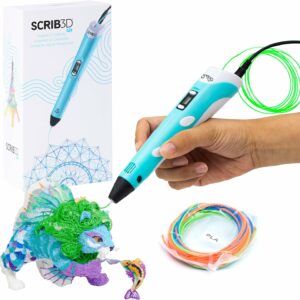
A published PLA range that starts at 160 °C and a display to check it, so it is easy to draw at the low end of the range in a ventilated room.
PLA in the box, not ABS
Check what comes with the pen. The MYNT3D Super takes PLA as well as ABS, but its starter filament is ABS, so swap to PLA for sessions indoors. When you buy refills, pick PLA with a published printing temperature: the SCRIB3D PLA Refills list 160–210 °C and the Yungden 30-Colour PLA Refills 180–210 °C. For a P1 still under warranty, stay with SCRIB3D’s own: its manual ties the warranty to SCRIB3D-approved filament. Our guide with PLA, ABS and PCL explained covers which pens take which plastic, and our ranked list of 3D pens helps if you are still choosing one.
A low-temperature pen for younger children
3Doodler says the 3Doodler Start+ runs at a low temperature with no hot external parts, and describes its plastic as non-toxic, BPA-free and compostable. It takes only 3Doodler Start plastic, not standard PLA or ABS, and 3Doodler UK says it is designed for ages 6 to 13. 3Doodler doesn’t name the polymer or publish emission figures. PCL, the low-temperature plastic in the studies, gave the fewest particles, yet Do’s team still detected phenol from it, so the same rules apply: window open, short sessions.
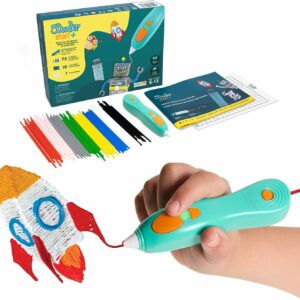
A low-temperature pen with no hot external parts, according to 3Doodler, designed for ages 6 to 13 according to 3Doodler UK, and rechargeable with the charging cable in the box.
House rules for drawing indoors
These follow from the studies and from CLEAPSS’s school guidance.
- PLA by default. CLEAPSS’s advice for schools is to choose PLA and avoid ABS. Keep ABS for projects that need it, drawn by an adult, by an open window, with nobody else at the table.
- The lowest temperature that flows. Start at the bottom of the filament’s published range and go up in small steps.
- A window open. Draw in a well-ventilated room, and avoid several pens running at once in a small or stuffy one.
- Head up. Sit upright rather than leaning over the nozzle: Yi’s team expects a pen’s emissions to reach the breathing zone of the person drawing.
- No partitions round the desk. In Kim and Lee’s study, three-sided desk partitions raised particle levels: with ABS in one pen, more than eight times higher than without.
- Short sessions and real breaks for children. Stop, step away from the table and let the room air between sessions. Do’s team singles out long use, closeness to the breathing zone and children.
- Filament from a supplier with a safety data sheet. CLEAPSS treats this as a good sign, and suggests storing filament sealed, dry and dark.
- A burning smell means stop. Lower the temperature; if it continues, unplug the pen, let it cool and clean the nozzle as the manual describes.
If anyone in the room has asthma or breathing difficulties, draw with PLA only, at the low end of its range, with a window open, and stop at the first cough or wheeze. Never use ABS in a closed room with children.
What to do if someone feels unwell
Stop drawing, switch the pen off, open the windows and take the person out of the room into fresh air. If symptoms don’t settle, get medical advice; NHS 111 can help if you’re unsure where to go.
For someone with asthma who starts to struggle to breathe, the NHS advice is to sit up straight, try to stay calm and use their reliever inhaler. Call 999 if they get worse at any point, don’t feel better after the maximum dose of their reliever, or don’t have an inhaler with them. Once they’ve recovered, the NHS advises an urgent GP appointment within 2 days.
Before the next session, change something: PLA only, a lower temperature, more ventilation or shorter sessions.
Common questions
Are 3D pen fumes toxic?
The studies measured styrene and benzene from ABS and ultrafine particles from every plastic tested, and their authors advise caution, especially for children close to the nozzle. None sets a safe level for a home. The practical aim is to keep exposure low with PLA, a low temperature and fresh air.
Does PLA give off fumes in a 3D pen?
Yes, but far less than ABS. In Kim and Lee’s chamber study, PLA released roughly 20 to 30 times fewer particles per minute than ABS in the same pens, and its main VOC in Do’s study was lactide. Use it in a ventilated room at the low end of its range.
Do I need a mask or an air purifier for a 3D pen?
None of the studies tested masks or purifiers with 3D pens, so there are no figures to go on. The research supports cutting emissions at the source instead: PLA rather than ABS, the lowest working temperature and an open window.
Why does my 3D pen smell of burning plastic?
A burning smell is a sign that plastic is overheating, for example because the temperature is set too high for the filament or old plastic has charred in the nozzle. Lower the temperature first. If the smell continues, unplug the pen, let it cool and clean the nozzle as the manual describes.
Can I use a 3D pen in a bedroom?
Yes, if you can open the window, but not at bedtime. Use PLA, finish well before anyone goes to sleep and let the room air afterwards. Keep ABS out of bedrooms altogether.
Sources
- Particle and organic vapor emissions from children’s 3-D pen and 3-D printer toys — Inhalation Toxicology, via PubMed Central
- Evaluation of particle and volatile organic compound emissions during the use of 3D pens — Science of the Total Environment (abstract record), via Europe PMC
- Characteristics of ultrafine particles emitted from 3D-pens and effect of partition on children’s exposure during 3D-pen operation — Indoor Air (abstract record), via Europe PMC
- G276 3D Printing in Schools and Colleges: Managing the Risks — CLEAPSS, with the Health and Safety Executive
- 3Doodler Start+ — 3Doodler
- Asthma attack — NHS