

Glow-in-the-dark 3D pen filament is plastic mixed with a phosphorescent pigment: it soaks up light, then glows on its own in the dark. Match it to your pen: 2.5 mm low-temperature strands for a 3Doodler Start or Start+, 1.75 mm glow PLA for standard pens. The pigment is abrasive, so keep it for details.
Glow is one of five special effects covered here, alongside transparent, fluorescent, metallic and wood-fill. Below: what each looks like, what its makers advise, which pens take it and which packs we list include it. For the base plastics themselves, see PLA, ABS and PCL explained.
Special-effect filaments at a glance
| Effect | What you see | What it needs | Packs we list |
|---|---|---|---|
| Glow-in-the-dark | A normal colour by day; glows after time in light | Light to charge it; abrasive, so use it for details | Kretrum 32-Colour Refills for 3Doodler Start (2.5 mm) |
| Transparent | Frosted lines that let light through | The pack’s usual settings | Yungden 30-Colour PLA Refills, 3Dmate PLA Refill Kit |
| Fluorescent | Vivid neon shades; no afterglow | The pack’s usual settings | Yungden 30-Colour PLA Refills, 3Dmate PLA Refill Kit |
| Metallic | A metal-like sheen | Metallic-look: no hardened nozzle. Metal-filled: a hardened nozzle | 3Dmate PLA Refill Kit |
| Wood-fill | A wood-like finish you can sand and stain | A pen that lists wood-fill; regular cleaning | None; the 3Doodler Flow takes it |
How does glow-in-the-dark filament work?
It stores light and gives it back slowly. SUNLU describes its glow PLA as containing phosphorescent additives that absorb light and then glow in darkness. Prusa names the pigment in its own glow filament: strontium aluminate.
That slow release is what separates glow from fluorescent colours. Florida State University’s microscopy primer explains that fluorescence gives absorbed light back after a brief interval, while phosphorescence has a much longer excited state. Fluorescent strands look bright only while lit; glow strands keep going in the dark.
For its PETG Ultraglow, Prusa says the glow is strong for several minutes and then fades: most of the noticeable glow comes in the first 1.5 hours, and in total darkness a weak glow can still be seen 6–8 hours after charging. Those are one maker’s figures for its own filament, not a promise for a refill pack. Check the glow colour, too: SUNLU sells one white glow PLA that glows green and another that glows blue.
Is glow filament abrasive? What its makers advise
Yes. Prusa calls strontium aluminate the hardest material it has ever used. Its advice: use a hardened nozzle, because the filament will destroy a brass one in no time, and prefer 0.6 mm to 0.4 mm to avoid clogs. Even hardened parts wear faster: occasional printing won’t be an issue, Prusa says, but regular high-volume use shortens their life.
Bambu Lab says the same of its PLA Glow and other particle-filled filaments: always a hardened steel nozzle, never stainless steel or brass, never 0.2 mm. It also warns that glow filaments can grind down the feed tubes inside its AMS units. SUNLU’s glow PLA page gives no nozzle advice.
No pen maker we list publishes advice on glow filament, and none calls its nozzle hardened: the SCRIB3D P1 and the LIHUACHEN RPC200B 3D Pen (Button Version) have ceramic nozzles, and the others don’t say. So our rule: glow for eyes, stars and outlines, not solid fills, then back to plain filament.
Transparent, fluorescent, metallic and wood-fill: what to expect
Transparent
Transparent strands let light through, which suits suncatchers, lantern panels, ice and water. Expect frosted rather than glass-clear: SUNLU notes that the layered structure of printed plastic reduces full transparency. Transparent and glow strands both suit the snowflakes and baubles in our 3D pen Christmas decorations.
Fluorescent
These are the neon shades in a pack. Fluorescence stops when the light does, so they don’t glow in the dark. The packs we list don’t say how they react under a UV torch, so if a blacklight effect is the point, try one strand first.
Metallic and sparkle
Two things share the word metallic. Metallic-look filament can simply be PLA with a sheen: SUNLU describes silk PLA as having a metallic-like glossy finish, and Bambu Lab counts its PLA Metal and PLA Silk as standard PLA that needs no hardened nozzle. Metal-filled filament contains real metal powder: Prusa calls it highly abrasive and says it needs a hardened steel nozzle. Bambu Lab wants a hardened steel nozzle for its PLA Sparkle too.
The 3Dmate PLA Refill Kit includes metallic shades, but its listing doesn’t say what gives the effect. Our rule: if a listing says metal-filled or names a metal powder, keep it for a printer with a hardened nozzle. Metallic and transparent strands also suit 3D pen jewellery projects.
Wood-fill
Wood-fill is PLA with wood powder in it, so you can sand, stain or paint the result, according to SUNLU. Prusa notes the trade-off: wood- and metal-filled filaments usually have weaker layer adhesion, so thin details snap more easily, and the particles raise the risk of a clog.
Of the pens we list, only the 3Doodler Flow names wood-fill among its filaments, alongside 1.75 mm PLA and ABS. Clean the nozzle after each wood-fill session.
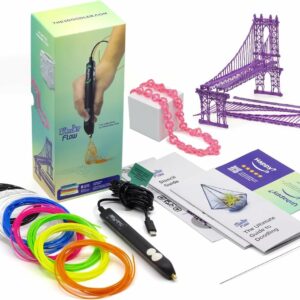
The only pen we list whose maker names wood-fill among its filaments, with a screen that shows the live nozzle temperature.
Which pens and printers take effect filaments?
Check diameter first. The SCRIB3D P1, MYNT3D Super, LIHUACHEN RPC200B and 3Doodler Flow take 1.75 mm filament; the 3Doodler Start+ takes only 3Doodler Start plastic or a compatible 2.5 mm pack. Then check temperature against the published figures below (Bambu Lab’s are given to within ±10 °C).
| Filament (maker) | Nozzle temperature | Hardened nozzle | Other advice |
|---|---|---|---|
| Glow-in-the-dark PLA (SUNLU) | 200–210 °C at 50–100 mm/s | Not stated | Two white versions: one glows green, one blue |
| PLA Glow (Bambu Lab) | 210–240 °C | Required | No 0.2 mm nozzle; AMS lite not recommended |
| PLA Wood (Bambu Lab) | 190–240 °C | Not required | No 0.2 mm nozzle; AMS lite not recommended |
| PLA Metal (Bambu Lab) | 190–230 °C | Not required | Treated as standard PLA |
| Yungden 30-Colour PLA Refills | 180–210 °C | Not stated | 2 transparent and 4 fluorescent colours |
The decision rule: the filament’s range has to meet your pen’s. The SCRIB3D P1 runs PLA at 160–210 °C and the LIHUACHEN RPC200B sets itself to 190–210 °C, so SUNLU’s 200–210 °C glow PLA falls inside both, while Bambu Lab’s 210–240 °C starts where they stop. The 3Doodler Flow runs at 160–220 °C, according to 3Doodler, so SUNLU’s glow PLA fits too; the MYNT3D Super doesn’t publish a range, so check its manual first.
There’s no 1.75 mm glow pack on our shelf, so glow for a standard pen usually comes off a printer spool. Our guide to using printer filament in a pen covers cutting and feeding it.
On a printer, follow the filament maker’s nozzle advice. The Elegoo Centauri Carbon comes with a hardened steel nozzle for carbon- and glass-fibre filaments. The Bambu Lab A1 mini comes with a 0.4 mm stainless steel nozzle, a type Bambu Lab rules out for PLA Glow. On the A1 Combo, Bambu Lab does not recommend feeding PLA Glow through the AMS lite.
Which refill packs include glow and other effects?
Glow for 3Doodler Start pens
The Kretrum 32-Colour Refills for 3Doodler Start are the only pack we list with glow-in-the-dark strands: low-temperature PCL, about 2.5 mm across, in 15 cm strands and a resealable pack, sold for the Start and Start+ only. They won’t fit a 1.75 mm pen. The listing says nothing about wear, so keep glow for details here too. It’s a third-party refill: if you’re unsure it suits your pen, 3Doodler’s own Start plastic is the default choice.
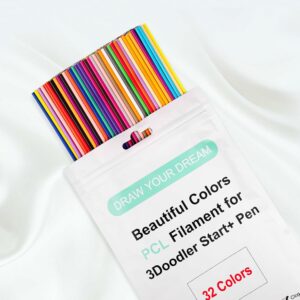
Thirty-two colours of low-temperature strands, glow-in-the-dark included, for younger artists with a Start or Start+ pen.
Transparent and fluorescent for 1.75 mm pens
The Yungden 30-Colour PLA Refills hold 30 colours of 1.75 mm PLA in 3 m lengths: 24 standard, 2 transparent and 4 fluorescent, at 180–210 °C. That overlaps the SCRIB3D P1 and LIHUACHEN RPC200B settings. Three metres per colour suits outlines and accents rather than large fills, and the pack doesn’t fit PCL pens or the 3Doodler Start.
The widest mix of effects
The 3Dmate kit holds about 110 m of 1.75 mm PLA in standard, transparent, metallic and fluorescent shades, with a silicone mat, a stencil book and four finger guards; the pen isn’t included. To compare more packs, browse our filament refill packs.
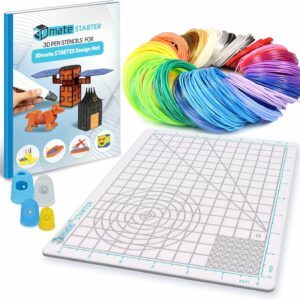
Transparent, metallic and fluorescent PLA in one kit, plus the silicone mat that keeps hot filament off your table.
How to get good results with effect filaments
- Charge glow pieces under strong light. Prusa names UV light as the best way to charge strontium aluminate. Daylight or a strong LED works more slowly; warm, weak bulbs will most likely not give the effect you want.
- Put glow where it counts. Eyes, stars and outlines give the effect with less abrasive filament through the nozzle. Glowing spider eyes suit Halloween 3D pen projects.
- Clear the old colour. When you switch strands, keep feeding until the previous colour has run out, so it doesn’t streak the next drawing.
- Sand wood-fill with care. Support thin parts with your fingers while you sand, since filled filaments snap more easily than plain PLA, then stain or paint.
Storage and safety
Keep packs sealed and dry. SUNLU advises a sealed bag or dry box, with desiccant packs strongly recommended for PLA, in a cool, dry place away from direct sunlight. Damp filament can bubble or pop, string more and sometimes clog. SUNLU also says to store PCL, the plastic in low-temperature strands such as the Kretrum pack, in a sealed container with desiccant. For printer spools, it lists drying wood PLA as a must, at 55–65 °C for 6–8 hours.
Follow your pen maker’s age rating. We’d also keep a hot pen for children of ten and up, with an adult beside them; under ten, choose a pen with no external hot parts, as 3Doodler says of its Start+. ABS needs a well-ventilated room, and the nozzle should cool before you pack the pen away.
Common questions
How long does glow-in-the-dark filament glow?
It depends on the filament and the charge. For its PETG Ultraglow, Prusa says most of the noticeable glow comes in the first 1.5 hours, with a weak glow still visible 6–8 hours after charging in total darkness. Pen refill packs don’t publish a figure.
Can I use glow-in-the-dark filament in any 3D pen?
Only if it matches your pen’s diameter and temperature: 2.5 mm low-temperature strands for Start and Start+ pens, 1.75 mm glow PLA within the PLA range of a standard pen. The pigment is abrasive and no pen maker we list publishes advice on it, so keep glow for details.
Does fluorescent filament glow in the dark?
No. Fluorescent pigments give back the light they absorb after only a brief interval, so the effect stops when the light does. For a glow after lights-out, you need phosphorescent filament.
Why is glow-in-the-dark filament white?
Some glow filaments have a pale base colour in daylight. SUNLU, for example, sells a white glow PLA that glows green and another that glows blue, so check which glow colour the listing names.
Sources
- Prusament PETG Ultraglow troubleshooting — Prusa Knowledge Base
- Composite materials (with metal or wood particles) — Prusa Knowledge Base
- Filament guide: printer, nozzle, AMS, build plate, glue compatibility and required parameters — Bambu Lab Wiki
- Luminous Glow in the Dark Filament, PLA — SUNLU
- Filament Usage Guide — SUNLU
- Basic Concepts in Fluorescence — Molecular Expressions, Florida State University