
You need a hardened steel nozzle only if you print abrasive filament: carbon- or glass-fibre blends, glow-in-the-dark, metal-fills and some other particle-filled filaments. These wear brass and stainless steel nozzles quickly. For PLA, PETG and TPU, the nozzle your printer came with is all you need. Before upgrading, check your printer’s maximum temperature and buy the nozzle its maker sells.
A hardened steel nozzle is a wear upgrade, not a quality upgrade. The makers’ own guides say which filaments need one; five questions further down settle whether you do.
Which filaments wear out a brass or stainless nozzle?
Filaments with hard particles mixed into the plastic. Prusa describes most abrasive filaments as composites, plastics with something mixed in, and names filaments with carbon, metal-filled filaments such as bronze-fill, and some glow-in-the-dark filaments. E3D adds wood, glitter and metal fills, and says even glow-in-the-dark filament will abrade brass.
Bambu Lab’s filament guide is the most useful reference, because it states, filament by filament, whether a hardened steel nozzle is necessary:
| Filament | Hardened steel nozzle | Nozzle temperature (±10 °C) | Also noted by Bambu Lab |
|---|---|---|---|
| PLA | Not required | 190–240 °C | Works in every nozzle size, 0.2 mm included |
| PETG | Not required | 240–270 °C | Open-frame or enclosed; an enclosure helps in a cold room, which can weaken layers |
| TPU | Not required | 200–250 °C | 0.2 mm not recommended |
| PLA Wood | Not required | 190–240 °C | Not with a 0.2 mm nozzle; not recommended for the AMS lite |
| PLA Glow | Required | 210–240 °C | Not with a 0.2 mm nozzle; not recommended for AMS feeders |
| PLA-CF and PLA-GF | Required | 210–240 °C | Not with a 0.2 mm nozzle |
| PETG-CF | Required | 240–270 °C | Not recommended for the AMS lite |
| PA-CF and PA-GF (nylon) | Required | 260–300 °C | Needs an enclosed printer |
One inconsistency is worth knowing about. The table marks PLA Marble as not needing hardened steel, but the notes underneath list marble and sparkle PLA with the particle-filled filaments that should always go through a hardened steel nozzle. We’d follow the notes.
Wood-fill is the real grey area. E3D lists wood fills as abrasive, and Bambu Lab’s nozzle page puts wood among the filaments hardened steel is made for, yet its filament table says its own PLA Wood doesn’t need it. Prusa’s advice settles it: when you’re unsure, ask the filament’s maker. Our guide to getting good results from wood-fill covers the settings that matter more than the nozzle.
Names can mislead with metal finishes too. Bambu Lab classes its PLA Metal as standard PLA without metal fillers, so it doesn’t need hardened steel, while true metal-filled filaments such as bronze-fill are on Prusa’s and E3D’s abrasive lists. Read the spool label. Carbon- and glass-fibre blends are the clearest case: Bambu Lab marks every one in its table as needing hardened steel, and we cover what you need to print carbon-fibre in its own guide.
What actually matters when you choose a nozzle material
Hardness: the reason to upgrade
Hardness decides how long a nozzle survives abrasive filament. Prusa says a regular brass nozzle will degrade quickly and lose its properties when printing it. Bambu Lab is blunter: stainless steel and brass aren’t hard enough, so they wear out quickly, which affects both print quality and the life of the nozzle.
Stainless steel isn’t a halfway house. Bambu Lab, which fits it as standard on its A-series printers, lists its strengths as heat and corrosion resistance and good value, and recommends it for filaments with no fibres or particles. Hardened steel is harder, with what Bambu Lab calls superior wear resistance. On Bambu Lab hotends you can tell them apart at a glance: black fins for hardened steel, grey for stainless.
Hardened steel still wears, only more slowly: for some of its other printers Bambu Lab sells tungsten carbide nozzles, which it says show significantly less wear than hardened steel. Treat a hardened nozzle as long-lasting, not permanent.
Heat transfer: why brass is still the default
Brass moves heat well. Prusa, whose printers ship with brass nozzles, calls its heat conductivity excellent and says it’s tough enough for most common filaments. Hardened steel has different thermal properties, and Prusa’s guidance spells out two practical costs: you may need to raise the hotend temperature by about 5 °C, and some standard materials, ABS for one, can’t be printed as fast as with a regular nozzle.
That’s why we wouldn’t swap a nozzle that prints PLA, PETG and TPU well. The upgrade buys wear resistance you won’t use and costs a little of the heat transfer you will.
Some nozzles split the difference. Elegoo’s nozzle for its Centauri series has a brass body for fast, even heating and a hardened steel tip for wear resistance, according to Elegoo. Prusa describes ruby-tipped brass nozzles built on the same idea, but warns that the gemstone is brittle.
Your printer’s maximum nozzle temperature
The nozzle rarely sets the limit; the printer does. Fibre-filled PLA and PETG print at 210–270 °C in Bambu Lab’s table, which every filament printer we list can reach. Nylon-based fibre filaments are different: Bambu Lab gives 260–300 °C, give or take 10 °C, and asks for an enclosed printer.
Compare that with the published maximums: 280 °C for the Flashforge Adventurer 5M, 300 °C for the Bambu Lab A1 mini and Bambu Lab A1 Combo, and 320 °C for the Elegoo Centauri Carbon. Elegoo lists PA (nylon) and PC among the Centauri Carbon’s supported filaments, and its 320 °C nozzle covers Bambu Lab’s 260–300 °C range for nylon-based fibre filaments. A new nozzle doesn’t raise that ceiling: Bambu Lab rates its A-series nozzles, hardened or stainless, to 300 °C, the same as the printers they fit.
A nozzle your printer’s maker sells for it
Nozzles aren’t interchangeable between hotends. Bambu Lab’s A-series nozzle fits the A1 and A1 mini, comes in hardened or stainless steel, and swaps without tools; the printers ship with a 0.4 mm stainless nozzle, with hardened steel as an optional upgrade. Elegoo lists its own brass-and-hardened-steel nozzle kit for the Centauri series. Buying the maker’s part is the simplest way to know the fit and the temperature rating match your hotend.
Nozzle size: 0.4 mm or larger for particles
Particles also clog small nozzles. Bambu Lab rules out 0.2 mm for every fibre- or particle-filled filament, because the clogging risk is extremely high. Its first choice for these filaments is a 0.6 mm hardened steel nozzle, with 0.4 mm second when you want more detail; for its own fibre-filled, marble, sparkle and glow filaments it recommends 0.4 mm. Our guide to choosing the right nozzle size covers what each size changes in detail, speed and strength.
The rest of the filament path
The nozzle isn’t the only part that wears: Bambu Lab says the nozzle and extruder gears need more frequent maintenance with these filaments, and that rough materials such as carbon-fibre or glow filaments can grind down the PTFE tubes inside its AMS feeders over time. It doesn’t recommend PETG-CF or PLA Wood for the AMS lite, the feeder used with the A1 and A1 mini. If you planned to print abrasive filament from a multicolour feeder, that can be a bigger limit than the nozzle.
Do you need to upgrade? Five questions in order
Answer these in order and stop when one settles it:
- Do you only print plain PLA, PETG, TPU, ABS or ASA? Keep the brass or stainless nozzle you have. Bambu Lab lists all five as not requiring hardened steel.
- Does the spool say carbon fibre, glass fibre or glow-in-the-dark, or ask for a hardened nozzle? Upgrade before the first print.
- Is it wood, marble, sparkle or metal-filled? Check the label or ask the maker. If it’s described as abrasive or asks for hardened steel, treat it like fibre.
- Can your printer reach the filament’s temperature, and does the filament need an enclosure? If not, a nozzle won’t fix it: the printer is the upgrade.
- Does your printer’s maker sell a hardened steel nozzle for its hotend? If yes, buy that one in 0.4 or 0.6 mm. If not, a printer that ships with hardened steel is the simpler route.
If you switch between abrasive and everyday filament often, leaving the hardened nozzle fitted saves repeated swaps. Expect to add a few degrees to your usual temperatures: about 5 °C, by Prusa’s figure.
Our picks by reader profile
One pick per kind of maker: two printers that differ in what comes fitted, then what to buy if you keep the nozzle you have or fit a hardened one.
Fibre-filled filament from day one: Elegoo Centauri Carbon
If abrasive filament is the reason you’re buying a printer, start with one that has hardened steel fitted. The Elegoo Centauri Carbon has Elegoo’s brass-and-hardened-steel nozzle as standard, rated to 320 °C, inside an enclosed CoreXY frame. Elegoo lists carbon- and glass-fibre reinforced filaments alongside PLA, PETG, ABS, ASA, TPU, PET, PC and PA, and it has the enclosure Bambu Lab’s guide asks for with nylon-, ABS- and ASA-based fibre filaments. It prints at up to 500 mm/s on a 256 × 256 × 256 mm build volume and arrives assembled and calibrated.
Skip it if you want multicolour prints: this model prints one colour at a time. It weighs 17.5 kg, so it needs a sturdy surface. If you’re weighing it against an open-frame printer, our Centauri Carbon and A1 comparison sets the enclosure against multicolour printing.
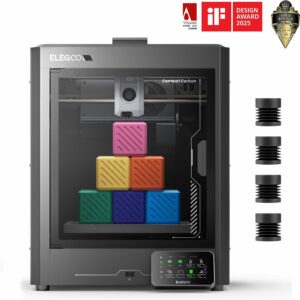
Hardened steel fitted from the start, a 320 °C nozzle and an enclosure: nothing to upgrade before your first fibre-filled spool.
Mostly PLA now, glow or fibre later: Bambu Lab A1 mini
If abrasive filament is only a maybe, buy for everyday printing and keep the upgrade for later. The Bambu Lab A1 mini ships with a 0.4 mm stainless steel nozzle for PLA, PETG and TPU, and Bambu Lab sells its A-series nozzle in hardened steel to fit it. Bambu Lab says the nozzle comes out without tools in a few minutes. At 300 °C, the A1 mini covers the PLA- and PETG-based fibre filaments in Bambu Lab’s table, and it calibrates itself.
Skip it if you want nylon-, ABS- or ASA-based fibre filaments, for which Bambu Lab’s guide recommends an enclosed printer. At 180 × 180 × 180 mm, its build volume is also the smallest of the printers we list. If you add the AMS lite, check Bambu Lab’s list before you load an abrasive spool into it.
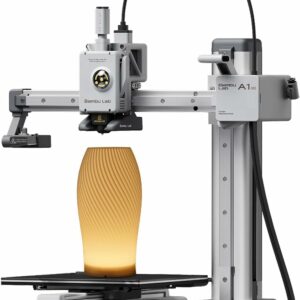
Stainless steel for everyday PLA, PETG and TPU, with a tool-free swap to Bambu Lab’s hardened steel nozzle when a glow or fibre spool arrives.
Tough parts without abrasives: SUNLU PETG Filament
Fibre-filled filament isn’t the only route to sturdier parts. If you mainly want parts that cope with knocks and warmth, plain PETG runs through the nozzle you already have: Bambu Lab’s guide says it doesn’t need hardened steel. The SUNLU PETG Filament has a heat deflection temperature of 70 ± 5 °C, against 55 ± 5 °C for SUNLU’s PLA, and SUNLU publishes a tensile strength of 48 ± 10 MPa. It prints at 240–260 °C, within the maximum of every filament printer we list.
Skip it if your project specifically calls for a fibre-reinforced filament: that’s when the hardened nozzle earns its place.
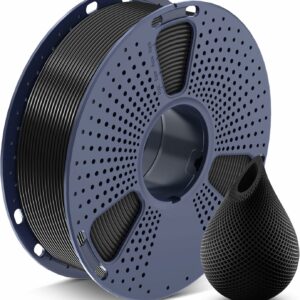
Tougher and more heat-resistant than PLA, and Bambu Lab’s filament guide lists PETG as not needing a hardened nozzle.
Keeping a hardened nozzle clear: Creality 3D Printer Tool Kit Pro
Abrasive filament brings more maintenance, not less. Bambu Lab advises cleaning the inside of the nozzle with an Allen key and a needle before you start on fibre- or particle-filled filament, and again if it clogs. The Creality 3D Printer Tool Kit Pro includes ten 0.38 mm needles, a 1.5 mm needle, an L-shaped hex key and a metal brush.
Skip it if you already own nozzle needles and a hex key. The 0.38 mm needles suit 0.4 mm nozzles and larger; use them to clear, not to force, as your printer’s manual describes.
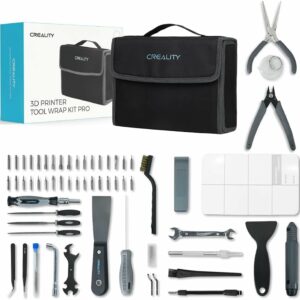
Ten 0.38 mm nozzle needles, a hex key and a metal brush in one case, with spatulas and finishing tools for the prints themselves.
After the swap: what changes in your settings
Most of the work is telling the printer what’s fitted. The order below follows Bambu Lab’s guidance for the A1 mini; on the Centauri Carbon, follow Elegoo’s manual for the swap itself.
- Turn the printer off, disconnect it from the mains and let the nozzle cool completely before you touch it.
- Fit the new nozzle as the maker’s guide shows, then refit the silicone sock. Bambu Lab says that without it the part-cooling fan cools the nozzle and makes its temperature fluctuate.
- Update the nozzle diameter and material on the printer: Settings, then Maintenance, then Nozzle. Recent versions of Bambu Studio only display this setting, so the printer is the place to change it.
- Before the first abrasive spool, clean the inside of the nozzle. Bambu Lab’s method is to heat it to 280 °C and clear it with a hex key and a needle.
- Start inside the range on the filament label and raise the temperature a few degrees if extrusion looks weak. Prusa’s figure for hardened steel is about 5 °C.
- For fibre-filled filament through a 0.4 mm hardened nozzle, Bambu Lab suggests layer heights of 0.15–0.3 mm and speeds up to about 100 mm/s.
What to avoid
- Fibre or glow filament through a stainless or brass nozzle. Bambu Lab says both wear out quickly, and print quality suffers.
- Abrasive filament through a 0.2 mm nozzle. Bambu Lab calls the clogging risk extremely high. Use 0.4 or 0.6 mm.
- Assuming stainless means hardened. The A1 mini’s standard stainless nozzle is for filaments with no fibres or particles.
- Forgetting the feeder. Rough filaments wear the PTFE tubes in multicolour feeders. Check the maker’s list before loading them.
Common questions
Can I print normal PLA with a hardened steel nozzle?
Yes. Prusa notes that hardened steel has different thermal properties from brass, so you may need to raise the temperature by about 5 °C, and some materials such as ABS can’t be printed quite as fast.
Is a stainless steel nozzle good enough for carbon-fibre filament?
No. Bambu Lab says stainless steel and brass nozzles aren’t hard enough for fibre- or particle-filled filaments and wear out quickly. The A1 mini ships with a stainless nozzle, so fit Bambu Lab’s hardened steel A-series nozzle before your first fibre-filled spool.
Is glow-in-the-dark filament abrasive?
Usually, yes. E3D says even glow-in-the-dark filament will abrade brass, and Bambu Lab lists a hardened steel nozzle as required for its PLA Glow. Bambu Lab also advises against loading glow filament into its AMS feeders, because rough filaments can wear their internal tubes.
How often should a hardened steel nozzle be replaced?
There’s no fixed interval in the makers’ guidance. Bambu Lab gives clogging and damage as the reasons to replace an A1 hotend, and says nozzles and extruder gears need more frequent maintenance with abrasive filaments. Hardened steel wears more slowly than brass or stainless steel, but it does wear.
Sources
- Filament guide – Printer, Nozzle, AMS, Build Plate, Glue Compatibility and Required Parameters — Bambu Lab Wiki
- Introduction to Bambu Nozzles — Bambu Lab Wiki
- Hotend Replacement for A1 Series — Bambu Lab Wiki
- E3D V6 Nozzles — Prusa Knowledge Base
- E3D V6 Hardened Steel 1.75mm Nozzle — E3D
- 0.4 mm Brass Hardened Steel Nozzle Kit for Centauri Series — Elegoo