
Choose the Elegoo Centauri Carbon if you want to print ABS, ASA, nylon or carbon-fibre filament: it is enclosed, with a 320 °C hardened-steel nozzle and a 110 °C bed. Choose the Bambu Lab A1 Combo if PLA, PETG and TPU cover what you make and you want up to four colours in one print.
On paper these two look like twins: the same 256 × 256 × 256 mm volume, the same 500 mm/s top speed, and both calibrate themselves. Underneath, the Centauri Carbon shuts the print inside a box to handle warp-prone engineering plastics, while the A1 Combo leaves it in the open and adds a feeder that switches between four spools. As sold, neither does both, so the question is which you’ll use more.
Centauri Carbon vs A1: the specs side by side
The figures below come from Elegoo’s product page for the Centauri Carbon and Bambu Lab’s technical specification for the A1.
| Specification | Elegoo Centauri Carbon | Bambu Lab A1 Combo |
|---|---|---|
| Frame | Enclosed CoreXY, die-cast aluminium, tempered glass door and top cover | Open frame, moving bed, steel and extruded aluminium chassis |
| Build volume | 256 × 256 × 256 mm | 256 × 256 × 256 mm |
| Max speed and acceleration | 500 mm/s (250 mm/s recommended), 20,000 mm/s² | 500 mm/s, 10,000 mm/s² |
| Nozzle supplied | 0.4 mm brass-hardened steel, up to 320 °C | 0.4 mm stainless steel, up to 300 °C |
| Max bed temperature | 110 °C (at 25 °C room temperature) | 100 °C |
| Filaments the maker lists | PLA, PETG, TPU, ABS, ASA, PET, PC, PA, carbon- and glass-fibre filled | Ideal: PLA, PETG, TPU, PVA. Not recommended: ABS, ASA, PC, PA, PET, carbon- and glass-fibre filled |
| Multicolour | One colour at a time; Elegoo sells a separate 4-colour add-on, CANVAS | Up to 4 colours with the included AMS lite |
| Camera | Chamber camera with LED strips, time-lapse | Low-rate camera up to 1080p, time-lapse |
| Printer dimensions | 398 × 404 × 490 mm | 385 × 410 × 430 mm (printer only) |
| Net weight | 17.5 kg | 8.3 kg (printer only) |
| Power | Rated 1100 W at 220 V | Max 1300 W at 220 V |
| Slicer | ElegooSlicer recommended; OrcaSlicer and Cura supported | Bambu Studio; other slicers work, but some advanced features may not |
Same volume, same headline speed, and both have a filament run-out sensor and power-loss recovery. The rows that settle it are the frame, the nozzle, the bed temperature, the two filament lists and the AMS lite. Both accept 100–240 V AC, so either runs from an ordinary UK socket, or from any household supply within that range.
Where the Centauri Carbon wins
ABS and ASA without fighting the room
ABS and ASA shrink as they cool, and Prusa puts their warping down to the temperature difference between the model and its surroundings. Its material guides say the printer should sit inside an enclosure to keep a higher ambient temperature, with no draught around the print. For ASA, Prusa recommends a 105 °C bed for the first layer and 110 °C after that.
That is where the two part company. The Centauri Carbon’s bed reaches 110 °C and its glass door and top cover keep the heat in. The A1’s bed stops at 100 °C, there’s no box, and Bambu Lab rates ABS, ASA, PC and PA as not recommended on it. No setting changes that.
The payoff is in what those plastics do. Prusa describes ABS as heat-resistant and ASA as UV-resistant and suited to outdoor use, so car interior clips, garden fittings and parts near a radiator become realistic.
Carbon- and glass-fibre filaments
Fibre-filled filaments add strength and heat resistance, but they wear nozzles. Prusa calls carbon, glass and Kevlar fibres highly abrasive and says a hardened nozzle is necessary. The Centauri Carbon ships with a brass-hardened steel nozzle rated to 320 °C, and Elegoo pitches it at carbon-fibre filament. The A1 ships with a stainless steel nozzle, and Bambu Lab lists carbon- and glass-fibre filaments as not recommended. Abrasive filament is the main reason a hardened steel nozzle earns its place.
Fibres aren’t a free upgrade. Prusa notes they lower impact resistance and layer-to-layer adhesion, so they suit brackets and jigs, not parts that need to flex or survive a drop.
A rigid CoreXY frame with a fixed footprint
On a CoreXY printer the head moves across the top and the bed only drops as the print grows. The Centauri Carbon pairs that with a die-cast aluminium frame, a semi-automatic belt tensioner and a 20,000 mm/s² maximum acceleration, double the A1’s figure. Its outline doesn’t change while it prints, which suits a shelf. That fixed footprint is one of the everyday differences between CoreXY printers and bed slingers.
Where the A1 Combo wins
Four colours in one print
This is the A1 Combo’s reason to exist. The AMS lite in the box feeds up to four spools and swaps between them mid-print. Multicolour signs, name tags, board-game pieces and figures come off the plate finished, with no painting. The Centauri Carbon prints one colour at a time as supplied; Elegoo sells a separate four-colour feeder for it, CANVAS, so colour on that machine means a second purchase.
There’s a cost: every colour change purges filament, so multicolour prints take longer and use more material. Four colours is also the ceiling, as the A1 connects to a single AMS lite.
Half the weight, and the bed is easy to reach
At 8.3 kg the A1 printer is under half the Centauri Carbon’s 17.5 kg, so it’s far easier to carry to a school club or another room. With no door or lid, you reach straight in to lift off a print or clear a blob.
Plan the space honestly, though. The bed travels back and forth on a bed slinger, so leave room in front of and behind it, plus space for the AMS lite as a separate unit. If four colours appeal but your desk is small, our A1 mini vs A1 comparison shows what the smaller bed gives up.
Everyday filaments, done well
Bambu Lab rates PLA, PETG, TPU and PVA as ideal on the A1, and for most home printing that’s the whole list. PETG is the tougher option: SUNLU gives its PETG a heat deflection temperature of 70 ± 5 °C, against 55 ± 5 °C for its PLA. The A1 also has a filament tangle sensor and measures how much filament has been fed, two checks that matter when four spools share one print.
What about PLA in a closed box?
The Centauri Carbon prints PLA, but warmth is not what PLA wants: SUNLU gives its PLA a heat deflection temperature of 55 ± 5 °C. Elegoo fits a chamber temperature regulator fan and an auxiliary part-cooling fan, and the dual-sided plate has a PLA-specific surface. If PLA is all you’ll ever print, the box adds weight and buys you little.
Fumes: what the enclosure does and doesn’t do
Prusa notes that ABS and ASA release fumes and substances that could pose a potential health risk, and advises a ventilated room without a draught across the print. Elegoo says the Centauri Carbon’s built-in filter absorbs harmful particles and odours (Elegoo calls it a nano mineral crystal filter, not a HEPA or carbon filter). Treat that as a help, not a substitute for ventilation. Our guide to printer fumes and placement at home covers where to put either machine. If the box is the main thing drawing you to the Centauri Carbon, weigh up whether your printer needs an enclosure before you decide.
Centauri Carbon or A1 Combo: who should choose which?
Run through these checks in order; the first clear answer decides it.
- List the five things you most want to print and the material each needs. If any calls for ABS, ASA, PC, nylon or a fibre-filled filament, choose the Centauri Carbon.
- Does colour matter? If the list is PLA, PETG or TPU and you picture several colours in one part, choose the A1 Combo.
- Where will it live? A spot that can’t take 17.5 kg, or a printer that will move between rooms, points to the A1 Combo.
- Still level? Pick the one whose strength you’re likelier to grow into, materials or colour.
If neither fits, our guide to choosing your first 3D printer covers the other routes, including smaller, lighter machines.
Choose the Elegoo Centauri Carbon for engineering plastics
The Elegoo Centauri Carbon suits a maker who wants functional parts: brackets, electronics cases, outdoor fittings, anything that has to cope with heat or sunlight. It arrives assembled and pre-calibrated, and its hardened nozzle is ready for fibre-filled filament from the first spool. Skip it if multicolour prints are the point and you don’t want to add a separate feeder, or if it would sit on a light desk you can’t reinforce.
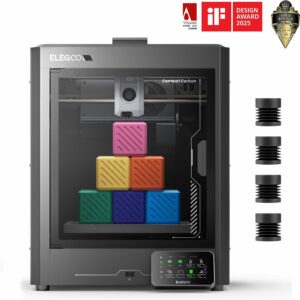
An enclosed CoreXY printer with a 320 °C hardened-steel nozzle and a 110 °C bed, listed by Elegoo for ABS, ASA, nylon and fibre-filled filaments.
Choose the Bambu Lab A1 Combo for colour on everyday filaments
The Bambu Lab A1 Combo is the better buy for a family, a classroom or anyone who prints models, gifts and signs in PLA and PETG. Four-colour printing works from the first day, and the open frame keeps the bed in easy reach. Skip it if you already know you need ABS, ASA or carbon-fibre parts, as Bambu Lab rates those as not recommended on the A1.
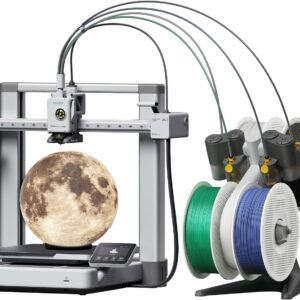
A 256 mm bed, automatic calibration and the AMS lite in the box, for up to four colours in one print.
Common questions
Can the Bambu Lab A1 print ABS?
Bambu Lab rates ABS and ASA as not recommended on the A1. Prusa’s advice for ABS is an enclosure that keeps the air around the print warm, and the A1 has no enclosure. For tough parts on the A1, PETG is the material Bambu Lab rates as ideal.
Can the Centauri Carbon print in more than one colour?
Not as supplied: it prints one colour at a time from a single spool on its right-side holder. Elegoo sells a separate add-on, CANVAS, that it says brings four-colour printing to this model. The A1 Combo has four colours in the box, with the AMS lite.
Is the Centauri Carbon a good printer for PLA?
Yes. Elegoo lists PLA, and the dual-sided plate has a PLA-specific surface, with a chamber fan to regulate the temperature inside. The enclosure brings little benefit for PLA, so if that’s all you print, the lighter A1 Combo is easier to live with.
Do I need a hardened nozzle for carbon-fibre filament?
Yes. Prusa describes carbon, glass and Kevlar fibres as highly abrasive and says a hardened nozzle is necessary. The Centauri Carbon comes with a brass-hardened steel nozzle; the A1 ships with stainless steel, and Bambu Lab lists fibre-filled filaments as not recommended on it.
Which one takes up less space?
On the published dimensions they’re close: 398 × 404 × 490 mm for the Centauri Carbon and 385 × 410 × 430 mm for the A1. The A1’s bed moves back and forth and the AMS lite is a separate unit, so it needs more clear space around it. The Centauri Carbon weighs 17.5 kg, so it needs a sturdy surface.
Sources
- Elegoo Centauri Carbon — Elegoo
- Bambu Lab A1 Technical Specification — Bambu Lab
- ABS — Prusa Knowledge Base
- ASA — Prusa Knowledge Base
- Composite materials (filled with carbon, kevlar or glass) — Prusa Knowledge Base
- CANVAS for Centauri Carbon — Elegoo