

Printing PLA at home is low risk if the room is ventilated and the printer sits on a hard surface, away from beds, curtains and anyone sleeping. The risk rises with ABS, ASA and resin, which need an enclosure, more ventilation or both. Where you put the printer matters more than which model you buy.
If a printer is heading for a home office or a child’s bedroom, here is what the research measures, how each material compares, and the placement and fire rules that matter most. Most figures come from a review led by US Environmental Protection Agency scientists and from school guidance written with the UK’s Health and Safety Executive.
New to all of this? Start with our beginner’s guide to 3D printing, which takes you from choosing a printer to a first successful print.
What are the real risks of 3D printing at home?
There are two: what the printer puts into the air, and heat. Both depend more on the material and the room than on the printer.
Particles and VOCs, in plain terms
Melting plastic at the nozzle releases two things. Ultrafine particles are specks smaller than 100 nanometres, a ten-thousandth of a millimetre, small enough to reach deep into the lungs. Volatile organic compounds (VOCs) are gases given off by the hot plastic, which you sometimes notice as a smell.
The EPA-led review covered 16 studies and found that most of the particles reported were ultrafine. Averaged across the seven studies that reported comparable figures, ABS produced about 300,980 particles per cubic centimetre of air against about 65,482 for PLA, roughly four and a half times as many. Higher nozzle temperatures typically meant more particles, and the authors expect room size, air exchange and enclosures to have a significant effect on how much reaches you.
CLEAPSS, whose school guidance the HSE endorses, says people with asthma or breathing difficulties are most at risk. Brief exposure may trigger symptoms in some people, with possible longer-term risks for anyone who spends long periods beside a printer. Neither source gives a safe number for a home; both agree the exposure is real and can be reduced.
Material by material
Temperatures are the filament makers’ own figures; the middle column reports only what the sources say.
| Material | Nozzle temperature | What the sources say | Our room rule |
|---|---|---|---|
| PLA | 200–240 °C, depending on speed (SUNLU) | Far fewer particles than ABS (EPA-led review); CLEAPSS’s recommended filament | Any room you can ventilate, not while someone sleeps |
| PETG | 240–260 °C (SUNLU) | No PETG data in either source; it prints hotter than PLA, and CLEAPSS notes emissions rise with nozzle temperature | As for PLA, with the window open |
| ABS | 255 °C (Prusa) | About four and a half times PLA’s particles (EPA-led review); Prusa lists styrene fumes | Enclosed printer, ventilated room, nobody beside it |
| ASA | 260 °C (Prusa) | Prusa warns of fumes that could pose a health risk and advises a well-ventilated room | As for ABS |
| Resin | No hot nozzle: liquid hardened by UV light | Liquid resin irritates skin; needs gloves, ventilation and washing and curing | Never in a child’s room |
Resin is a different risk, and resin printer safety comes down to gloves, ventilation and careful disposal rather than fumes from a hot nozzle. If you haven’t picked a technology yet, see how filament and resin printers compare before you buy.
Heat, moving parts and fire
According to CLEAPSS, a printer nozzle can reach 200–300 °C and a heated bed 50–100 °C, and a print can still be hot enough to burn just after it finishes. Hair, sleeves and fingers can also catch in moving belts. Fire comes from a heater that keeps heating when it shouldn’t, or a printer standing next to something that burns.
Which printer features reduce the risk?
Three features matter: an enclosure and filters for fumes, and thermal runaway protection for fire.
An enclosure, and what filters add
CLEAPSS’s best solution is a fully enclosed printer with filters for particles and chemical emissions. Its model for a separate cabinet is a fan that draws air through a HEPA filter for ultrafine particles and a carbon filter for VOCs. Panels alone are not a filter, and CLEAPSS warns that some printers have openings at the top that let particles and gases out, so check what a printer’s maker says about filtration and keep airing the room. An enclosure also keeps hands and paws off hot and moving parts.
The Elegoo Centauri Carbon is the enclosed printer we list. Elegoo rates it for ABS, ASA and fibre-reinforced filaments; it arrives assembled and calibrated. At 17.5 kg, it needs a sturdy table.
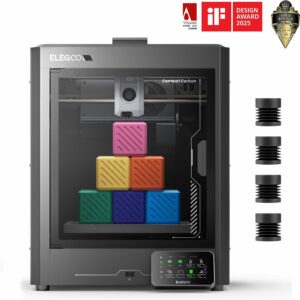
An enclosed printer for ABS and ASA that keeps hot and moving parts behind its panels, with a chamber camera for keeping an eye on long prints.
CLEAPSS suggests a cabinet over an open-frame printer when there’s no other extraction, but check your printer maker’s advice first: an enclosure traps heat as well as fumes, so whether you need an enclosure depends on the printer and on what you print.
Open frame: fine for PLA in a ventilated room
If you’ll stick to PLA in a room you can ventilate, an open-frame printer is a reasonable choice. CLEAPSS sets a higher bar for schools: an enclosed printer, or a cabinet over an open-frame one. The Bambu Lab A1 mini arrives assembled and calibrates itself, and its open frame and 80 °C bed suit PLA, PETG and TPU. That 80 °C is the very bottom of Prusa’s 80–110 °C bed range for ABS, another reason to keep ABS and ASA for an enclosed machine. Don’t box it in to make up the difference: Bambu Lab doesn’t recommend enclosing the A1 mini, so ventilation is the answer for it.
Still choosing? Our guide on how to choose a first printer covers size and setup; to compare models, see our ranked list of 3D printers, or browse all the printers we list.
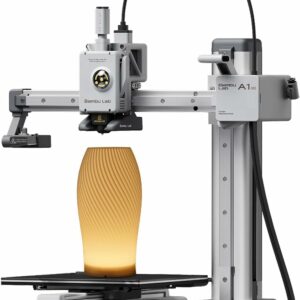
A compact open-frame printer for PLA, PETG and TPU that sets itself up, so a ventilated corner of a home office or family room is all it needs.
Thermal runaway protection
This firmware safeguard stops a heater running out of control. As Prusa explains, if a temperature sensor works loose, the printer reads a falsely low temperature and keeps heating until it could become a fire hazard; the protection spots this and cuts power to the heaters. On Prusa’s i3 printers it trips when the temperature drops by more than 15 °C for more than 45 seconds. Check that the manual of any printer you’re considering mentions it, and install firmware updates.
Where should you put a 3D printer at home?
Placement does more for safety than any feature. Check these before the first print.
- A room you can air. CLEAPSS recommends a well-ventilated room with space around the printer. For ABS and ASA, Prusa adds a caveat: ventilate, but don’t create a draught across the print.
- A hard, level surface. Never a bed, sofa or carpet: soft surfaces wobble and burn. Keep paper, curtains and filament offcuts clear of the printer.
- Not where anyone sleeps. In a home office, use the far side of the room or next door: CLEAPSS notes that long periods close to a printer increase what you breathe in.
- A smoke alarm in the same room. GOV.UK’s baseline is at least one smoke alarm on every level of the home, tested at least monthly.
- A wall socket of its own. GOV.UK advises one plug per socket where possible and warns that extension leads and adaptors have a current limit.
- Within earshot for the first long prints. Watch the first layer, then check in regularly rather than sitting beside it.
Noise also shapes where a printer can live: how loud 3D printers are decides whether one can share a home office.
House rules for safe use
Once the printer is in place, a few habits keep the risk low.
- Start with PLA. ABS and ASA can wait for an enclosed printer.
- Print at the low end of the spool’s range. CLEAPSS advises the lower melt range the filament supplier gives, since emissions rise with nozzle temperature.
- Wait before opening an enclosure. Enclosures take time to clear; CLEAPSS says to allow a clearance time and follow the enclosure maker’s guidance.
- Check the cable and plug before each session, and unplug and let everything cool before cleaning or maintenance.
- Buy filament from suppliers that can provide a safety data sheet, and store spools sealed, dry and dark, as CLEAPSS suggests.
- No overnight or empty-house prints at first. GOV.UK advises against running appliances such as washing machines overnight; we’d treat a new printer the same way until several long prints have finished cleanly.
Never stand a printer on a bed, sofa or carpet, and never print in a room where someone is asleep. Fit a smoke alarm in the printer’s room before the first long print.
Is 3D printing safe around children and pets?
It can be, with the right material and room. Follow the age guidance in your printer’s manual, and treat the nozzle like an oven ring: the A1 mini’s goes up to 300 °C.
We’d keep the printer out of a child’s bedroom: it’s where they spend the most hours. If there’s truly no other room, print PLA only, by day, with the window open, and finish well before bedtime. If your child has asthma, keep the printer out of their room: CLEAPSS puts people with asthma among those most at risk. An enclosed printer adds a barrier between small fingers and hot, moving parts. Resin printers don’t belong in children’s rooms at all.
Pets can’t open a window or leave a smelly room, so keep them, their beds and their cages out of the printer’s room while it runs.
What to do if something goes wrong
A strong smell, a headache or wheezing: stop the print, open the windows and leave the room until it clears. Next time, lower the temperature or improve ventilation. If symptoms don’t settle, get medical advice, from NHS 111 if you’re unsure.
A burning smell but no flames: switch the printer off at the wall and let it cool before you look. Loose heater or sensor cables are a job for the maker’s manual or support team.
Smoke or flames: GOV.UK’s advice is not to tackle a fire yourself. Get everyone out and call 999 once you’re clear of the building.
Common questions
Is it safe to sleep in a room with a 3D printer?
Not while it’s printing. Long periods near a running printer increase what you breathe in, and a night is a long period. Finish prints before bedtime, or move the printer to a room nobody sleeps in.
Does PLA give off toxic fumes?
PLA still releases ultrafine particles and some VOCs, but far fewer particles than ABS: about a fifth as many in the EPA-led review. CLEAPSS recommends it as the main filament for schools, in place of ABS. Print it in a ventilated room, at the low end of the spool’s temperature range.
Can I leave a 3D printer running overnight?
Not until you’ve watched several long prints finish cleanly on that printer. Even then, make sure it has thermal runaway protection, a smoke alarm in the room and nothing that burns nearby.
Do I need an air purifier for a 3D printer?
For PLA in a ventilated room, an open window does the main job. For heavier use, the CLEAPSS ideal is an enclosure that pulls air through HEPA and carbon filters. We’d treat a room purifier as a fallback, not a replacement for ventilation.
Sources
- G276 3D Printing in Schools and Colleges: Managing the Risks — CLEAPSS, with the Health and Safety Executive
- Particle emissions from fused deposition modeling 3D printers: Evaluation and meta-analysis — Science of the Total Environment (US EPA authors), via PubMed Central
- ABS — Prusa Research
- ASA — Prusa Research
- Thermal Runaway (i3 series) — Prusa Research
- Fire safety in the home — Home Office, GOV.UK