

Wood filament is usually PLA mixed with fine wood particles. It prints with a matte, wood-like finish you can sand and stain, but it’s weaker and more brittle than plain PLA. Use a 0.4 mm nozzle or larger, never 0.2 mm, dry the spool first, and in a 3D pen use it only if the pen’s maker lists wood-fill.
Wood-fill prints much like PLA, with three catches: it clogs fine nozzles, it’s brittle, and only one of the pens we list is made to take it. Below: makers’ published figures side by side, which pens and printers take it, the settings to start from, and how to finish and store it.
What is wood filament made of?
Mostly PLA, with wood ground into it. Prusa says wood- and metal-filled filaments are usually PLA or PETG with the powder added, and that people use them mainly for their looks. Bambu Lab describes its PLA Wood as its own PLA mixed with fine wood powder. Not every maker publishes how much wood goes in: Formfutura’s EasyWood is PLA-based and filled with 40 % wood particles, while Bambu Lab gives no figure for PLA Wood.
The finish is the reason to buy it. Bambu Lab describes a matte surface that hides layer lines, with a smooth but slightly grainy feel, and Formfutura says EasyWood looks, feels and smells like real wood. Because the wood powder is natural, Bambu Lab warns that colour can vary slightly with how dry the filament is and with differences in the raw material. For a set of matching pieces, we’d print them all from the same spool, dried the same way.
Wood filament properties at a glance
These are each maker’s own published figures. The Prusa column is its general advice for wood- and metal-filled filaments, not one product, which is why its temperature ranges are so wide. Where your spool’s label gives a figure, it beats all three.
| Published figure | Bambu Lab PLA Wood | Formfutura EasyWood | Prusa, filled filaments in general |
|---|---|---|---|
| Base and wood content | PLA with fine wood powder; share not published | PLA with 40 % wood particles | Usually PLA or PETG |
| Nozzle size | 0.4, 0.6 or 0.8 mm; not 0.2 mm | 0.4 mm or larger | 0.6 mm or larger (Prusament excepted) |
| Nozzle temperature | 190–240 °C | About 190–240 °C | 190–270 °C, by filament type |
| Bed temperature | 35–45 °C, with glue | About 50–60 °C | 60–100 °C, by filament type |
| Print speed | Under 250 mm/s | 20–45 mm/s | Not given |
| Retraction | 0.6–1.0 mm at 20–40 mm/s | About 5 mm | Not given |
| Layer height | Not given | 0.2 mm or more | 0.2 mm |
| Drying before use | 55 °C for 8 h | Not given | Not given |
What the figures tell you
Strength is the trade-off. Bambu Lab’s data sheet gives PLA Wood a tensile strength of 26 ± 5 MPa along the layers but only 15 ± 4 MPa across them, so the bond between layers is the weak point. Prusa says filled filaments usually have worse mechanical resistance and layer adhesion than the unfilled versions, and that small protruding details can break easily.
Heat resistance is PLA-level. Bambu Lab gives PLA Wood a heat deflection temperature of 57 °C under a 1.8 MPa load; SUNLU gives 55 ± 5 °C for its plain PLA. Keep wood-fill prints out of hot cars and away from heaters, as you would any PLA. Nozzle temperatures are ordinary PLA territory too; the real differences between brands are speed and retraction.
What wood-fill suits, and what it doesn’t
- Good for: display pieces, ornaments, boxes and figures, where the matte grain matters more than strength.
- Good for: prints you plan to sand or stain.
- Not for: hooks, brackets and clips that carry a load. For those, our PLA vs PETG comparison helps you pick the right plain filament.
- Not for: anything that touches food. Bambu Lab states its PLA Wood isn’t food-grade.
- Not for: fine detail that needs a 0.2 mm nozzle.
Which pens and printers can use wood filament?
Any printer whose maker allows it at 0.4 mm or larger, and only the pens whose makers list it. Among the pens we list, that’s one: the 3Doodler Flow.
In a 3D pen: the 3Doodler Flow
The 3Doodler Flow takes 1.75 mm PLA, ABS and wood-fill. 3Doodler designed it for 1.75 mm spooled filament and says it accepts other brands that melt within its 160–220 °C range. It adds that it can’t guarantee the quality, safety or compatibility of third-party filament.
Check the spool’s range against the pen’s before you buy. Bambu Lab and Formfutura both quote about 190–240 °C, so their wood-fill overlaps the Flow at 190–220 °C. The Flow’s screen shows the live nozzle temperature, which helps you stay inside that band. Wood-fill is more prone to clogging than plain PLA, so clean the nozzle after every session.
The other pens we list don’t name wood-fill. The SCRIB3D P1 and MYNT3D Super take PLA and ABS, the LIHUACHEN RPC200B 3D Pen (Button Version) takes PLA only, and the 3Doodler Start+ uses its own low-temperature plastic. For what they do take, see our guide to PLA, ABS and PCL in 3D pens.
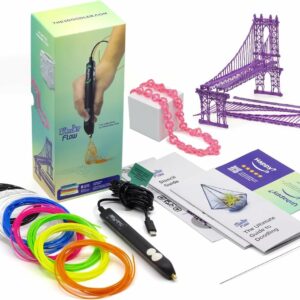
The only pen we list whose maker names wood-fill, with a 160–220 °C range according to 3Doodler and a screen showing the live temperature, so you can match the spool’s figures.
In a printer: the Bambu Lab A1 mini
The Bambu Lab A1 mini prints wood-fill with the nozzle it ships with. Bambu Lab’s filament guide lists PLA Wood as compatible with its open-frame A series and with 0.4, 0.6 and 0.8 mm nozzles, and says a hardened steel nozzle isn’t required. So the standard 0.4 mm stainless steel nozzle is fine. The optional 0.2 mm nozzle is the one to avoid: Bambu Lab marks PLA Wood as not compatible with it.
The catch is multicolour. Bambu Lab’s store page lists PLA Wood as compatible with the AMS lite, but its filament guide names PLA Wood among filaments brittle enough to break inside the feeder and doesn’t recommend it for the AMS lite. We’d feed it as an external spool. The A1 mini’s 300 °C nozzle and 80 °C bed cover Bambu Lab’s 190–240 °C and 35–45 °C settings with room to spare.
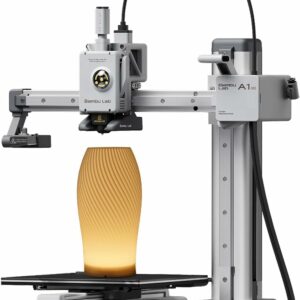
Bambu Lab clears its PLA Wood for the A series with the standard 0.4 mm nozzle and no hardened steel upgrade. Keep wood-fill out of the 0.2 mm nozzle and feed it as an external spool.
Other printers
Check two things in the maker’s documentation: whether wood-filled PLA is on the material list, and the smallest nozzle it allows. Prusa recommends at least 0.6 mm for wood-filled filaments other than its own Prusament, with 0.2 mm layers, to prevent clogging. Bambu Lab and Formfutura allow 0.4 mm. Our guide to nozzle sizes covers the wider trade-offs; for wood-fill, use 0.4 mm or more, and 0.6 mm if clogs keep coming back.
Wood isn’t a reason to buy a hardened nozzle. Prusa asks for one with metal-filled filaments, and Bambu Lab lists it as not required for PLA Wood but required for carbon- and glass-fibre PLA, the filaments where upgrading to a hardened steel nozzle pays off.
How to get good results with wood filament
Work through these in order. Where your spool’s maker publishes a figure, use it over anything here.
- Dry the spool first. Bambu Lab recommends drying PLA Wood before printing, at 55 °C for 8 hours in a forced-air drying oven. It warns that a kitchen oven or a microwave can damage the filament.
- Fit a 0.4 mm nozzle or larger. Never 0.2 mm. Move to 0.6 mm if your spool’s maker suggests it or the nozzle keeps clogging.
- Start inside the published temperature range. Bambu Lab printed its own test pieces at 220 °C, within its 190–240 °C range.
- Print at the spool’s speed, not your usual PLA speed. Bambu Lab keeps PLA Wood under 250 mm/s, while Formfutura suggests 20–45 mm/s for EasyWood. If your spool gives a low figure, keep to it.
- Set retraction from the spool’s label. Bambu Lab gives 0.6–1.0 mm at 20–40 mm/s; Formfutura’s figure is about 5 mm. The gap is wide, so don’t copy one brand’s figure onto another’s spool.
- Use layers of 0.2 mm or more. Prusa pairs its 0.6 mm nozzle advice with 0.2 mm layers, and Formfutura gives 0.2 mm as its minimum.
- Turn the part-cooling fan on. Bambu Lab’s data sheet says so, and Formfutura gives 80–100 %.
- Prepare the bed as the maker says. Bambu Lab specifies glue on a PEI plate at 35–45 °C; Formfutura gives a 50–60 °C bed.
- Purge with plain PLA when you finish. Formfutura recommends feeding 15–20 cm of PLA through the nozzle straight after printing a filled filament, to flush the particles out. Any plain PLA spool from our printer filament range does the job.
Bringing out the grain: sanding and staining
Formfutura says sanding a print with fine-grit sandpaper brings out a wood-grain structure, and that varying the print temperature during printing can give a similar effect. It doesn’t publish temperatures for that, so treat it as an experiment on a test piece.
Prusa notes that wood-filled prints can be stained like wood, which gives them a weathered look. Try the stain on an offcut first, since the base colour can vary between batches. Go gently around thin parts: Prusa warns that protruding details on filled-filament prints break easily.
Storing wood filament and using it safely
Keep it sealed and dry. Bambu Lab vacuum-seals PLA Wood but still recommends drying it right after opening, then storing it in a sealed container with desiccant. Its data sheet sets the target below 20 % relative humidity, and the store page asks for a cool, dark, dry place away from direct sunlight. Dry it again before each long storage period.
To dry at home without the kitchen oven, use a filament dryer: the SUNLU FilaDryer S2‘s 70 °C ceiling covers Bambu Lab’s 55 °C setting.
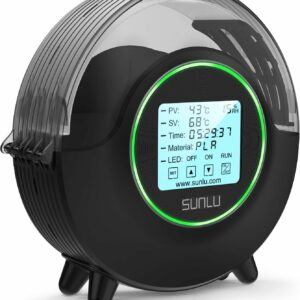
Dry the spool, then print straight from the dryer: it doubles as the external spool holder we’d use for wood-fill on the A1 mini.
Bambu Lab asks for ventilation when printing PLA Wood and warns that prints aren’t for food. Keep offcuts and snapped strands away from small children and pets. In a pen, let the nozzle cool before you clean it, and follow 3Doodler’s manual for anything that means removing parts.
Common questions
Does wood filament smell like wood when it prints?
Makers say it does. Formfutura describes EasyWood as looking, feeling and smelling like real wood, and Bambu Lab mentions a mild wood scent from the wood powder. Ventilate anyway, as Bambu Lab advises.
Is wood filament stronger than normal PLA?
No. Prusa says filled filaments usually have worse mechanical resistance and layer adhesion than the unfilled versions. Bambu Lab’s data sheet gives its PLA Wood 26 ± 5 MPa along the layers and 15 ± 4 MPa across them. Use it for decorative prints and choose plain PLA or PETG for parts that carry a load.
Why does my wood filament keep snapping?
It’s more brittle than plain PLA. Prusa advises against running wood-filled filament through its multi-material unit for that reason, and Bambu Lab doesn’t recommend it for the AMS lite. We’d feed it from a spool holder with a short, gentle path to the extruder, and handle loose ends with care.
Can I use wood filament for cups or kitchen items?
Not for anything that holds or touches food. Bambu Lab states its PLA Wood isn’t food-grade and shouldn’t be used for food storage or contact. Keep wood-fill for ornaments, boxes and display pieces.
Sources
- Bambu Filament Technical Data Sheet: PLA Wood — Bambu Lab
- PLA Wood — Bambu Lab
- Filament guide: Printer, Nozzle, AMS, Build Plate, Glue Compatibility and Required Parameters — Bambu Lab Wiki
- Composite materials (with metal or wood particles) — Prusa Knowledge Base
- EasyWood — Formfutura
- FAQs — 3Doodler