
Carbon fibre filament is ordinary PLA, PETG or nylon filled with short, chopped carbon fibres. It prints stiffer, flatter parts with a matte finish, but they are less tough than the plain plastic, and the fibres wear brass nozzles. You need a hardened nozzle, dry filament and, for some nylons, good ventilation or a filtered enclosure.
What is carbon fibre filament?
It’s a composite: a standard printing plastic with short carbon fibres mixed through it. SUNLU sums up the effect for nylon-CF: the short fibres raise stiffness, dimensional stability and heat resistance, and give a matte surface. On spool labels you’ll mostly see PLA-CF, PETG-CF and PA-CF (PA is polyamide, or nylon), and sometimes ABS-CF or ASA-CF.
The fibres are loose fragments in the plastic, not the woven sheet used for bike frames and car panels. Prusa, for example, says the fibres in its PETG carbon fibre filament are recycled from industrial production waste or end-of-life carbon composites.
The base plastic still sets most of the rules: printing temperature, bed temperature, moisture and whether an enclosure helps. The fibres add stiffness and abrasion. If you haven’t settled on a base plastic yet, start with how PLA and PETG differ.
What carbon fibre adds, and what it doesn’t
What you gain
- Stiffness. A review of published studies in the journal Materials reports tensile modulus, a measure of stiffness, rising by over 160 % for PLA-CF and 313 % for PETG-CF compared with the plain plastics, for parts loaded along the direction the fibres were printed.
- Flatter, more stable parts. The same review notes that carbon fibre’s low thermal expansion limits warping in high-shrinkage plastics such as ABS. Prusa lists improved dimensional stability for its PETG CF.
- A matte, even surface. Prusa describes a matte black surface with a low tendency to string, and SUNLU also mentions the matte finish.
- Some extra heat resistance. Prusa claims improved temperature resistance over plain PETG, and the review says fibre reinforcement raises the heat deflection temperature.
What you give up
- Toughness. Prusa lists lower toughness than its regular PETG: the part absorbs less energy before it breaks, so it copes worse with knocks.
- Strength between layers. The fibres line up along the print path, so, the review says, strength across the layers is still governed by the plastic itself. Loaded across the fibres, some carbon fibre composites test weaker than the unfilled plastic: up to 15.7 % lower for ABS-CF. Prusa lists lower layer adhesion for its PA11 CF than for plain PA11.
- Fine detail. Prusa says its PETG CF reproduces detail less well than PLA.
- Hidden voids. According to the review, fibres thicken the melt, which can trap air between lines and layers.
A quick decision rule
Print a part in carbon fibre when it must stay stiff and flat under load (brackets, jigs, mounts, frames) or when you want the matte look. Stay with plain PETG or nylon when the part has to flex, snap-fit or take knocks, and with plain PLA when you need fine detail. And don’t load a spool until your printer has a hardened nozzle.
Carbon fibre filaments at a glance
These are each maker’s published settings for its own filament. Another brand’s spool may differ, so the label or data sheet for your spool wins.
| Property | PLA-CF | PETG-CF | Nylon-CF (PA-CF) |
|---|---|---|---|
| Hardened nozzle | Yes (Polymaker) | Yes (Prusa) | Yes (Prusa) |
| Nozzle temperature, one maker’s figure | 220–230 °C at 15 mm³/s (Polymaker PolyLite PLA-CF) | 265 ± 10 °C (Prusament PETG CF) | 285 ± 10 °C (Prusament PA11 CF) |
| Bed temperature | Follow the spool label | 90 ± 10 °C (Prusament PETG CF) | 110 ± 10 °C (Prusament PA11 CF); 50 °C at most for Polymaker PA6-CF20 |
| Drying (SUNLU) | 50 °C for 6–8 hours, recommended | 60–70 °C for 6–8 hours, recommended | 80–110 °C for 8–12 hours, required |
| Enclosure | Not needed: open frames suit PLA | Not needed: Polymaker says keep the door open | Varies by brand (see below) |
The pattern: each step from PLA-CF to nylon-CF asks more of the printer and the dryer, and nylon-CF is the only one SUNLU says you must dry.
Which printers and pens can print carbon fibre filament?
A hardened nozzle comes first
Carbon fibres are abrasive. Prusa warns they may damage a regular brass nozzle, and the Materials review calls a wear-resistant nozzle (hardened steel, ruby or silicon carbide) an absolute prerequisite. Nozzle materials get their own page: hardened steel and brass nozzles compared.
Check your printer before you buy a spool. The Bambu Lab A1 mini ships with a 0.4 mm stainless-steel nozzle, and Bambu Lab’s filament guide marks a hardened-steel nozzle as required for carbon- and glass-fibre PLA, so the stock nozzle isn’t for carbon fibre. The Flashforge Adventurer 5M’s published material list stops at PLA, PETG and TPU.
The Elegoo Centauri Carbon is built for it. It’s an enclosed CoreXY printer with a hardened-steel nozzle rated to 320 °C, and Elegoo lists carbon- and glass-fibre reinforced filaments among its materials, alongside PLA, PETG, ABS, ASA and TPU. That 320 °C ceiling sits above the nylon-CF figure in the table. Elegoo also lists a 110 °C maximum bed (at 25 °C room temperature), the middle of Prusament PA11 CF’s 110 ± 10 °C, so check a nylon spool’s label against that. It arrives assembled and pre-calibrated with a 256 × 256 × 256 mm build volume, but at 17.5 kg it needs a sturdy surface.
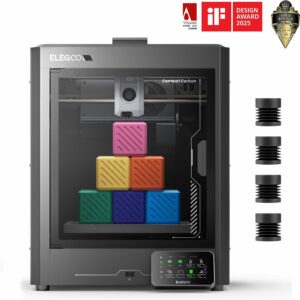
A hardened-steel nozzle as standard and an enclosed frame, so you can load a carbon fibre spool without changing parts first.
Enclosure: it depends on the base plastic
The fibre doesn’t decide this; the plastic does. PLA-CF and PETG-CF print on open printers, and Polymaker even advises keeping the door open when printing its PETG carbon fibre in an enclosed machine. ASA-CF is different: Polymaker says keeping the chamber closed can help layer adhesion.
Nylon-CF varies by brand. Prusa recommends a well-ventilated room or an enclosure with active filtration for its PA11 CF because of the odour, while Polymaker says to keep the doors open for its PA6 and PA612 carbon fibre. Our guide to when a printer needs an enclosure covers the wider question.
Multi-colour feeders
Polymaker advises against feeding its carbon fibre filaments through a Bambu Lab AMS because of the abrasiveness. If your printer has an automatic feeder, such as the AMS lite on the A1 Combo, print carbon fibre from an external spool unless the feeder’s maker says otherwise.
3D pens: stick to the maker’s list
None of the 3D pens we list names carbon fibre among its plastics. They take PLA, ABS or both, the 3Doodler Start+ takes only 3Doodler’s own Start plastic, and the 3Doodler Flow adds wood-fill. Use only what the pen maker lists.
How to get good results with carbon fibre filament
- Dry the spool first at the maker’s figure, or SUNLU’s from the table. For nylon-CF, SUNLU marks drying as a must.
- Give it a short, gentle path. Polymaker warns that its ASA-CF can be brittle and needs a very clear filament path. Avoid tight bends in the feed tube and spool holders that tug.
- Start at the maker’s temperature. Don’t reuse your plain-plastic profile: Polymaker, for example, raises its PLA-CF to 220–230 °C when printing at 15 mm³/s.
- Don’t push the speed. Polymaker suggests a top volumetric speed of 15 mm³/s for its PLA-CF, and printing a little slower if its PETG carbon fibre shows weak layers.
- Set the fan for the base plastic. Polymaker recommends the fan at full for PLA-CF, turned down if layers don’t bond, and 50 % at most for its PETG carbon fibre.
- Orient the part so the load runs along the layers. Because the fibres follow the print path, lay the part out so its main load runs along the lines rather than pulling the layers apart.
- Anneal nylon-CF if the maker says so. Polymaker recommends 100 °C for 16 hours for its PA6-CF20 and PA612-CF15 after printing.
Storing carbon fibre filament and printing it safely
Store it as SUNLU advises for any filament: in a sealed bag or dry box with desiccant, somewhere cool, dry and out of direct sunlight. Nylon-CF is the demanding one. Prusa calls its PA11 CF slightly hygroscopic and says it needs drying before use, while Polymaker says its PA-CF is very hygroscopic and should be printed from a heated filament dryer the whole time.
A heated dryer such as the SUNLU FilaDryer S2 is enough for PLA-CF and PETG-CF, not for nylon-CF: it tops out at 70 °C, short of SUNLU’s 80–110 °C for nylon.
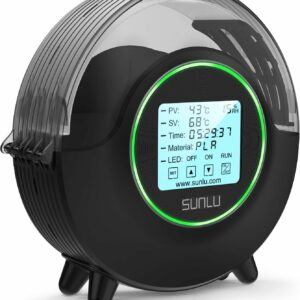
Reaches the drying temperatures SUNLU publishes for PLA-CF and PETG-CF, and feeds the printer straight from the dryer.
On fumes, a study of ultrafine particle emissions from common filaments found that higher nozzle temperatures increased emissions, and its authors advise good ventilation or enclosing the printer away from people. The carbon fibre settings in the table are high, so ventilate the room. Prusa describes its PETG CF as almost odourless, but its PA11 CF needs ventilation or a filtered enclosure.
Common questions
Is carbon fibre filament stronger than normal PLA or PETG?
Stiffer, yes, but not tougher. Studies report large gains in stiffness along the print direction, while Prusa lists lower toughness for its PETG CF than for plain PETG. For parts that must flex or take impacts, plain PETG or nylon is usually the better choice.
How long does a brass nozzle last with carbon fibre filament?
None of the filament makers cited here publishes a figure, and the review of published studies describes the wear as rapid. Prusa says the fibres may damage a regular brass nozzle and asks for a hardened one. Fit a hardened nozzle before the first carbon fibre print.
What nozzle size should I use for carbon fibre filament?
The standard 0.4 mm works if the nozzle is hardened: Prusa’s settings for its PA11 CF use a 0.4 mm hardened nozzle that isn’t a high-flow type. For anything smaller, check your filament maker’s profile first.
Why does my carbon fibre filament keep snapping?
Some fibre-filled grades are brittle: Polymaker says so of its ASA-CF and asks for a very clear filament path. SUNLU adds that damp filament becomes weaker and more brittle. Give it a short, gentle path and dry the spool at the maker’s temperature.
Sources
- Prusament PETG Carbon Fibre Black — Prusa Research
- Prusament PA11 Carbon Fibre Black — Prusa Research
- Polymaker Material Print Tips — Polymaker Wiki
- Filament Usage Guide — SUNLU
- Elegoo Centauri Carbon — Elegoo
- Filament guide: Printer, Nozzle, AMS, Build Plate, Glue Compatibility and Required Parameters — Bambu Lab Wiki
- Enhancing the Performance of FFF-Printed Parts: A Review of Reinforcement and Modification Strategies for Thermoplastic Polymers — Materials, via PubMed Central
- Parameters Influencing the Emission of Ultrafine Particles during 3D Printing — International Journal of Environmental Research and Public Health, via PubMed Central