

The best 3D printed Halloween decorations are the ones you can finish before the 31st: window silhouettes and bat garlands that print quickly, articulated creatures and glow-in-the-dark ghosts for an afternoon, and lanterns lit by LED tealights for a weekend. Below are eight ideas, sorted by print time and difficulty, each with its filament and the one thing that catches people out. Crafting with a 3D pen instead? See our Halloween crafts with a 3D pen.
Halloween decorations by print time and difficulty
The time bands are our planning guide for one copy at default settings, not measured figures. Slice each model and read your slicer’s estimate before you commit: a bigger scale or finer layers stretch it.
| Decoration | Level | Print time | Filament | Watch out for |
|---|---|---|---|---|
| 1. Window silhouettes | Easy | Quick, a plate at a time | Black PLA | Bed size for big shapes |
| 2. Bat garland | Easy | Quick | Black or purple PLA | A hole that fits your cord |
| 3. Low-poly pumpkins and skulls | Easy | Quick | Orange or white PLA | Stems in a second colour |
| 4. Print-in-place creatures | Intermediate | An afternoon | PLA | Scaling shrinks the joint gaps |
| 5. Glow-in-the-dark ghosts and eyes | Intermediate | Quick, after a nozzle swap | Glow PLA | Needs a hardened steel nozzle |
| 6. Vase-mode pumpkin lantern | Intermediate | An afternoon | Orange or white PLA | LED tealights only |
| 7. Haunted house lantern | Ambitious | A weekend, in parts | PLA in two or more colours | LED tealights only |
| 8. Garden tombstones | Ambitious | Overnight each | PETG | Plate adhesion and cold rooms |
Easy: quick prints
1. Window silhouettes. Flat cut-outs of bats, cats, witches or a crooked roofline, fixed to the inside of a window. With the room lit behind them, they read as black shapes from the street. Print them in black PLA and put them up with removable adhesive putty. Steps below.
2. Bat garland. A dozen small flat bats, each with a hole near the wingtips, threaded on cord or ribbon along a mantelpiece or bannister. Print one bat first and check your cord goes through the hole before you print the rest.
3. Low-poly pumpkins and skulls. Faceted desk-size decorations that look deliberate even with visible layer lines. Use orange PLA for pumpkins and white or bone-coloured PLA for skulls. With an AMS lite, the green stem prints in the same job; on a single-colour printer, print the stem separately and glue it in.
Intermediate: an afternoon
4. Print-in-place articulated creatures. Skeletons, dragons, spiders and bats whose joints print already assembled: they come off the bed in one piece and pose or wiggle once you free the joints. The gaps between moving parts are designed for one size, so don’t shrink the model unless the designer says it still works. Steps below.
5. Glow-in-the-dark ghosts and eyes. Small ghosts, skulls or pairs of eyes to tuck into bookshelves and hedges. The shapes are simple; the hardware is the catch. Glow filament is filled with hard particles, and Bambu Lab’s filament guide marks a hardened steel nozzle as required for glow PLA, advises against stainless steel and brass nozzles, and rules out the 0.2 mm size because of the clogging risk. Its first choice for particle-filled filament is a 0.6 mm hardened steel nozzle.
The A1 and A1 mini come with a 0.4 mm stainless steel nozzle, with hardened steel as an optional upgrade, so plan the swap before you buy glow filament. Keep it out of the AMS lite too: Bambu Lab doesn’t recommend it there, warning that glow filaments can grind down the feeder’s internal PTFE tubes. Whatever the brand, follow the spool maker’s nozzle advice.
6. Vase-mode pumpkin lantern. A round pumpkin or ghost shell printed as a single spiralling wall, open at the top, with an LED tealight inside. In Bambu Studio’s spiral vase mode, the printer builds one outer wall with no infill and no top, so a pale or orange filament lets the light through. The mode suits simple, rounded shapes; for a carved face with cut-out eyes, choose a lantern with normal walls. Steps below.
Ambitious: overnight or over a weekend
7. Haunted house lantern. A house with cut-out windows, printed as panels that slot or glue together, with LED tealights inside so every window glows. Check the panels fit your bed (180 × 180 mm on the A1 mini, 256 × 256 mm on the A1 Combo) or choose a design split into smaller pieces. Coloured window frames are where a multicolour feeder earns its keep.
8. Garden tombstones. A row of headstones for the front garden or the path to the door. Anything that lives outdoors wants PETG, which is tougher and more heat-resistant than PLA: SUNLU gives its PETG a heat deflection temperature of 70 ± 5 °C, against 55 ± 5 °C for its PLA. Each tombstone is a big print, so give it its own overnight run.
PETG can bond very hard to smooth PEI plates, so check your printer maker’s plate advice first. Print in a warm room, not a cold garage: Bambu Lab notes that low ambient temperatures can reduce PETG’s layer strength.
When the decorations come down, our list of useful things to print around the house keeps the printer busy for the rest of the year, and the LED-lit lantern idea carries straight over to hollow Christmas ornaments in December.
What you need
A printer with a big enough bed
Every idea here prints on a compact open-frame printer. If you haven’t chosen one yet, start with our ranked list of 3D printers. For Halloween, bed size is the spec that decides most: silhouettes, panels and tombstones grow quickly.
The Bambu Lab A1 mini arrives assembled, calibrates itself and has a 180 × 180 × 180 mm build volume. That covers silhouettes, bats, pumpkins, glow ghosts and most print-in-place creatures. It prints one colour as standard; multicolour needs the optional AMS lite.
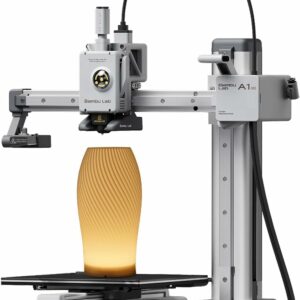
Bats, pumpkins, glow ghosts and window cut-outs all fit its 180 mm bed, and it arrives ready to print.
The Bambu Lab A1 Combo pairs the 256 × 256 × 256 mm A1 with the AMS lite, which feeds up to four colours in one print: pumpkins with green stems, haunted houses with coloured frames, two-tone tombstones. A pumpkin’s stem in a second colour costs little, as the change happens once, at the height where the stem starts; window frames that change colour on every layer add a purge each time.
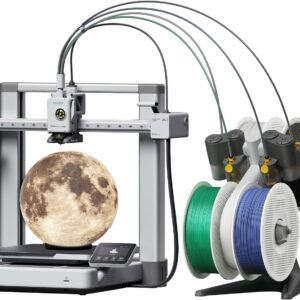
A 256 mm bed for haunted house panels and tombstones, and the AMS lite included for up to four colours without swapping filament by hand.
Filament for indoors and out
Black and orange spools of SUNLU PLA Filament cover most indoor ideas. For the garden, add SUNLU PETG Filament and use your printer’s PETG profile or SUNLU’s published 240–260 °C nozzle range. For the AMS lite, choose spools with a 53–58 mm hub hole, Bambu Lab’s published range; SUNLU’s PLA spool has a 6.3 cm hub, so feed it from the external holder instead. For glow prints, fit the hardened steel nozzle first.
LED tealights, never candles
Never put a real candle in a printed lantern. SUNLU gives its PLA a heat deflection temperature of 55 ± 5 °C, so a flame can soften it, and London Fire Brigade’s advice is to keep all decorations away from naked flames. Use LED tealights.
London Fire Brigade points out that flameless candles can be left unattended and used outdoors, and come in flickering, rechargeable and waterproof versions. A waterproof one suits a lantern on the doorstep.
If your tealights take button batteries, store the spares high up and out of children’s reach, and look for loose battery covers when you unpack them each year. The Child Accident Prevention Trust’s advice if you think a child has swallowed one: go straight to A&E or call an ambulance.
A model, and respect for its licence
Search the big model libraries for each idea by name: “print in place skeleton”, “window silhouette”, “vase mode pumpkin”. Our guide to where to find free 3D models covers MakerWorld, Printables and Thingiverse.
Licences vary by model: decorating your own house is fine under any of them, but a non-commercial (NC) licence rules out selling prints at a craft fair, so check each one and credit the designer.
Step outlines for three decorations
Window silhouettes in black PLA
- Measure the panes you want to decorate.
- Download a set of flat Halloween silhouettes whose licence suits your plans.
- Scale each shape to its pane and check it fits your bed. Flat shapes scale without trouble.
- Slice in black PLA and fill a plate with shapes.
- Let the plate cool before you remove the prints.
- Fix them to the inside of the glass with removable adhesive putty, then switch on the room light after dark.
Print-in-place skeleton or dragon
- Search the libraries for print-in-place models and pick one whose makes show the joints moving freely.
- Read the designer’s notes on scale, orientation and supports, and follow them.
- Keep the model at the designer’s size, because shrinking it shrinks the gaps between the joints too.
- Clean the build plate, slice in PLA and start the print.
- Let the plate cool, then lift the creature off in one piece.
- Work each joint gently, starting at the tail or the feet, until the whole body moves.
Vase-mode pumpkin lantern
- Choose a round pumpkin or ghost shell made for vase mode: a simple shape with an open top.
- Measure your LED tealight and scale the model so the light drops in with room to spare.
- In Bambu Studio, open the Others tab and turn on Spiral vase under Special mode. It sets one outer wall, no top layers and no infill.
- Load orange or white PLA so the light shows through the single wall.
- Print, let it cool, then add a face with black acrylic paint or glue on eyes printed in black.
- Switch on the LED tealight and lower it in.
Common questions
Can I put a real candle in a 3D printed lantern?
No. A flame can soften PLA, which SUNLU rates at 55 ± 5 °C heat deflection, and London Fire Brigade advises keeping decorations away from naked flames. LED tealights give the glow without the flame.
Will 3D printed decorations survive outside?
They last better in PETG than in PLA. SUNLU describes its PETG as tougher and more heat-resistant than PLA, for parts that live outdoors. Bring them in after Halloween and store them away from heaters until next year.
Do I need a special nozzle for glow-in-the-dark filament?
Yes. Bambu Lab’s filament guide marks a hardened steel nozzle as required for glow PLA, because the particles in it wear stainless steel and brass nozzles quickly. The A1 and A1 mini ship with a stainless steel nozzle, with hardened steel as an optional upgrade.
Can I sell Halloween decorations printed from free models?
Only if the model’s licence allows commercial use. A Creative Commons licence marked NC permits non-commercial use only, which rules out selling prints. Decorating your own home isn’t commercial, so an NC licence doesn’t stop that.
Sources
- Filament guide: printer, nozzle, AMS and build plate compatibility — Bambu Lab Wiki
- Introduction to Bambu Nozzles — Bambu Lab Wiki
- Spiral Vase mode — Bambu Lab Wiki
- Candles: fire safety at home — London Fire Brigade
- Button Battery Safety — Child Accident Prevention Trust
- AMS lite FAQ — Bambu Lab Wiki