
A resin printer is fine to run at home if you treat liquid resin as a chemical. Wear nitrile gloves and safety glasses whenever resin is uncured, print in a ventilated room away from bedrooms, kitchens and pets, and never pour liquid resin, rinse water or used IPA down the drain: cure scraps hard before they go in the bin.
Resin printers are built for fine detail, which is why they suit work such as printing tabletop miniatures. The catch is the material: liquid resin can trigger a skin allergy, the isopropyl alcohol used to wash standard resin is highly flammable, and the waste can’t go down the sink. If you’re still weighing up whether resin or filament suits you, this is what the resin side asks of you.
The real risks of resin printing, with figures
These figures come from Formlabs’ safety data sheet (SDS) for its Grey Resin, a typical methacrylate resin, and from the UK Health Security Agency (UKHSA) on isopropyl alcohol (IPA). Elegoo’s safety information lists the same allergy, eye and aquatic hazards for its resins, plus skin irritation. Check the sheet for the bottle you buy.
| Hazard | Liquid resin | IPA (isopropyl alcohol) |
|---|---|---|
| Skin | Skin sensitiser, category 1: may cause an allergic skin reaction | Can cause tingling, redness and contact dermatitis |
| Eyes | Serious eye irritation, category 2A | Serious eye irritation, category 2 |
| Breathing | Use only with adequate ventilation | May cause drowsiness or dizziness |
| Fire | Not flammable; flash point above 93.5 °C | Highly flammable liquid and vapour; flash point below 23 °C |
| Environment | Toxic to aquatic life with long-lasting effects | Keep spills out of drains and groundwater |
Skin: an allergy risk, not just irritation
A sensitiser does more than irritate: it can cause an allergy. Formlabs’ resin is 55–75 % urethane dimethacrylate and 15–25 % methacrylate monomers, each carrying that allergy warning, and the SDS says effects depend on dose, concentration and contact time. Aim for zero contact with bare skin, not quick washing.
Never let uncured resin touch bare skin. Wear nitrile gloves, change them as soon as resin gets on them, and wash any splash off with soap and water straight away.
Fumes: printing, washing and curing all give off vapour
In a chamber study of one enclosed resin printer, UL’s Chemical Insights Research Institute measured very few particles but emissions of volatile organic compounds (VOCs) three to six times the average for filament printing. IPA made up over 97 % of the VOCs released during washing and showed up again during curing. Total VOC emissions from every step stayed below the limit in the UL 2904 standard, but the researchers warn that the mix of alcohols, aldehydes and acrylates could still cause strong irritation. Ventilation is about keeping that everyday exposure down, not escaping an emergency.
IPA: the fire risk is the solvent, not the resin
UKHSA classes IPA as highly flammable, with a flash point below 23 °C. Its vapour is about twice as heavy as air (2.1 against 1), and UKHSA warns that vapour and air mixtures are explosive. Treat an open wash tank like an open tin of solvent: no heaters, boilers, flames or sparks nearby, and the lid back on afterwards.
Which gloves and eye protection do you need?
Single-use nitrile gloves and safety glasses or goggles, every time liquid resin is out. Formlabs specifies nitrile, and the Health and Safety Executive (HSE) advises non-latex gloves unless nothing else protects well enough. HSE also says to pick gloves that meet EN 374 and check the glove maker’s chart, because materials differ in how long a chemical takes to reach the inside: the breakthrough time.
- Inspect gloves before use, as the SDS says: a small split lets resin sit against your skin.
- Change them as soon as resin lands on them. HSE’s guide shows how to take gloves off without contaminating your hands.
- Check the chart for IPA too: UKHSA notes that it attacks some plastics and rubber.
- Cover your arms: the SDS asks for protective clothing, washed before you wear it again.
What about a mask? The SDS puts ventilation first and calls for an approved respirator only where ventilation can’t keep vapour to an acceptable level. A dust mask is designed for particles, and the UL study found very few: the problem is vapour.
Where should you put a resin printer?
In a room you can ventilate and close the door on, away from where anyone sleeps, eats or prepares food. A spare room, utility room or garage with an opening window works; a bedroom, lounge or kitchen doesn’t. Check the room against this list:
- Air going outside: a window you can open, ideally with an extractor fan pushing air outside.
- No ignition sources: keep printer, resin and IPA away from heaters, boilers and open flames.
- No direct sunlight: sunlight cures resin, and the SDS says to avoid storing it above 38 °C or letting it freeze, which matters in an unheated garage in winter.
- Wipe-clean surfaces: a tray or silicone mat under the printer, never carpet.
- A door that shuts on children and pets.
Filament printers raise different questions, covered in our guide to 3D printing safety at home. If no room ticks these boxes, a filament printer is the more practical choice, and our ranked list of 3D printers is the place to compare them.
Features that reduce the risk
Nothing makes the chemistry harmless, but some choices cut how often you handle it. Keep these in mind as you browse the mid-range and resin printers we list.
A printer that flags failed prints
Failed prints mean more time with your hands near the vat. The Elegoo Saturn 4 Ultra 16K has an AI camera that detects detachment and warping, plus sensors for resin level and foreign objects, so a failed print is flagged without you lifting the lid to check. When prints do fail, work through the fixes for prints that won’t stick.

Its AI camera flags failed prints and its sensors watch the resin level and the vat for foreign objects, so you need to lift the lid and check less often.
A covered wash and cure station
A station keeps the cleaning liquid in a tank and the UV light under a cover. Elegoo says the cover of the Elegoo Mercury Plus V3.0 Wash & Cure Station blocks 99.9 % of UV, and curing stops when you lift it. For the compact Anycubic Photon Mono 4, the Anycubic Wash & Cure 3 has a two-height basket designed to save alcohol.
A resin that skips the IPA
The Elegoo Water Washable Resin 2.0 cleans in water instead of IPA, according to Elegoo, which takes the flammable solvent out of your home. Uncured, it still irritates skin, so gloves and ventilation stay, and the rinse water carries dissolved resin.
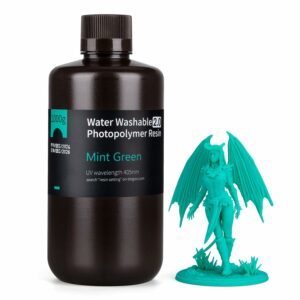
It takes the highly flammable solvent out of the wash step. Gloves, glasses and ventilation still apply.
Washing and curing without spreading resin around
The full technique is in our guide to washing and curing resin prints. For safety, keep gloves on until the part is washed, keep the IPA tank closed between batches, and cure in the ventilated room, since the UL study measured IPA coming off washed parts during curing. Handle a part bare-handed only once it is cured hard; if it still feels tacky, treat it as uncured.
How to dispose of resin and IPA safely
Cured resin is solid plastic; liquid resin in any form is a chemical. Formlabs’ guidance is that liquid resin, whether neat, dissolved in solvent or partly cured, may count as hazardous waste and must not go down the drain or in household waste. The SDS adds that resin must not reach public wastewater or surface waters.
| Waste | What to do |
|---|---|
| Cured prints, supports and failed parts | Household waste, once fully hard |
| Small amounts of leftover liquid resin | Pour into a labelled, clear container, leave in sunlight for 1–10 days until solid, then bin resin and container |
| Paper towels, gloves and wipes with resin on | Leave in sunlight or under UV until cured, then bin |
| Used IPA | Never down the drain or in the bin: ask your local council or waste authority about hazardous waste disposal |
| Rinse water from water-washable resin | Not down the sink: let the resin in it cure in sunlight or under UV first, then follow your local council’s or waste authority’s rules for what is left |
| Empty resin bottles | Dispose of according to local rules, as the SDS says for contaminated packaging |
Formlabs adds that 405 nm light plus heat cures resin most effectively, so a curing station helps on grey days. Before taking IPA to a household waste recycling centre, check what your local council or waste authority accepts.
Children and pets
Elegoo says to keep its resin out of the reach of children, and UKHSA notes that severe burns have been reported in young children after prolonged skin contact with IPA. Keep the printer out of children’s rooms and family spaces. For pets, shut the door while you print, store resin and IPA in a closed cupboard, and never leave drip trays or curing waste where a cat could walk through them or a dog could lick them.
House rules for safe use
- Gloves and glasses on before you open the printer lid or a resin bottle.
- Window open or extractor running before you start, and while you wash and cure.
- No food or drink in the printing room.
- Lids on the printer, resin and IPA whenever you step away.
- Wipe drips up straight away, then cure the paper towels.
- Gloves off and hands washed with soap and water before you leave the room, so resin doesn’t reach door handles.
If something goes wrong
- Resin on skin: take off contaminated clothing and wash with plenty of soap and water. Get medical advice if irritation or a rash appears.
- Resin or IPA in the eyes: rinse with lukewarm water, removing contact lenses if that’s easy; the resin SDS says to keep going for 15 minutes. Get medical advice if symptoms persist.
- Vapour breathed in: fresh air and rest; get medical advice if breathing symptoms develop.
- Resin swallowed: rinse the mouth, don’t make the person sick unless a doctor says so, and get medical advice straight away (in the UK, NHS 111 can tell you where to go).
- A spill: ventilate, switch off ignition sources, soak it up with paper towels and cure them before binning.
Take the bottle, label or SDS with you: Elegoo and the SDS both say to have it to hand for the doctor.
Common questions
Is water-washable resin safer than standard resin?
It removes IPA from the wash, and with it the fire risk of the solvent. The resin itself still irritates skin when uncured, so gloves, glasses and ventilation stay the same, and the rinse water can’t go down the sink.
Can I use latex gloves for resin printing?
Nitrile is the better choice. HSE advises non-latex gloves unless nothing else gives the protection needed, and Formlabs specifies nitrile. Whatever you use, check it meets EN 374 and change it as soon as resin gets on it.
Can I print resin in a flat?
Yes, if you have a room with a window that opens and a door that closes, away from where people sleep and eat. A bedroom doesn’t count. Without such a room, the vapour has nowhere to go but the rest of the flat.
Sources
- Grey Resin Safety Data Sheet — Formlabs
- Product Safety Information — Elegoo
- Disposing of resin — Formlabs
- Isopropanol: incident management — UK Health Security Agency
- Choosing the right gloves to protect skin: a guide for employers — Health and Safety Executive
- Particle and Chemical Emissions from a Vat Photopolymerization 3D Printer — Chemical Insights Research Institute (UL)