
For most outdoor prints, choose PETG: it prints on an open-frame printer, and SUNLU gives its PETG a 70 ± 5 °C heat deflection temperature. Choose ASA for parts that will sit in strong sun for years, and print it in an enclosure. Keep ABS for indoor parts: Prusa says ABS used outdoors turns yellowish and more brittle over time.
Plant labels, a hose guide, a bike-light bracket or a box for a garden sensor: once a part lives outside, the choice usually comes down to ASA, ABS or PETG. This guide compares them on sunlight, heat, ease of printing and fumes, using the makers’ own data sheets, and gives you a rule to apply part by part. If you’re still choosing your everyday filament, our PLA and PETG comparison covers that first step.
For the temperature ranges makers publish for each material, see our filament temperature chart.
ASA vs ABS vs PETG: properties at a glance
Bambu Lab publishes a data sheet for each of the three plastics, using the same tests, so its figures make the fairest side-by-side. They are typical values from its own test bars, and Bambu Lab says they are for design reference and comparison only: another brand, your printer and your settings will shift them.
| Property (source) | ASA | ABS | PETG |
|---|---|---|---|
| Heat deflection temperature at 0.45 MPa (Bambu Lab) | 100 °C | 87 °C | 71 °C |
| Heat deflection temperature at 1.8 MPa (Bambu Lab) | 92 °C | 84 °C | 68 °C |
| Vicat softening temperature (Bambu Lab) | 106 °C | 94 °C | 69 °C |
| Impact strength across layers (Bambu Lab) | 4.9 kJ/m² | 7.4 kJ/m² | 10.5 kJ/m² |
| Nozzle and bed temperature (Bambu Lab) | 240–270 °C and 80–100 °C | 240–270 °C and 80–100 °C | 230–260 °C and 65–75 °C |
| Chamber temperature (Bambu Lab) | 45–60 °C | 45–60 °C | 35–50 °C |
| Sunlight (maker’s description) | Exceptional UV and weather resistance (Bambu Lab) | UV resistance listed (Bambu Lab), but turns yellowish and more brittle outdoors (Prusa) | Enhanced resistance to water, UV and temperature (Bambu Lab) |
| Printers we list that suit it | Enclosed only (Centauri Carbon) | Enclosed only (Centauri Carbon) | All four filament printers |
What the heat figures mean
Heat deflection temperature is the point at which a loaded test bar starts to bend in the lab, so higher means more margin for a part in strong sun or near something warm. At the lower load, ASA leads ABS by 13 °C and PETG by 29 °C on Bambu Lab’s sheets. That gap is the clearest reason to step up from PETG.
Two caveats. Bambu Lab annealed its ASA and ABS test bars at 80 °C for 12 hours before testing, and it doesn’t recommend annealing PETG at all. And brands differ: Prusa’s ASA guide quotes temperature resistance up to 93 °C, and SUNLU gives 70 ± 5 °C for the PETG we list. Read the sheet for the spool you actually buy.
Which should you print? A rule for each part
Decide by where the part will live. Start from PETG and move up only when the part needs something PETG can’t give:
- Will it sit in direct sun for years? Choose ASA.
- Will it get hotter than about 70 °C? Choose ASA, for its 100 °C heat deflection figure.
- Do you want a glossy, acetone-smoothed finish? ASA or ABS: Prusa says both can be smoothed and glued with acetone. If the part goes outside, pick ASA.
- None of these? PETG. It prints without an enclosure and has the strongest layer bond of the three on Bambu Lab’s sheets.
PETG: the default for most outdoor parts
PETG suits garden fittings, plant labels, brackets and boxes that see rain and some sun. Bambu Lab describes its PETG as having enhanced resistance to water, UV and temperature, and pitches it for outdoor accessories. It needs no enclosure: SUNLU’s published 240–260 °C nozzle range sits within the maximum nozzle temperature of every filament printer we list.
The trade-off is heat. At around 70 °C on both Bambu Lab’s and SUNLU’s sheets, PETG has the least margin of the three, so keep it away from anything that runs hot.
SUNLU PETG Filament is the PETG we list: 1.75 mm on a 1 kg spool, with a ±0.02 mm diameter tolerance and a 60–70 °C bed, according to SUNLU.
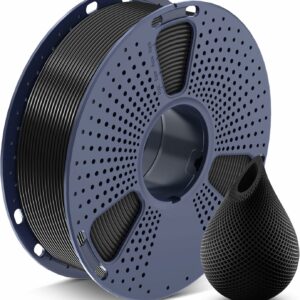
Water-resistant, according to SUNLU, so it suits garden and outdoor parts that see rain, and it prints on an open-frame printer with no enclosure.
ASA: for long sun exposure, with an enclosure
ASA is the plastic whose data sheet is written for the outdoors. Bambu Lab claims exceptional UV and weather resistance and names plant signs, mailboxes and wind vanes among its uses. Prusa calls it a successor to ABS that is more UV resistant, warps less and doesn’t smell as much.
The catch is the printer. Prusa lists significant warping and says larger parts need an enclosure, and Bambu Lab’s sheet asks for a 45–60 °C chamber. If you only have an open-frame printer, plan on PETG.
ABS: an indoor plastic with a smoothing habit
ABS has the heat resistance for warm indoor jobs, at 87 °C on Bambu Lab’s sheet. Bambu Lab lists UV resistance among its strengths, but Prusa says ABS parts used outdoors turn yellowish and more brittle over time, and calls ASA the more UV-resistant of the two. It needs the same enclosure as ASA, and Bambu Lab itself says ABS warps easily and gives off a strong smell when printing.
Its main draw indoors is acetone: Prusa notes that ABS can be smoothed in acetone vapour to a glossy finish and glued with acetone. ASA smooths and glues with acetone too, so for a part that goes outside it gives the same finish with better UV resistance. On Bambu Lab’s sheets, ABS keeps one edge over ASA: higher impact strength across the layers, at 7.4 against 4.9 kJ/m².
Which printers and pens take ASA, ABS and PETG?
PETG prints on any of the filament printers we list; ASA and ABS need an enclosed one.
The makers set a high bar for ASA and ABS: an 80–100 °C bed on Bambu Lab’s sheets, 100 °C for ABS and 105–110 °C for ASA in Prusa’s guides, and warm, still air around the print. None of the three open-frame printers we list has that warm, enclosed space. The Bambu Lab A1 mini tops out at an 80 °C bed, the Bambu Lab A1 Combo reaches 100 °C but its open frame is best with PLA, PETG and TPU, and the Flashforge Adventurer 5M has no enclosure and lists PLA and PETG (plus TPU with a larger optional nozzle). Our guide to when a printer needs an enclosure covers add-on boxes and their limits.
For ASA and ABS, the Elegoo Centauri Carbon is the printer we list. It is enclosed, arrives assembled and pre-calibrated, and Elegoo names PLA, PETG, ABS and ASA among its materials, so one machine covers all three plastics. Its hardened-steel nozzle reaches 320 °C, above the 270 °C top of Bambu Lab’s ASA range, and Elegoo lists a 110 °C bed (at a 25 °C room temperature), which covers Prusa’s 105–110 °C for ASA. Skip it if PETG covers everything you make, and note that at 17.5 kg it needs a sturdy surface.
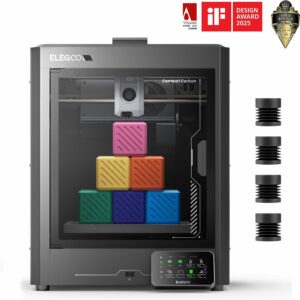
An enclosed printer, assembled and calibrated out of the box, that Elegoo rates for ASA, ABS and PETG, so every plastic in this guide runs on one machine.
3D pens are a different story. The SCRIB3D P1, MYNT3D Super and 3Doodler Flow take ABS, but none of the pens we list names ASA or PETG among its filaments.
Fumes: how the three compare
ABS and ASA are the two to plan around. Prusa says ABS releases fumes and substances that could pose a potential health risk, styrene among them, and gives ASA a similar warning, though it says ASA doesn’t smell as much. Prusa asks for a well-ventilated room, without a draught across the print.
PETG comes out better in research. In a study published in the International Journal of Environmental Research and Public Health, PLA, PETG and TPU printed at lower nozzle temperatures gave the least ultrafine particle emissions, and ABS at the highest temperature tested gave the most. ASA wasn’t tested. Higher nozzle temperatures meant more particles, so print at the lower end of the data sheet’s range when quality allows, and ventilate the room well or enclose the printer away from people, as the authors advise. Our guide to printer fumes and placement at home goes further.
How to get good outdoor prints
- Dry the spool first. Bambu Lab dries its ASA and ABS at 80 °C for 8 hours and its PETG at 65 °C for 8 hours, in a forced-air oven, and says a kitchen or microwave oven isn’t suitable. Prusa notes that ASA is partially hygroscopic.
- Prepare the bed. Bambu Lab recommends glue for all three. PETG can bond very hard to smooth PEI plates, so follow your printer maker’s advice for the plate you have.
- Keep the air still for ASA and ABS. Close the enclosure and keep draughts away from the print. Without an enclosure, Prusa suggests the draft shield option in PrusaSlicer, which prints a wall round the model to keep it slightly warmer.
- Smooth with acetone only in a ventilated space. Acetone is a solvent: follow the safety advice on its label, and keep it off powder-coated build sheets, as Prusa warns.
Storage and safety
Store all three sealed. Bambu Lab’s sheets ask for under 20 % relative humidity, sealed with desiccant, for printing and storage. If you dry spools at home, the SUNLU FilaDryer S2 is hot enough for PETG at Bambu Lab’s 65 °C but not for ASA and ABS at 80 °C, so check your spool’s own sheet first.
All three print at 230 °C or more on Bambu Lab’s sheets, with beds of up to 100 °C for ASA and ABS, so let the nozzle and plate cool before you reach in.
Common questions
Is PETG UV resistant enough for outdoor use?
For most outdoor parts, yes. Bambu Lab describes its PETG as having enhanced resistance to water, UV and temperature, and calls it the perfect choice for outdoor accessories. For parts that will sit in strong sun for years, ASA is the material whose data sheet is written around long-term outdoor exposure.
Can I print ASA without an enclosure?
Not for large parts. Prusa lists significant warping, says larger parts need an enclosure and suggests the draft shield in PrusaSlicer when you don’t have one. On an open-frame printer such as the Bambu Lab A1 mini, PETG is the better outdoor plastic.
Is ASA stronger than ABS?
They’re close. On Bambu Lab’s sheets ASA edges ABS for impact strength along the layers, 41.0 against 39.3 kJ/m², and for bending strength, 65 against 62 MPa. ABS leads only on impact strength across the layers, at 7.4 against 4.9 kJ/m².
Does ASA smell less than ABS?
Yes, according to Prusa, which says ASA doesn’t smell as much as ABS. It still warns that ASA releases potentially dangerous fumes, so print it in a well-ventilated room, without a draught across the print.
Sources
- Bambu Filament Technical Data Sheet: ASA — Bambu Lab
- Bambu Filament Technical Data Sheet: ABS — Bambu Lab
- Bambu Filament Technical Data Sheet: PETG Basic — Bambu Lab
- ASA — Prusa Knowledge Base
- ABS — Prusa Knowledge Base
- Parameters Influencing the Emission of Ultrafine Particles during 3D Printing — International Journal of Environmental Research and Public Health, via PubMed Central
- Centauri Carbon 3D Printer — Elegoo
- Adventurer 5M 3D Printer — Flashforge