The easiest way into 3D pen animals is three levels of difficulty. First, flat animals traced on a template. Next, standing animals made from flat parts joined together. Last, fully round animals built over a simple core such as a ping-pong ball. Below are ideas at each level, a rule for when to move up, and step outlines for a sea turtle, an alligator and a lion.
Want something ready to trace? Download our free printable 3D pen templates, with shapes, letters and simple 3D builds on A4 pages.
Which level should your child start at?
Start flat, whatever the child’s age. Each level relies on the one before: a standing animal needs pieces that peel off whole, and a round one needs joints that hold.
| Level | What you make | New skill | Move up when |
|---|---|---|---|
| 1. Flat on a template | Sea turtle, octopus, butterfly | Tracing an outline and filling it with lines that touch | Pieces peel off in one go, with no gaps or loose ends |
| 2. Standing from flat parts | Alligator, rabbit, dinosaur skeleton | Welding pieces together at an angle | The model survives being picked up by one leg |
| 3. Round a simple core | Ping-pong lion, tiger, bear | Covering a curved surface evenly, without a template | You can invent your own animal on the same core |
The move-up tests are our rule of thumb, not a maker’s figure. If your child has never traced and filled a shape, warm up first with our fifteen beginner projects such as keyrings and coasters.
3D pen animal ideas by difficulty
Where 3Doodler publishes a time and a strand count for its own tutorial, we give its figures. Other times are our planning guides, not measured figures.
Easy: flat animals on a template
3Doodler’s stencil library includes a sea turtle, a crab, an octopus, a jellyfish, a dolphin, a blue bird and a pastel butterfly, each as a PDF to print.
- Sea turtle. An outlined shell filled in one green, with flippers and a head in another, and a pattern on top. Allow about 30 minutes. You need the stencil, two or three colours and a DoodlePad or mat.
- Octopus or jellyfish. Outlines only, so every tentacle line has to touch the body or it falls off when you peel the piece away. Allow about 20 minutes, with one or two colours.
- Butterfly. Two lattice wings in contrasting colours and a filled body. Allow about 30 minutes. For a first taste of level 2, draw the wings separately and weld them on at an angle.
Sea creatures also open the six-week summer challenge, so a flat turtle is a good test before a longer holiday plan.
Intermediate: standing animals from joined flat parts
Every part is still traced flat, then joined so the animal stands. The skill is the weld: 3Doodler’s advice is to tack the corners where pieces meet first, then go along the whole joint to secure it.
- Alligator. Body pieces and two legs traced from a free stencil, then joined along the bottom. 3Doodler wrote it for the Start+, rates it beginner, allows 30 minutes and lists 6 strands. Step outline below.
- Rabbit. 3Doodler’s Easter bunny starts with a body skeleton traced and assembled from flat pieces, wrapped with plastic until it’s round. The head is two circles positioned to form a sphere, then wrapped and filled. It’s written for the Start+, rated intermediate, with 45 minutes and 5 strands.
- Dinosaur skeleton. 3Doodler has brontosaurus and tyrannosaurus skeleton stencils: each bone is traced flat, then the bones are welded together into a skeleton that stands. With so many small pieces, allow an hour or more and keep a tray to hold the bones in order.
Ambitious: full 3D animals round a simple core
At this level there is no template. 3Doodler’s Ping Pong Safari uses a ping-pong ball as the mould for the body, and suggests lions, tigers and bears from the same start.
- Lion. A sphere for the body, short legs, a squiggly orange mane, ears, a tail and a face. 3Doodler wrote it for the Start+, rates it beginner, allows 20 minutes and lists 15 strands. It comes last here because the ball is the only guide. Step outline below.
- Tiger. The same sphere in orange, with black stripes laid across it and round ears instead of a mane. Allow about 30 minutes.
- Bear. The same sphere in brown, with a smaller round head welded on top. Make the head the way 3Doodler makes its rabbit’s: two traced circles positioned to form a sphere, then wrapped and filled. Allow 45 minutes to an hour.
For a one-week school break, a five-day half-term plan builds the same skills, from flat fill to joining and building upwards, with robots and castles instead of animals.
What you need for 3D pen animals
A pen that suits the child’s age
For children aged 6 to 13, we’d start with the 3Doodler Start+. 3Doodler UK designs it for ages 6 to 13 and says it has no external hot parts. It’s rechargeable, has a stand-by mode, and comes with a charging cable, 72 strands of Start eco-filament and an activity guide. It takes only 3Doodler Start plastic or a compatible 2.5 mm pack, which stays softer than PLA: fine for animals, less suited to fine detail.
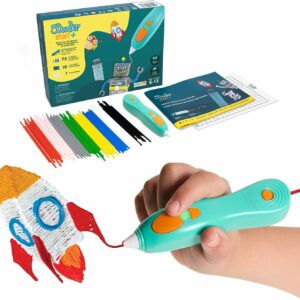
3Doodler UK designs it for ages 6 to 13 and says it has no external hot parts. Its own alligator, rabbit and lion tutorials are written for it.
The 72 strands cover a first batch of animals: the alligator lists 6 and the lion 15. Check you have the colours you need, such as beige and orange for the lion, before you start. The Kretrum 32-Colour Refills for 3Doodler Start add 32 colours of low-temperature plastic, about 2.5 mm thick, sold as compatible with the Start and Start+ only. Teenagers can follow the same levels with a hot pen that takes 1.75 mm PLA, within its maker’s age rating; compare both kinds on our shelf of 3D pens for kids.
For a hot pen: a heat-rated mat and finger guards
With a hot pen, work on a heat-rated silicone mat rather than the bare table. The mat in the AQTAQ 3D Pen Starter Kit measures 45 × 28 cm, with room to lay out an animal’s parts side by side before you join them. Its PLA is 1.75 mm, so it won’t fit the Start+, and the pen isn’t included.
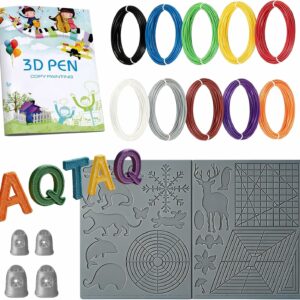
Finger guards for holding small legs while you weld them, and a mat rated 220–260 °C, which covers PLA and ABS pen temperatures.
Odds and ends
Keep ping-pong balls, a printer for the stencils and nail clippers or small scissors to hand: 3Doodler says to snip the melted end off each strand to avoid jams, which matters when an animal needs four colours. Taping templates down and peeling cleanly are covered in our guide to 3D pen stencils.
Two house rules. Only shape plastic with your fingers on the Start+, which has no external hot parts, according to 3Doodler; never touch fresh plastic from a hot pen. And keep an adult nearby for under-tens, whichever pen they use, following the maker’s age rating.
Step outlines for three animals
Before each one, switch the pen on and let it warm up: 30 seconds for the Start+, according to 3Doodler. To start each line, 3Doodler says to push the nozzle onto the surface and let the plastic flow for a couple of seconds, then lift and draw.
Easy: flat sea turtle
- Print 3Doodler’s sea turtle stencil and lay the DoodlePad or drawing board over it.
- Trace the whole outline in dark green.
- Fill the shell with lines that touch each other and the outline.
- Snip the end of the strand and load a lighter green.
- Fill the head and the four flippers.
- Add a pattern on the shell and an eye in a contrasting colour.
- Let the plastic cool and harden for a few seconds, then peel the turtle off gently.
Intermediate: standing alligator
- Print the free stencil from 3Doodler’s alligator tutorial and get a DoodlePad or mat ready.
- Trace the body pieces and remove them from the pad.
- Trace the leg shape twice and remove those too.
- Place the sides of the body together and doodle along the bottom to join them.
- Add plastic to the inside of each foot to attach the legs to the body.
- Hold each joint still until it sets: 3Doodler says you have about 5 seconds to shape a weld before it hardens.
- Stand it up. If a leg works loose, add a little more plastic inside that foot.
Ambitious: ping-pong ball lion
- With beige plastic, draw a line round the middle of the ping-pong ball, then fill one half by going round until you reach the end.
- Draw a line close to the edge of the first half, without touching it, and fill the other half.
- Doodle the two halves of the sphere together.
- Draw four circles on the underside and build them up into short legs.
- In orange, draw a line round the face, add small squiggly triangles along it, letting the plastic fall naturally, and fill out the mane.
- Draw two small half circles for ears and a little tail. Fix the ears on top of the head in front of the mane, and the tail at the back.
- For the eyes, let white plastic build up and shape it with your fingers, then add black. Do this by hand on the Start+ only.
- In black, build a small triangle for the nose and an upside-down Y for the mouth.
Common questions
What is the easiest animal to make with a 3D pen?
A flat animal traced from a template, such as a sea turtle or a crab, because there is nothing to join. For a first standing animal, 3Doodler’s alligator is rated beginner, takes 30 minutes and uses 6 strands of Start+ plastic.
How do you make a 3D pen animal stand up?
Follow 3Doodler’s alligator: join the body sides along the bottom, then add plastic to the inside of each foot to fix the legs. Tack the corners of each joint before running plastic along it, and hold each part still until it sets. For a first attempt, pick a low body with four short legs, like the alligator or the ping-pong lion.
Can children shape the plastic with their fingers?
Only with a pen like the 3Doodler Start+, which 3Doodler says has no external hot parts; its own tutorials shape the lion’s eyes and the rabbit’s tail by hand. With a hot pen, keep fingers away from the nozzle and fresh plastic, and use finger guards.
How long does a 3D pen animal take?
3Doodler allows 20 minutes for its ping-pong lion, 30 for the alligator and 45 for the rabbit. Add time for printing the stencil, changing colours and letting joints set. Flat animals are usually quicker, as there is nothing to join.
Sources
- Ping Pong Safari — 3Doodler
- Doodle an alligator and take an adventure! — 3Doodler
- Easter Bunny — 3Doodler
- 3D Pen Stencils — 3Doodler
- Start+ getting started guide — 3Doodler
- How to draw with a 3D pen — 3Doodler